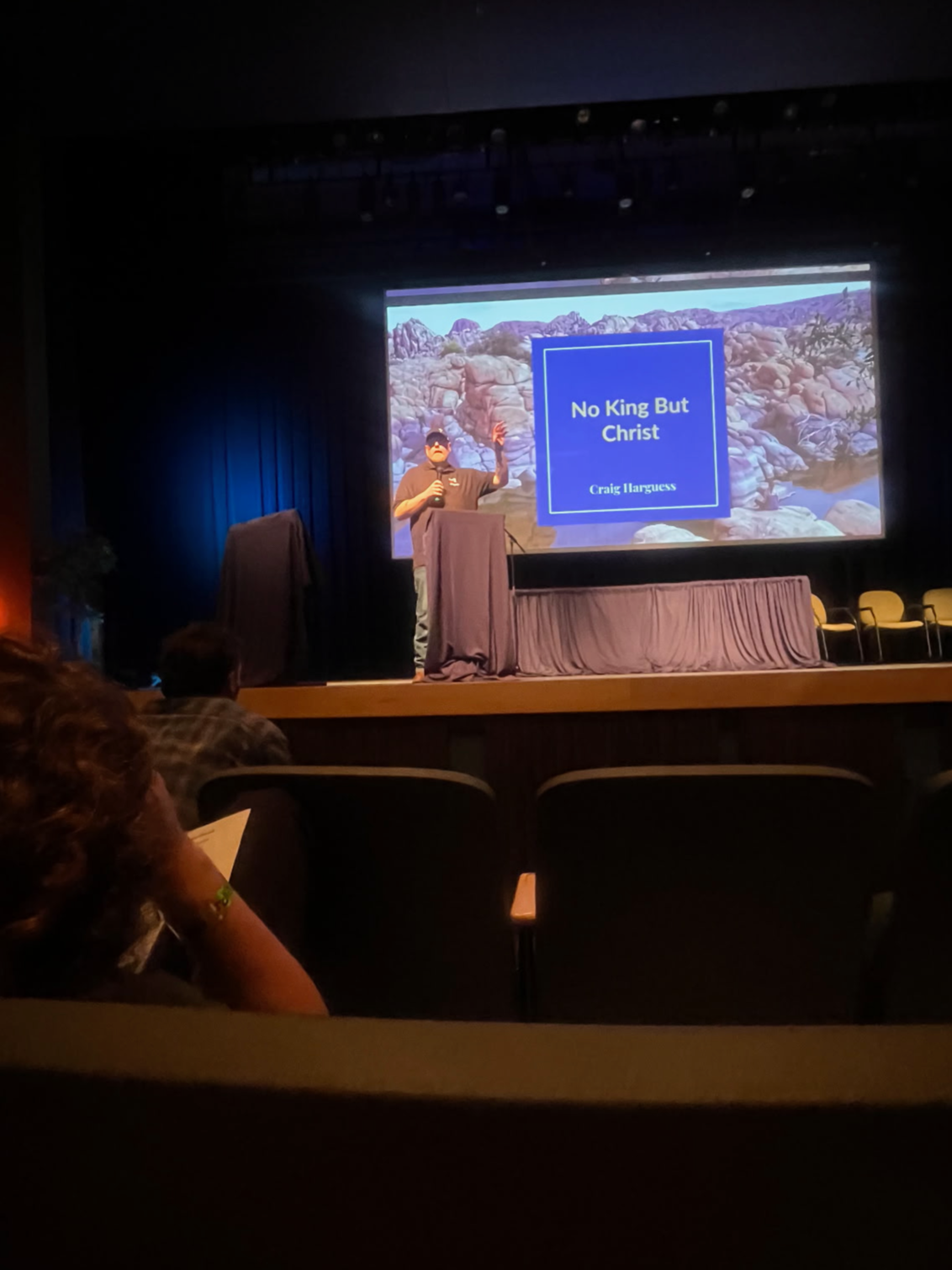


Craig with Larken and Amanada Rose
This was one of three talks I gave at Approaching Humanity, a conference hosted by Larken and Amanda Rose. We gathered to question coercion, authority, fear, and the systems that keep us from seeing one another as fully human.
I began by asking who in the room was Christian, who had left Christianity, and who had never claimed a religious faith.
I asked because this message cuts in every direction.
You may still call yourself a Christian. You may remember when you did. You may have never believed any of it. Either way, I wanted us to look honestly at one uncomfortable question:
Can we say Jesus is King while giving our loyalty to the state?
When the State Becomes a God
Exodus 20:3 says:
“You shall have no other gods before me.”
We often imagine a god as a statue or an ancient idol. But a god can be anything that receives our highest loyalty, our sacrifices, our fear, and our trust.
So what do we give the state?
We pledge allegiance to its flag. We give it part of our labor. We send our children to fight its wars. We accept its claim that it may regulate us, punish us, imprison us, and control our neighbors.
When we are afraid, we ask it to protect us. When we are struggling, we ask it to provide for us. When society feels broken, we wait for the next politician to save us.
At some point, we have to ask whether this is still just government.
When an institution demands our loyalty, sacrifice, fear, and faith, it begins to act like a god.
And if Christ is King, Washington, D.C., is not.
That is where The Bad Roman Project began for me. It did not begin with a desire to improve politics. It began with a theological crisis.
If Jesus truly sits on the throne, no president, political party, government agency, or nation can sit beside Him.
Are We Asking Caesar to Rule Our Neighbors?
I also challenged the idea that voting is automatically a sacred Christian duty.
When we vote, we are not only sharing an opinion. We are helping choose who will rule our neighbors, tax them, regulate them, and punish them when they refuse to obey.
We may hope our ruler will be kinder than the last one. We may call our choice the lesser evil. But we are still asking Caesar to rule.
In 1 Samuel 8, Israel demanded a king so it could be like the other nations. God warned the people that the king would take their sons, daughters, land, crops, and labor.
They asked for a king anyway.
We still face that temptation. We say Christ is King, but every election season we search for another ruler to protect us, defeat our enemies, and save the country.
The Flag and the Cross
I also asked us to think about the Pledge of Allegiance and the place national symbols hold in Christian life.
Allegiance means loyalty to a sovereign.
Can we promise that loyalty to a nation while saying Jesus is our only King?
Nations rise and fall. The Kingdom of God does not.
The flag represents a system maintained through laws, borders, taxation, prisons, armies, and force. The cross reveals a King who loved His enemies and gave His own life rather than taking theirs.
Those are not the same story.
We cannot simply place the cross above the flag and assume the problem is solved. The First Commandment does not say we may keep smaller gods as long as God remains at the top.
It says no other gods.
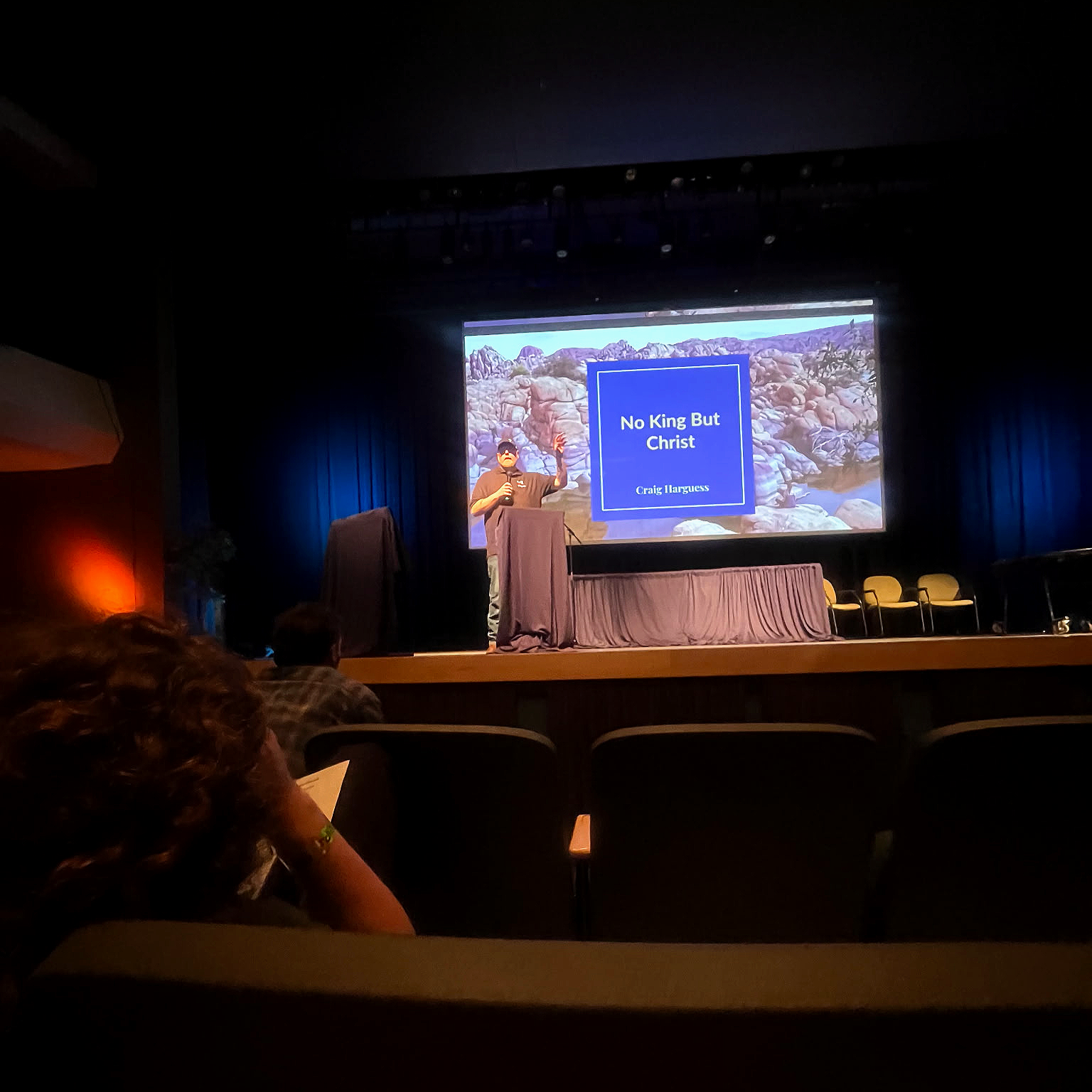
No King but Christ
Christian anarchism is not a call for chaos. It is a refusal to treat one person as the rightful ruler of another.
If Christ is King, no politician is.
Living that belief means we stop expecting the state to do the work Jesus gave us.
We feed hungry people directly. We care for families. We teach our children. We help our neighbors. We protect the vulnerable through relationships, generosity, and voluntary community.
Leaving electoral politics does not mean doing nothing.
It means replacing political action with Kingdom action.
We do not need to wait for a law before we love someone. We do not need a government program before we serve. We do not need permission from Caesar to obey Christ.
Scripture repeatedly asks us to choose whom we will serve.
We cannot have two kings. We cannot give ultimate loyalty to both Christ and Caesar. We cannot ask the state to become our protector, provider, and messiah while claiming that we place no gods before God.
No King but Christ is not merely a slogan. It is a call for you and me to live as though the First Commandment still means what it says.