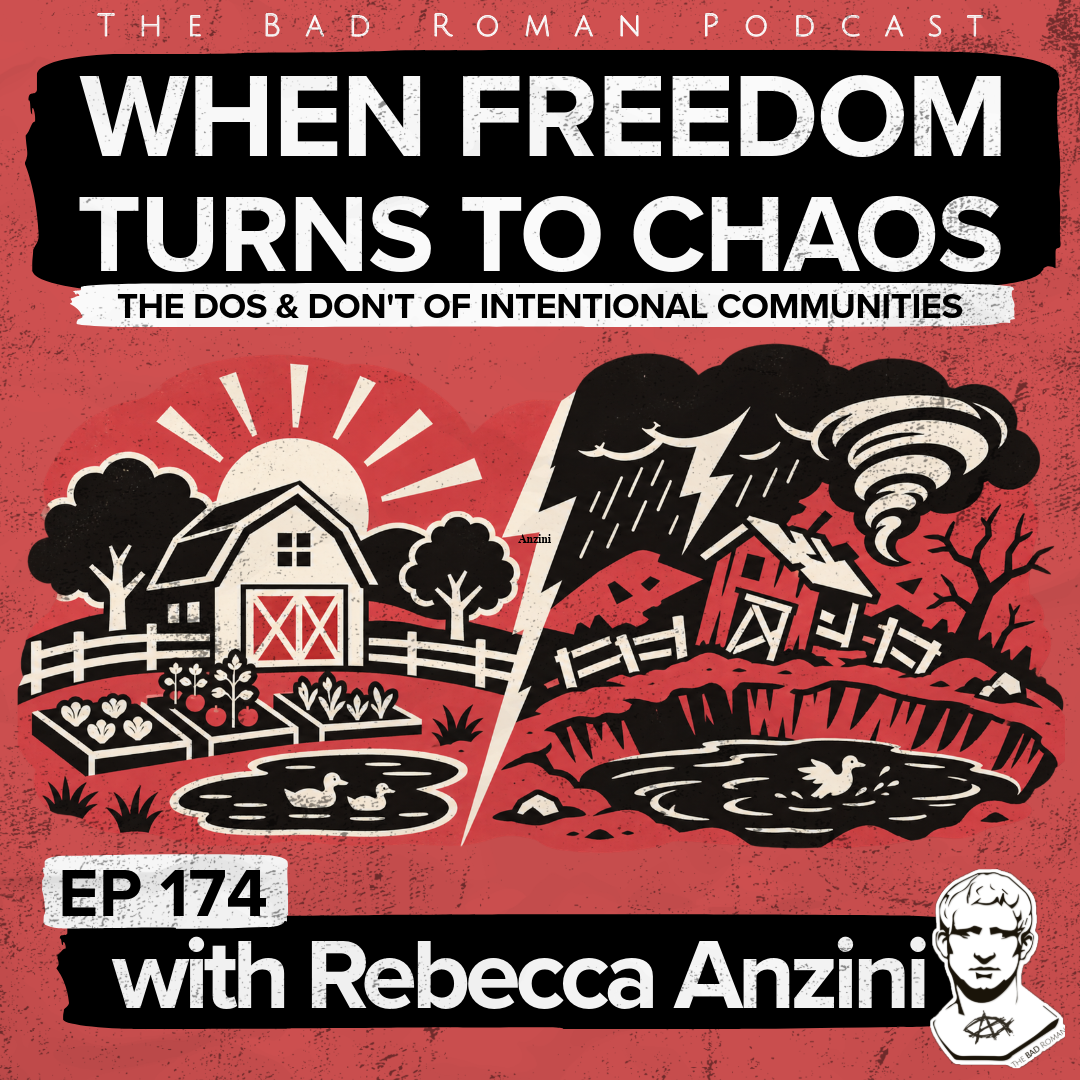
What happens when a group of people who believe in freedom can't agree on how to live together?
For Rebecca Anzini, that question isn't theoretical. It's what she was left asking after years spent helping build an intentional community on nearly ten acres of Texas land. There were gardens, chickens, ducks, beehives, food forests, and workshops teaching people how to live more independently. There were also unexpected expenses, disagreements, exhaustion, and one spectacularly ill-fated duck pond.
By the time the property was sold in May 2026, Rebecca had learned more about the difficulty of voluntary cooperation than she ever expected.
In this episode of The Bad Roman Podcast, Craig Harguess talks with Rebecca about the promise and pitfalls of intentional living, the difference between shared values and shared responsibilities, and why building a freer world might require more structure than freedom-minded people expect.
The Dream Wasn't the Problem
Rebecca didn't arrive at intentional community living overnight. Her path began with political activism, moved through entrepreneurship and farmers markets, and eventually led her to an RV on a 50-acre ranch.
She wanted something different from the conventional cycle of working, paying rent, and depending on institutions to provide the essentials of life. Learning to grow food, exchange goods directly, and live alongside people with common goals offered an alternative she could actually participate in.
Eventually, she helped build a community in Texas. For years, the project delivered much of what she'd hoped for: food grown on the property, shared meals, hands-on workshops, and the satisfaction of turning an idea into a physical place.
That's an important part of Rebecca's story. The community wasn't simply a disaster from beginning to end. There were real successes, meaningful relationships, and plenty of moments worth remembering.
But creating a place where people want to live is different from creating one they can sustainably maintain.
The Duck Pond That Became a Money Pit
One of Rebecca's most memorable stories begins with a simple request: build a small pond for her Muscovy ducks.
She describes proposing a roughly ten-by-ten-foot pond with a $2,000 budget. Instead, a resident working in exchange for housing began excavating something dramatically larger. Equipment rentals, additional materials, and months of work turned the modest idea into a project Rebecca says grew toward $20,000.
And the pond never got finished.
Another misunderstanding disrupted an educational food-forest workshop when trees intended for a planting demonstration were planted before participants arrived.
Then there was the septic backup.
The stories are occasionally absurd, but the lesson underneath them isn't. Everyone may believe they're contributing to a shared goal while having fundamentally different ideas about the work, the budget, and who gets to make decisions.
When expectations remain unspoken, cooperation can quickly become resentment.
How Much Structure Does Freedom Need?
This is where the conversation becomes especially interesting for people committed to voluntaryism, anarchism, or building alternatives to centralized authority.
Rebecca describes a reluctance to create rigid contracts and rules. After all, the point was to build something different from the coercive systems they wanted to leave behind.
But without clear agreements, questions kept emerging. Who was responsible for maintenance? What did a work-trade arrangement actually require? Who could authorize a major expense? What happened when someone contributed less than expected?
Craig presses Rebecca on whether the residents had formal agreements, and the conversation reveals a difficult distinction: choosing to cooperate voluntarily doesn't eliminate the need to define what everyone is agreeing to.
A community can reject unnecessary authority without rejecting accountability.
When Your Simple Life Becomes Two Full-Time Jobs
The difficulties weren't limited to disputes among residents.
Rebecca and her former partner were also running businesses, raising children, paying property expenses, managing animals, maintaining gardens, and coordinating events. The homestead was supposed to create a simpler, more independent life, but it demanded an extraordinary amount of labor.
Rebecca describes how even going home from work meant arriving at another job.
And the property did produce good things. There were pecan trees, vegetables, eggs, flowers, and educational gatherings. But enjoying the fruits of that labor became harder when there was so little room for rest.
The conversation asks a question that applies well beyond homesteading: What are we willing to give up to build the life we say we want?
For Rebecca, one of the hardest lessons was recognizing that even worthwhile projects can become unsustainable when people spread themselves too thin.
Self-Reliance Isn't the Same as Doing Everything Yourself
Rebecca and Craig also connect intentional living to emergency preparedness, local food systems, and the relationships people build with their neighbors.
Rebecca recalls the February 2021 Texas winter storm and the vulnerability of relying on electricity, water, and supply chains that can fail. But her idea of preparedness isn't simply stockpiling supplies. It's knowing who has the skills, resources, and willingness to help when something goes wrong.
That lesson became painfully real when a horse on the property escaped onto a road and was fatally struck by a vehicle. Rebecca recalls the shock of the accident and the importance of neighbors who could respond when she needed help.
In an emergency, the person next door may matter more than the institutions or distant networks we spend most of our time thinking about.
It's a theme Craig returns to often: meaningful change can begin with the people immediately around us.
The Dream Isn't Dead. The Approach Has Changed.
Despite everything, Rebecca still believes intentional communities can offer a worthwhile way to live.
She's now taking time to focus on her own well-being in Sedona, but she remains interested in homesteading, regenerative agriculture, and developing or joining communities in the future.
Her advice for anyone curious about the lifestyle is refreshingly practical: try it before you buy it.
Visit an established community. Spend time with the people. Learn how decisions are made, how the property is maintained, and what happens when somebody wants to leave.
You don't have to buy ten acres to start participating in a different economy or a stronger local community. Sometimes the first step is considerably smaller: visit a farmers market, learn a useful skill, help a neighbor, or grow something yourself.
Rebecca's experience doesn't invalidate her ideals. It forces a more serious question about what it takes to live them.
About Rebecca Anzini
Rebecca Anzini, previously known publicly as Rebecca Powers and Rebecca Bush, has spent more than a decade exploring intentional communities, off-grid living, tiny homes, entrepreneurship, and homesteading.
Her earlier work included the Exit and Build Land Summit and projects focused on helping people pursue independent lifestyles and build community around land and agriculture.
Today, she lives in Sedona, Arizona, where she's reflecting on those experiences and writing about the lessons she learned.
Highlights & Takeaways
Shared beliefs aren't a substitute for clear expectations. People can agree on philosophy and still disagree about money, labor, and boundaries.
Voluntary cooperation requires accountability. Agreements can protect people's freedom rather than undermine it.
The costs of homesteading extend beyond the purchase price. Utilities, taxes, maintenance, equipment, and time all affect sustainability.
Community can be a form of preparedness. Relationships and complementary skills matter when ordinary systems fail.
Burnout can defeat a good idea. Building an alternative lifestyle shouldn't mean sacrificing every part of your existing life to maintain it.
Start by participating, not necessarily purchasing. Visiting existing communities offers a chance to learn before making a major commitment.
Listen, Reflect, Read & Practice
Listen: Notice how Rebecca talks about both the successful years and the community's collapse. What made the early arrangement work, and what changed?
Reflect: Where is the line between freedom and responsibility? Can written agreements make a voluntary community more genuinely voluntary?
Read: Explore the Foundation for Intentional Community's directory or the Global Ecovillage Network to see how differently communities can organize themselves.
Practice: Start with one local connection. Visit a farmers market, ask a neighbor about a skill they're willing to share, or find an existing gardening or mutual-aid group before trying to build something entirely new.
Resources Mentioned
Foundation for Intentional Community: Explore intentional communities and opportunities to visit or join.
Global Ecovillage Network: Discover ecovillages and community models around the world.
WWOOF USA: Learn about farm-based volunteer exchanges.
SKIP: Skills to Inherit Property: Explore a skills-based approach to land stewardship and potential property transfer.
Episode Timestamps
(00:00) Preview: The Worst Intentional Community Ever
A heated community dispute
Rebecca's unforgettable assessment of what went wrong
When metaphorical problems become a literal septic disaster
(00:28) Craig Introduces Rebecca Anzini
Meeting at the Approaching Humanity event in Sedona
Why anyone considering an intentional community should hear her story
(01:41) From Political Activism to Off-Grid Living
Rebecca's background in activism and entrepreneurship
Farmers markets, tiny homes, and pursuing greater independence
The experiences that led her toward intentional communities
(08:07) What Is an Intentional Community?
Coming together around a shared purpose
Voluntary cooperation and reduced reliance on centralized institutions
Why no one can do everything alone
(12:45) Building the Dream in Texas
Life on a 50-acre ranch and in a tiny-home community
Establishing a nearly ten-acre homestead
How the project grew and began to unravel
(15:20) A $20,000 Duck Pond & a Septic Disaster
A small project that became an expensive excavation
Work-trade arrangements and misunderstandings
The consequences of unclear agreements
(20:40) When Shared Values Aren't Enough
Thirteen people living on the property
How relationships and expectations changed over time
The difference between ideological agreement and compatibility
(24:00) Does Freedom Require Rules?
Craig asks about contracts and resident agreements
Boundaries, accountability, and voluntary cooperation
The emotional consequences of watching a community fall apart
(27:15) The Hidden Costs of Owning Land
Mortgage arrangements and unexpected property taxes
Financial pressure on the homestead
Why joining an existing community may be a better starting point
(31:43) When a Simpler Life Becomes Exhausting
Running businesses while raising children and maintaining the homestead
The beauty and rewards of growing food
What Rebecca learned about time, money, and burnout
(38:00) Local Economies & Recovering from Burnout
Buying directly from nearby farmers and sharing resources
The importance of healthy relationships
Rebecca's decision to step away and recover
(42:29) Preparing for Collapse Without Living in Fear
Preparedness beyond bunkers and stockpiles
Lessons from the 2021 Texas winter storm
Why neighbors and practical skills matter in an emergency
(48:00) A Tragedy & the Importance of Neighbors
A horse escaping onto a road
Responding to an emergency with community support
What local relationships can provide when things go wrong
(52:00) Would Rebecca Do It Again?
Life in Arizona after leaving the Texas property
Her continued interest in intentional living
Exploring alternative community and property models
(54:00) Try It Before You Buy It
Visiting existing intentional communities and ecovillages
Finding opportunities through community directories
Learning how a community works before committing
(57:00) Writing the Worst Intentional Community Ever
Rebecca's book in progress
Turning painful experiences into stories and practical lessons
Why she still believes the lifestyle is worth exploring
(59:58) Starting Where You Are
Finding meaning in smaller, everyday changes
What Rebecca is focusing on now
Closing reflections on living differently
Everything beyond production costs supports local charities in Memphis, Tennessee.
No King but Jesus.
Related Episodes

Related Blog Post