What happens when following Jesus starts pulling us away from the politics that once made us feel safe?
The change can be lonely. Friends may stop calling. Church conversations may grow tense. People who once praised our faith may suddenly wonder if we have lost it.
Brian Drinkwine knows that road.
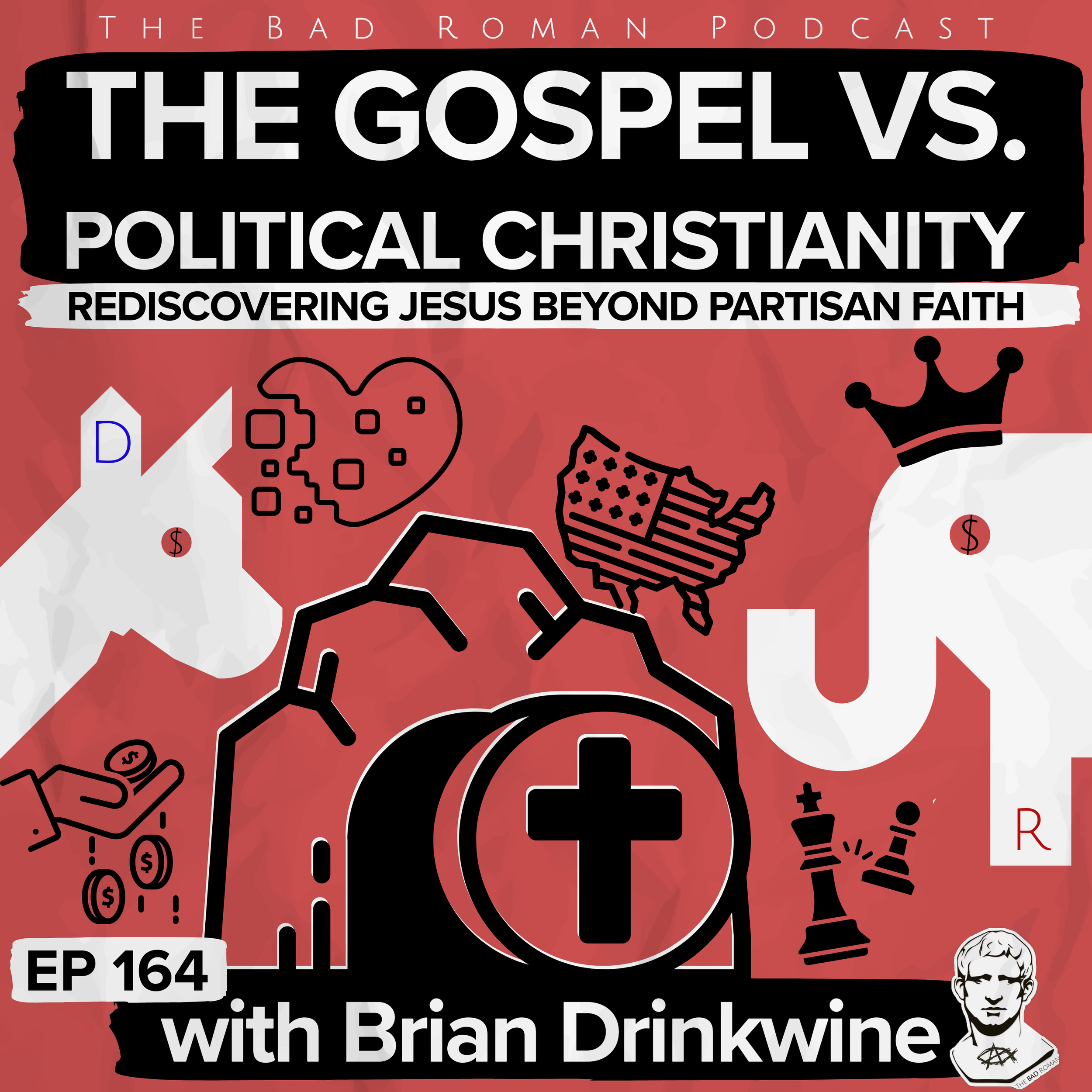
He returns to The Bad Roman Project to discuss his new book, Kingdom Over Empire: Recovering the Gospel from Political Captivity. The book grows out of Brian’s own journey from political certainty toward a deeper allegiance to Jesus. It is not a guide for switching parties. It is a call to notice how political power forms us, and to recover the gospel from its grip.
Brian once believed that America needed the right Christians in office. He listened to conservative talk radio, protested taxes, feared Democratic leaders, and looked to elections for hope. He loved Jesus, but the empire had quietly taught him what to fear, whom to distrust, and what victory should look like.
Then he began reading the teachings of Jesus differently.
The Kingdom of God was not a religious decoration placed on top of American politics. Jesus was not offering spiritual support for one tribe. He was announcing another Kingdom, another King, and another way to live.
That discovery became the heart of Brian’s book, and the heart of this episode.
A Book Born from Political Captivity
Kingdom Over Empire is not written by someone throwing rocks from outside the church.
Brian writes as someone who lived inside political Christianity, believed its promises, and felt its fears. He remembers supporting John McCain and Sarah Palin in 2008 because he believed they could help restore America as a Christian nation.
When Barack Obama won, Brian sat alone in his living room and cried.
He thought the country was finished.
Years later, that memory helped him see where his hope had been placed. He had treated the loss of an election almost like the loss of the gospel.
“It never occurred to me at the time to question whether our country being over or not even matters.”
— Brian Drinkwine, 07:45
That is not a claim that nations or policies never matter. It is a question about order.
What matters most?
If our preferred country, party, or leader falls, is Jesus still Lord? If the answer is yes, then why do elections sometimes have more control over our peace than the risen Christ?
Brian’s book is an attempt to name that tension and help Christians come home to Jesus.
The Political Smoothie We Were Handed
Brian uses the word syncretism to describe what happens when two opposing beliefs are mixed together.
The word may sound academic. The picture Brian gives is not.
He jokes about making a “Christian Republican smoothie.” We could make a Democratic version too. Add a few Bible verses, a flag, a favorite politician, some fear about the other side, and blend until nobody can tell where Christianity ends and party loyalty begins.
Many of us drank that smoothie without knowing what was in it.
We assumed Christians voted a certain way. We treated political opponents as spiritual threats. We learned which news sources good Christians watched and which people could not be trusted.
Our party became part of our identity.
But Brian argues that Jesus does not belong to the right, the left, or a polite middle.
“We take the narrow path. We’re going a different way entirely.”
— Brian Drinkwine, 10:10
The Kingdom is not a compromise between two empires. It is a different political reality under a crucified King.
The Main Question of Kingdom Over Empire
Brian’s book asks us to look deeper than policies and elections.
Before we decide how to vote, what cause to support, or which political claim to repeat, something has already happened to us.
We have been formed.
Campaigns, parties, algorithms, news channels, churches, and influencers teach us what to fear. They shape our view of safety. They tell us who threatens our family and who can rescue us.
“The real crisis that’s facing the church isn’t political opposition, but political formation.”
— Brian Drinkwine, 12:37
This is the book’s central warning.
Empire does not only want our vote. It wants to disciple us.
It wants our attention, loyalty, money, imagination, and anger. It wants to shape us into people who believe that control is the only path forward and that winning excuses almost anything.
Brian organizes the book around six ways empire does this: fear, seduction, winning, certainty, enemies, and pressure.
Fear, Seduction, and the Promise of Safety
Fear turns threats into teachers.
When fear takes over, we stop asking, “What does faithfulness to Jesus require?” We begin asking, “What must we do to survive?”
That change may seem small, but it opens the door to cruelty. Mercy begins to look weak. Empathy feels dangerous. Violence becomes protection.
Seduction works from the other side.
Empire offers hope, comfort, security, prosperity, and influence. It whispers that everything will be better once our people are in control.
Give us your vote.
Give us your loyalty.
Defend us when we fail.
We will protect your way of life.
The offer sounds like salvation because that is what it is trying to replace.
Winning, Certainty, and Control
Empire also forms us through winning.
Brian says the logic of winning replaces the question “Is it faithful?” with “Does it work?”
That is how Christians begin excusing what they once condemned. A dishonest leader becomes acceptable because he gets results. Cruel policies become necessary because the stakes are too high. Integrity becomes a luxury we cannot afford.
But Jesus did not tell His disciples to win at all costs.
He told them to take up a cross.
Certainty adds another layer. It lets us trade trust for control while calling the trade “conviction.”
Real trust leaves room for mystery. It admits that we do not control history, elections, or tomorrow. Certainty demands that we know exactly who the good people are, who the bad people are, and what must be done to them.
The Kingdom calls us to trust Jesus.
Empire offers the illusion that we can control everything ourselves.
Enemies, Pressure, and the Loss of Empathy
Empire needs enemies.
It cannot keep people afraid without a threat. It cannot demand loyalty without someone to blame. It cannot justify violence without first teaching us to stop seeing certain people as human.
Brian says empire can even make contempt feel like discernment.
“You can’t go kill somebody if you’re empathetic with them.”
— Brian Drinkwine, 15:00
That sentence cuts through a great deal of political noise.
Empathy does not mean pretending harmful ideas are harmless. It means remembering that the person in front of us bears the image of God.
Pressure is the sixth tool.
When the world feels chaotic, political tribes demand loyalty. Questioning the group may cost relationships, church standing, employment, or social belonging.
People we love may cut us off because we no longer repeat the approved political lines.
That is not an accident. Pressure teaches us that belonging depends on obedience to the tribe.
Faith as Allegiance to a Crucified King
Brian does not write Kingdom Over Empire to tell Christians to disappear from public life or find a better political party.
He wants to recover the New Testament meaning of faith.
Faith is not only agreeing with religious ideas. It is trust, faithfulness, and allegiance.
Brian describes it as an
“undivided allegiance to a crucified King whose Kingdom cannot be advanced by the tools of empire.” —Brian Drinkwine, 16:45
That means the method matters.
We cannot build a Kingdom of truth with lies.
We cannot build a Kingdom of mercy with cruelty.
We cannot build a Kingdom of peace by killing our enemies.
We cannot build a Kingdom of voluntary love through coercion.
Jesus does not need Caesar’s sword to complete His mission.
Jesus Was Not Joking About Enemy-Love
The chapter on enemies was one of the hardest parts of the book for Brian to write.
Enemy-love sounds beautiful until the enemy is real.
It is easy to pray for an annoying coworker. It is harder to love someone we believe threatens our family, religion, nation, or safety.
Yet Jesus gave this command in a world of soldiers, occupation, public torture, and political violence.
“When Jesus tells us to love our enemies, He’s not speaking hyperbolically.”
— Brian Drinkwine, 18:55
Jesus showed us enemy-love while hanging on a Roman cross.
He did not merely refuse revenge. He prayed for the people killing Him.
Brian contrasts that call with the version of cross-bearing he learned at youth camp. Taking up the cross meant not drinking, smoking, or cussing. It meant wearing a Christian shirt and putting a fish on the car.
Those choices may be fine, but they are not the full weight of the cross.
The cross is where love refuses to become hatred under pressure.
When an Online Opponent Became a Friend
Brian shares one of the book’s ideas through a real relationship.
A man repeatedly challenged him online, leaving combative comments and sending argumentative messages. Brian could have blocked him and moved on.
Instead, he asked, “Tell me who you are.”
The man was a missionary serving in Africa.
Brian began supporting him, praying for him, and talking with him. Their disagreement did not vanish, but the enemy became a person.
The missionary carried a deep fear about Muslim influence in America. As they talked, Brian saw all six tools of empire at work: fear, a named enemy, certainty, political seduction, pressure, and a demand to win.
Brian also had to apply his own book to himself.
“I’m always in process. Everything I wrote about in my book…is something that I feel like I’m actually experiencing. It’s not theoretical.”
— Brian Drinkwine, 23:20
That honesty matters.
Kingdom Over Empire is not written from a mountaintop by someone who has finished the journey. It is written from the road.
When Party Loyalty Overrides Jesus
Brian and Craig spend the next part of the conversation testing the book’s ideas against present political life.
Brian is careful not to declare that politically loyal Christians are not saved. He knows sincere followers of Jesus on both sides.
The deeper question is about reflexes.
What happens when our party does something that clearly clashes with Jesus?
Do we grieve?
Do we speak honestly?
Or do we rush to explain why this case is different?
“That’s where you’ve been compromised.”
— Brian Drinkwine, 29:49
They talk about immigration, political fear, government cuts, foreign aid, children suffering, and the way parties turn vulnerable people into threats.
The concern is larger than one program or policy. It is about what happens to our hearts.
When real people suffer, can we still see them?
Or has loyalty to our side made us numb?
Brian says he did not move from Republican to Democrat. He went from Republican to “nope.”
His goal is not to baptize another party. His goal is to ask why followers of Jesus can overlook suffering when their preferred leaders cause it.
Remembering the Poor
Brian reflects on how his political formation shaped the way he viewed poor and marginalized people.
He had been trained to see people in need as irresponsible, dangerous, or undeserving. He later compared that formation with the deep concern for the poor found throughout the Hebrew Scriptures and the teachings of Jesus.
The difference was hard to ignore.
“I was not being formed in the ways of Jesus. I was being formed by empire.”
— Brian Drinkwine, 42:22
Political formation had not only changed his opinions. It had changed the kind of person he was becoming.
Eventually, even cruelty could be called love.
We may tell someone we are only “speaking truth,” when we are really enjoying the chance to be mean.
Brian puts it more simply:
“In reality, I’m just being a punk.”
— Brian Drinkwine, 42:45
That may be the least academic line in the episode. It may also be one of the most useful.
If our truth does not carry the character of Jesus, we should stop and ask who is really forming us.
The Social Cost of Coming Home to Jesus
The opening of Brian’s book includes a character named Jeffrey.
Jeffrey is a composite of three people from Brian’s life. Each relationship changed as Brian’s understanding of Jesus, empire, and the Kingdom changed.
Brian does not blame them for noticing the change.
He was changing.
But the change threatened more than political opinions. It threatened social networks, shared language, and a whole way of understanding the world.
Leaving political allegiance can feel like leaving a family.
The loss is real.
Brian describes meetings over coffee or lunch where friends quietly made it clear that the relationship could not continue in the same way.
“You lose a person you love…to wanting to follow Jesus more faithfully.”
— Brian Drinkwine, 48:10
Political deconstruction is not only about ideas. It can bring grief, isolation, and confusion.
That is why people need community. They need to know they are not crazy. They need others who understand what it feels like to choose Kingdom over empire and lose something along the way.
Image-Bearers Are Not Collateral Damage
Craig brings the discussion back to a simple truth.
Every person being discussed in our political arguments is created by God.
Immigrants, Muslims, political opponents, people in poverty, victims of war, and people caught in systems we barely understand are not categories. They are image-bearers.
Following Jesus may become uncomfortable when we refuse to overlook harm simply because our side caused it.
Comfort is not the goal.
Faithfulness is.
That discomfort also shaped the response to Brian’s earlier viral post about Charlie Kirk. The post brought a wave of messages and changed Brian’s daily life. It also became the subject of Brian’s previous appearance on The Bad Roman Project.
The response showed how hungry many Christians are for language that names the uneasy mix of Christianity, nationalism, celebrity, and political power.
The new book gives that unease a larger framework.
When the Cross Became a Weapon
The second half of the episode turns toward Constantine, one of the book’s major historical examples.
Before Constantine, Christians existed as a persecuted and often marginalized people within the Roman Empire. The movement grew through households, relationships, witness, sacrifice, and care.
Then the relationship changed.
Constantine claimed to see a vision of the cross before the Battle of the Milvian Bridge. His soldiers placed the Chi-Rho symbol on their shields and entered battle under a Christian sign.
The cross, once a symbol of Rome killing its enemies, became a banner carried by soldiers killing in Christ’s name.
Brian calls it a stunning reversal.
“The thing that we take to represent ourselves being willing to die [became] the thing that we put on our shields so that we can go in and kill other people.”
— Brian Drinkwine, 58:00
The church gained legal standing, money, influence, and safety.
It also became tied to the machinery of empire.
Bishops received privilege. Church leaders gained access. Allegiance to Rome became more useful, and eventually more necessary.
The persecuted faith became the favored faith.
That bargain still echoes.
Constantine Did Not Invent Empire, He Co-opted the Church
Brian does not claim that empire began with Constantine.
Rome was already Rome.
The important change was that the empire learned to use Christianity.
The church did not need to be destroyed if it could be absorbed. The cross did not need to disappear if it could be placed on a shield. Jesus did not need to be denied if His name could be used to bless conquest.
That may be the more dangerous form of captivity.
Open persecution makes the conflict clear.
Political favor makes compromise feel like success.
Brian and Craig ask whether the same pattern appears in American Christianity. When pastors flatter rulers, excuse conduct they once condemned, or preach national power while ignoring Jesus, has the church gained influence, or has it been captured?
Seven Mountains and a Gospel of Domination
Brian then tells a story that becomes another major part of the book.
Years ago, he attended a Christian gathering where Lance Wallnau taught the Seven Mountains Mandate.
The teaching says Christians must take control of major areas of culture, including government, education, business, media, family, religion, and the arts.
At the time, Brian accepted it. He even brought the teaching back to his own ministry.
Now he sees it differently.
The Seven Mountains Mandate teaches Christians to climb, capture, and control culture.
Jesus did not climb a mountain to dominate His enemies.
He went to a cross.
Brian calls the mandate an anti-gospel because it replaces cruciform faithfulness with power and control.
“He didn’t go climb the mountain and show His dominance. He went to a cross.”
— Brian Drinkwine, 1:03:35
The contrast could not be sharper.
One path seeks the highest seat.
The other washes feet.
Cyrus, Trump, and the Political Loophole
The episode closes with one of the book’s strongest biblical challenges.
Lance Wallnau helped popularize the claim that Donald Trump was a modern Cyrus. In Scripture, Cyrus was a pagan ruler who helped release the Jewish people.
The comparison allowed many Christians to say that a leader’s character did not matter. God could use an immoral man to get the right political results.
Integrity became expendable.
Winning became the proof of faithfulness.
Brian asks whether Christians chose the wrong biblical king.
What if the better comparison is not Cyrus, but Nebuchadnezzar?
Nebuchadnezzar did not only conquer through violence. He brought Israel’s brightest people into his court. He gave them education, status, new names, new clothes, and access to power.
He offered influence in exchange for identity.
Brian describes it as
“proximity to power in exchange for an almost imperceptible surrender of identity.”
— Brian Drinkwine, 1:06:00
Babylon did not need to erase the faith of God’s people.
It only needed to make Babylon feel like home.
That is the final warning of Kingdom Over Empire.
Political captivity does not always begin with a threat.
Sometimes it begins with an invitation to the table.
Recovering the Gospel
Brian’s book is not simply a complaint about politics.
It is an invitation to recover something.
To recover faith as allegiance to Jesus.
To recover enemy-love as a real command.
To recover the cross as the opposite of domination.
To recover compassion for people our parties teach us to fear.
To recover a church that does not need state power to be faithful.
The path out of political captivity may cost us certainty, status, and even relationships.
But it gives us back the freedom to see Jesus clearly.
That is a trade worth making.
🤝Connect with Brian🤝
Kingdom Over Empire: Recovering the Gospel from Political Captivity
Also available through Amazon and other book retailers
Email: brian@briandrinkwine.com
Highlights & Takeaways
Brian’s new book is a recovery project. Kingdom Over Empire helps Christians recognize political formation and return to allegiance to Jesus.
Empire disciples before it governs. Fear, seduction, winning, certainty, enemies, and pressure shape us before policy debates begin.
Political compromise often appears as a reflex. When our party contradicts Jesus and we immediately defend it, our allegiance has been exposed.
The cross cannot be used to bless domination. Constantine’s fusion of Christianity and military power changed how the gospel was practiced and imagined.
Leaving political identity carries a social cost. Friends, churches, and communities may pull away when we question shared loyalties.
The poor and marginalized reveal our formation. Our treatment of vulnerable people shows whether Jesus or empire has shaped our hearts.
Seven Mountains teaching reverses the way of Christ. Jesus did not conquer culture from the top; He served and suffered from below.
Babylon often assimilates before it attacks. Access, praise, and political influence can slowly replace Christian identity.
Listen
Listen for the six tools Brian develops in Kingdom Over Empire: fear, seduction, winning, certainty, enemies, and pressure. Notice how they return throughout the whole conversation.
Reflect
When your political side acts against the teachings of Jesus, what is your first response? Grief, honesty, silence, or defense?
Read
Read Matthew 5–7, Matthew 20:20–28, Daniel 1–3, and the crucifixion story in Matthew 27. Compare the politics of domination with the politics of the cross.
Practice
Choose one person or group your political tribe has taught you to fear. Learn a name, hear a story, and practice seeing an image-bearer before seeing a label.
Episode Timestamps:
(00:00) Introducing Kingdom Over Empire
Brian’s new book and personal journey
Political faith, loneliness, and reassurance
From Christian nationalism toward Jesus
(05:30) A Crisis of Hope and Identity
Election-night despair and misplaced hope
When politics feels like salvation
Reordering what matters most
(09:30) How Empire Disciples Us
Jesus as King beyond party categories
Political formation before policy
Fear, seduction, winning, certainty, enemies, pressure
(18:50) Enemy-Love and the Way of the Cross
Jesus’ command without political loopholes
Cross-bearing beyond Christian branding
Online conflict transformed through relationship
(24:30) Winning, Certainty, and Control
Results over faithfulness
Certainty as a substitute for trust
The illusion of control in political life
(28:45) When Party Loyalty Overrides Jesus
Defending a party against clear Christian teaching
Immigration, aid cuts, poverty, and political enemies
Compassion numbed by tribal allegiance
(36:30) Remembering the Poor and the Marginalized
Formation that reshapes how we see people in need
Biblical concern for the vulnerable
When truth-telling becomes cruelty
(43:49) The Cost of Leaving Political Identity
Friendship loss and Brian’s composite character “Jeffrey”
Social belonging, worldview, and political deconstruction
Image-bearers, discomfort, and the Charlie Kirk response
(49:30) Image-Bearers Over Political Categories
Seeing people beyond labels and tribes
Discomfort as a sign of faithfulness
Compassion in a polarized world
(53:25) Constantine and the Co-opted Cross
Milvian Bridge and Christian symbols in battle
Persecuted church becoming state-favored faith
Cross of self-sacrifice turned into military power
(57:45) When the Church Gains Power
Influence, privilege, and compromise
Empire absorbing rather than opposing the church
The danger of political favor
(1:01:10) Seven Mountains, Cyrus, and Political Power
Lance Wallnau and cultural domination
Seven Mountains teaching as an anti-gospel
Trump as Cyrus and integrity made expendable
(1:05:25) Nebuchadnezzar and Assimilation into Babylon
Access to power in exchange for identity
Daniel’s resistance as the exception
Political influence as a tool of captivity
(1:07:45) Assimilation and the Subtle Loss of Identity
Babylon’s strategy of comfort and access
When empire feels like home
The slow surrender of allegiance
(1:09:40) Finding and Sharing the Book
Support The Bad Roman Project through Spotfund. Donations above production costs go to local charities in Memphis, Tennessee.
You can also Salsa the Love and share the episode, everything helps spread the message of Jesus over empire. Faithfulness over winning. Neighbor-love over coercion.
Thanks for being here, and No King but Christ!
Looking for more EPISODES? You May ALSO Like:


Related Blog Post

