The Gospel

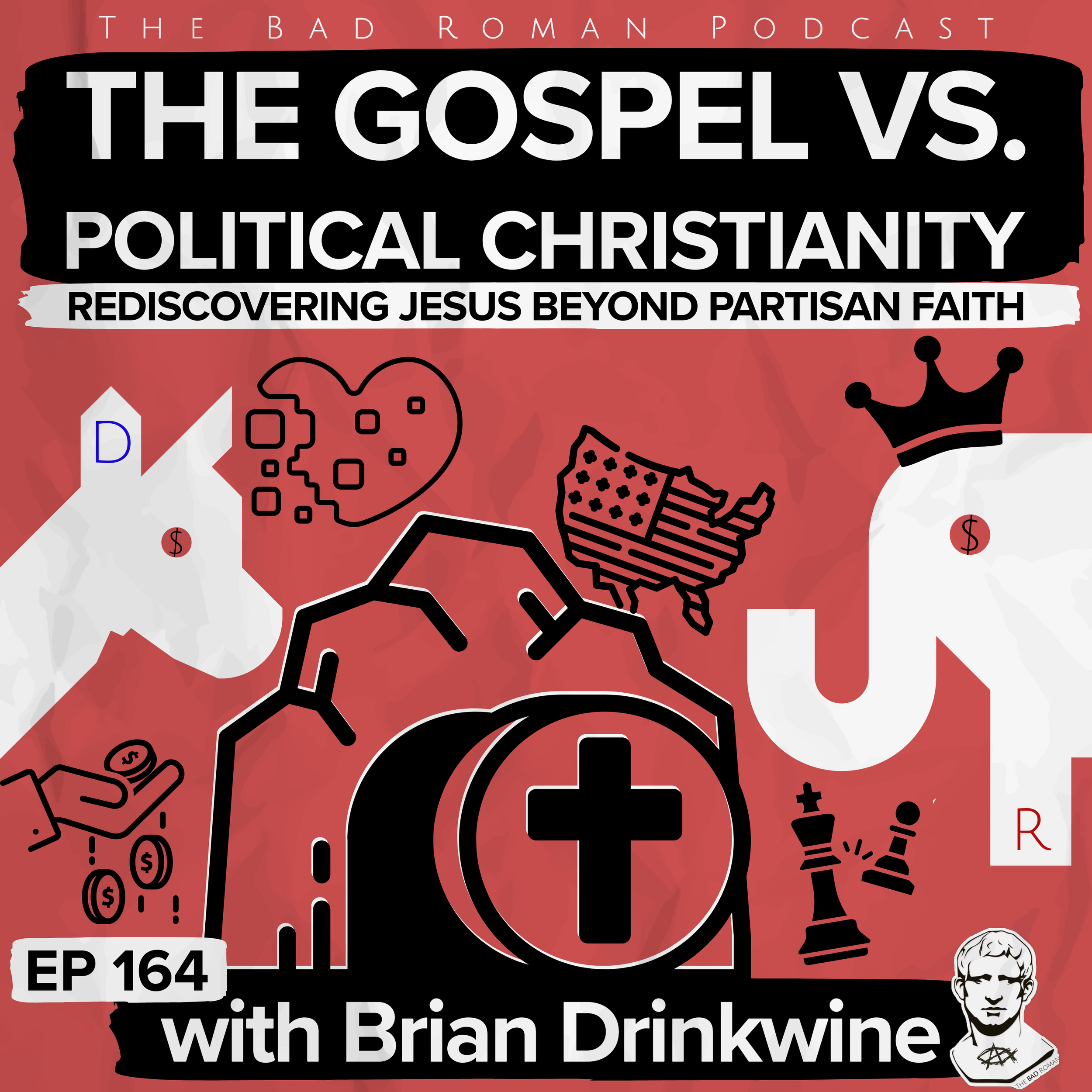
164. Breaking Free from Political Christianity: Rediscovering the Gospel Beyond Partisan Faith with Brian Drinkwine

What happens when following Jesus starts pulling us away from the politics that once made us feel safe?

The change can be lonely. Friends may stop calling. Church conversations may grow tense. People who once praised our faith may suddenly wonder if we have lost it.

Brian Drinkwine knows that road.

He returns to The Bad Roman Project to discuss his new book, Kingdom Over Empire: Recovering the Gospel from Political Captivity. The book grows out of Brian’s own journey from political certainty toward a deeper allegiance to Jesus. It is not a guide for switching parties. It is a call to notice how political power forms us, and to recover the gospel from its grip.

Brian once believed that America needed the right Christians in office. He listened to conservative talk radio, protested taxes, feared Democratic leaders, and looked to elections for hope. He loved Jesus, but the empire had quietly taught him what to fear, whom to distrust, and what victory should look like.

Then he began reading the teachings of Jesus differently.

The Kingdom of God was not a religious decoration placed on top of American politics. Jesus was not offering spiritual support for one tribe. He was announcing another Kingdom, another King, and another way to live.

That discovery became the heart of Brian’s book, and the heart of this episode.

A Book Born from Political Captivity

Kingdom Over Empire is not written by someone throwing rocks from outside the church.

Brian writes as someone who lived inside political Christianity, believed its promises, and felt its fears. He remembers supporting John McCain and Sarah Palin in 2008 because he believed they could help restore America as a Christian nation.

When Barack Obama won, Brian sat alone in his living room and cried.

He thought the country was finished.

Years later, that memory helped him see where his hope had been placed. He had treated the loss of an election almost like the loss of the gospel.

“It never occurred to me at the time to question whether our country being over or not even matters.”

— Brian Drinkwine, 07:45

That is not a claim that nations or policies never matter. It is a question about order.

What matters most?

If our preferred country, party, or leader falls, is Jesus still Lord? If the answer is yes, then why do elections sometimes have more control over our peace than the risen Christ?

Brian’s book is an attempt to name that tension and help Christians come home to Jesus.

The Political Smoothie We Were Handed

Brian uses the word syncretism to describe what happens when two opposing beliefs are mixed together.

The word may sound academic. The picture Brian gives is not.

He jokes about making a “Christian Republican smoothie.” We could make a Democratic version too. Add a few Bible verses, a flag, a favorite politician, some fear about the other side, and blend until nobody can tell where Christianity ends and party loyalty begins.

Many of us drank that smoothie without knowing what was in it.

We assumed Christians voted a certain way. We treated political opponents as spiritual threats. We learned which news sources good Christians watched and which people could not be trusted.

Our party became part of our identity.

But Brian argues that Jesus does not belong to the right, the left, or a polite middle.

“We take the narrow path. We’re going a different way entirely.”

— Brian Drinkwine, 10:10

The Kingdom is not a compromise between two empires. It is a different political reality under a crucified King.

The Main Question of Kingdom Over Empire

Brian’s book asks us to look deeper than policies and elections.

Before we decide how to vote, what cause to support, or which political claim to repeat, something has already happened to us.

We have been formed.

Campaigns, parties, algorithms, news channels, churches, and influencers teach us what to fear. They shape our view of safety. They tell us who threatens our family and who can rescue us.

“The real crisis that’s facing the church isn’t political opposition, but political formation.”

— Brian Drinkwine, 12:37

This is the book’s central warning.

Empire does not only want our vote. It wants to disciple us.

It wants our attention, loyalty, money, imagination, and anger. It wants to shape us into people who believe that control is the only path forward and that winning excuses almost anything.

Brian organizes the book around six ways empire does this: fear, seduction, winning, certainty, enemies, and pressure.

Fear, Seduction, and the Promise of Safety

Fear turns threats into teachers.

When fear takes over, we stop asking, “What does faithfulness to Jesus require?” We begin asking, “What must we do to survive?”

That change may seem small, but it opens the door to cruelty. Mercy begins to look weak. Empathy feels dangerous. Violence becomes protection.

Seduction works from the other side.

Empire offers hope, comfort, security, prosperity, and influence. It whispers that everything will be better once our people are in control.

Give us your vote.

Give us your loyalty.

Defend us when we fail.

We will protect your way of life.

The offer sounds like salvation because that is what it is trying to replace.

Winning, Certainty, and Control

Empire also forms us through winning.

Brian says the logic of winning replaces the question “Is it faithful?” with “Does it work?”

That is how Christians begin excusing what they once condemned. A dishonest leader becomes acceptable because he gets results. Cruel policies become necessary because the stakes are too high. Integrity becomes a luxury we cannot afford.

But Jesus did not tell His disciples to win at all costs.

He told them to take up a cross.

Certainty adds another layer. It lets us trade trust for control while calling the trade “conviction.”

Real trust leaves room for mystery. It admits that we do not control history, elections, or tomorrow. Certainty demands that we know exactly who the good people are, who the bad people are, and what must be done to them.

The Kingdom calls us to trust Jesus.

Empire offers the illusion that we can control everything ourselves.

Enemies, Pressure, and the Loss of Empathy

Empire needs enemies.

It cannot keep people afraid without a threat. It cannot demand loyalty without someone to blame. It cannot justify violence without first teaching us to stop seeing certain people as human.

Brian says empire can even make contempt feel like discernment.

“You can’t go kill somebody if you’re empathetic with them.”

— Brian Drinkwine, 15:00

That sentence cuts through a great deal of political noise.

Empathy does not mean pretending harmful ideas are harmless. It means remembering that the person in front of us bears the image of God.

Pressure is the sixth tool.

When the world feels chaotic, political tribes demand loyalty. Questioning the group may cost relationships, church standing, employment, or social belonging.

People we love may cut us off because we no longer repeat the approved political lines.

That is not an accident. Pressure teaches us that belonging depends on obedience to the tribe.

Faith as Allegiance to a Crucified King

Brian does not write Kingdom Over Empire to tell Christians to disappear from public life or find a better political party.

He wants to recover the New Testament meaning of faith.

Faith is not only agreeing with religious ideas. It is trust, faithfulness, and allegiance.

Brian describes it as an

“undivided allegiance to a crucified King whose Kingdom cannot be advanced by the tools of empire.” —Brian Drinkwine, 16:45

That means the method matters.

We cannot build a Kingdom of truth with lies.

We cannot build a Kingdom of mercy with cruelty.

We cannot build a Kingdom of peace by killing our enemies.

We cannot build a Kingdom of voluntary love through coercion.

Jesus does not need Caesar’s sword to complete His mission.

Jesus Was Not Joking About Enemy-Love

The chapter on enemies was one of the hardest parts of the book for Brian to write.

Enemy-love sounds beautiful until the enemy is real.

It is easy to pray for an annoying coworker. It is harder to love someone we believe threatens our family, religion, nation, or safety.

Yet Jesus gave this command in a world of soldiers, occupation, public torture, and political violence.

“When Jesus tells us to love our enemies, He’s not speaking hyperbolically.”

— Brian Drinkwine, 18:55

Jesus showed us enemy-love while hanging on a Roman cross.

He did not merely refuse revenge. He prayed for the people killing Him.

Brian contrasts that call with the version of cross-bearing he learned at youth camp. Taking up the cross meant not drinking, smoking, or cussing. It meant wearing a Christian shirt and putting a fish on the car.

Those choices may be fine, but they are not the full weight of the cross.

The cross is where love refuses to become hatred under pressure.

When an Online Opponent Became a Friend

Brian shares one of the book’s ideas through a real relationship.

A man repeatedly challenged him online, leaving combative comments and sending argumentative messages. Brian could have blocked him and moved on.

Instead, he asked, “Tell me who you are.”

The man was a missionary serving in Africa.

Brian began supporting him, praying for him, and talking with him. Their disagreement did not vanish, but the enemy became a person.

The missionary carried a deep fear about Muslim influence in America. As they talked, Brian saw all six tools of empire at work: fear, a named enemy, certainty, political seduction, pressure, and a demand to win.

Brian also had to apply his own book to himself.

“I’m always in process. Everything I wrote about in my book…is something that I feel like I’m actually experiencing. It’s not theoretical.”

— Brian Drinkwine, 23:20

That honesty matters.

Kingdom Over Empire is not written from a mountaintop by someone who has finished the journey. It is written from the road.

When Party Loyalty Overrides Jesus

Brian and Craig spend the next part of the conversation testing the book’s ideas against present political life.

Brian is careful not to declare that politically loyal Christians are not saved. He knows sincere followers of Jesus on both sides.

The deeper question is about reflexes.

What happens when our party does something that clearly clashes with Jesus?

Do we grieve?

Do we speak honestly?

Or do we rush to explain why this case is different?

“That’s where you’ve been compromised.”

— Brian Drinkwine, 29:49

They talk about immigration, political fear, government cuts, foreign aid, children suffering, and the way parties turn vulnerable people into threats.

The concern is larger than one program or policy. It is about what happens to our hearts.

When real people suffer, can we still see them?

Or has loyalty to our side made us numb?

Brian says he did not move from Republican to Democrat. He went from Republican to “nope.”

His goal is not to baptize another party. His goal is to ask why followers of Jesus can overlook suffering when their preferred leaders cause it.

Remembering the Poor

Brian reflects on how his political formation shaped the way he viewed poor and marginalized people.

He had been trained to see people in need as irresponsible, dangerous, or undeserving. He later compared that formation with the deep concern for the poor found throughout the Hebrew Scriptures and the teachings of Jesus.

The difference was hard to ignore.

“I was not being formed in the ways of Jesus. I was being formed by empire.”

— Brian Drinkwine, 42:22

Political formation had not only changed his opinions. It had changed the kind of person he was becoming.

Eventually, even cruelty could be called love.

We may tell someone we are only “speaking truth,” when we are really enjoying the chance to be mean.

Brian puts it more simply:

“In reality, I’m just being a punk.”

— Brian Drinkwine, 42:45

That may be the least academic line in the episode. It may also be one of the most useful.

If our truth does not carry the character of Jesus, we should stop and ask who is really forming us.

The Social Cost of Coming Home to Jesus

The opening of Brian’s book includes a character named Jeffrey.

Jeffrey is a composite of three people from Brian’s life. Each relationship changed as Brian’s understanding of Jesus, empire, and the Kingdom changed.

Brian does not blame them for noticing the change.

He was changing.

But the change threatened more than political opinions. It threatened social networks, shared language, and a whole way of understanding the world.

Leaving political allegiance can feel like leaving a family.

The loss is real.

Brian describes meetings over coffee or lunch where friends quietly made it clear that the relationship could not continue in the same way.

“You lose a person you love…to wanting to follow Jesus more faithfully.”

— Brian Drinkwine, 48:10

Political deconstruction is not only about ideas. It can bring grief, isolation, and confusion.

That is why people need community. They need to know they are not crazy. They need others who understand what it feels like to choose Kingdom over empire and lose something along the way.

Image-Bearers Are Not Collateral Damage

Craig brings the discussion back to a simple truth.

Every person being discussed in our political arguments is created by God.

Immigrants, Muslims, political opponents, people in poverty, victims of war, and people caught in systems we barely understand are not categories. They are image-bearers.

Following Jesus may become uncomfortable when we refuse to overlook harm simply because our side caused it.

Comfort is not the goal.

Faithfulness is.

That discomfort also shaped the response to Brian’s earlier viral post about Charlie Kirk. The post brought a wave of messages and changed Brian’s daily life. It also became the subject of Brian’s previous appearance on The Bad Roman Project.

The response showed how hungry many Christians are for language that names the uneasy mix of Christianity, nationalism, celebrity, and political power.

The new book gives that unease a larger framework.

When the Cross Became a Weapon

The second half of the episode turns toward Constantine, one of the book’s major historical examples.

Before Constantine, Christians existed as a persecuted and often marginalized people within the Roman Empire. The movement grew through households, relationships, witness, sacrifice, and care.

Then the relationship changed.

Constantine claimed to see a vision of the cross before the Battle of the Milvian Bridge. His soldiers placed the Chi-Rho symbol on their shields and entered battle under a Christian sign.

The cross, once a symbol of Rome killing its enemies, became a banner carried by soldiers killing in Christ’s name.

Brian calls it a stunning reversal.

“The thing that we take to represent ourselves being willing to die [became] the thing that we put on our shields so that we can go in and kill other people.”

— Brian Drinkwine, 58:00

The church gained legal standing, money, influence, and safety.

It also became tied to the machinery of empire.

Bishops received privilege. Church leaders gained access. Allegiance to Rome became more useful, and eventually more necessary.

The persecuted faith became the favored faith.

That bargain still echoes.

Constantine Did Not Invent Empire, He Co-opted the Church

Brian does not claim that empire began with Constantine.

Rome was already Rome.

The important change was that the empire learned to use Christianity.

The church did not need to be destroyed if it could be absorbed. The cross did not need to disappear if it could be placed on a shield. Jesus did not need to be denied if His name could be used to bless conquest.

That may be the more dangerous form of captivity.

Open persecution makes the conflict clear.

Political favor makes compromise feel like success.

Brian and Craig ask whether the same pattern appears in American Christianity. When pastors flatter rulers, excuse conduct they once condemned, or preach national power while ignoring Jesus, has the church gained influence, or has it been captured?

Seven Mountains and a Gospel of Domination

Brian then tells a story that becomes another major part of the book.

Years ago, he attended a Christian gathering where Lance Wallnau taught the Seven Mountains Mandate.

The teaching says Christians must take control of major areas of culture, including government, education, business, media, family, religion, and the arts.

At the time, Brian accepted it. He even brought the teaching back to his own ministry.

Now he sees it differently.

The Seven Mountains Mandate teaches Christians to climb, capture, and control culture.

Jesus did not climb a mountain to dominate His enemies.

He went to a cross.

Brian calls the mandate an anti-gospel because it replaces cruciform faithfulness with power and control.

“He didn’t go climb the mountain and show His dominance. He went to a cross.”

— Brian Drinkwine, 1:03:35

The contrast could not be sharper.

One path seeks the highest seat.

The other washes feet.

Cyrus, Trump, and the Political Loophole

The episode closes with one of the book’s strongest biblical challenges.

Lance Wallnau helped popularize the claim that Donald Trump was a modern Cyrus. In Scripture, Cyrus was a pagan ruler who helped release the Jewish people.

The comparison allowed many Christians to say that a leader’s character did not matter. God could use an immoral man to get the right political results.

Integrity became expendable.

Winning became the proof of faithfulness.

Brian asks whether Christians chose the wrong biblical king.

What if the better comparison is not Cyrus, but Nebuchadnezzar?

Nebuchadnezzar did not only conquer through violence. He brought Israel’s brightest people into his court. He gave them education, status, new names, new clothes, and access to power.

He offered influence in exchange for identity.

Brian describes it as

“proximity to power in exchange for an almost imperceptible surrender of identity.”

— Brian Drinkwine, 1:06:00

Babylon did not need to erase the faith of God’s people.

It only needed to make Babylon feel like home.

That is the final warning of Kingdom Over Empire.

Political captivity does not always begin with a threat.

Sometimes it begins with an invitation to the table.

Recovering the Gospel

Brian’s book is not simply a complaint about politics.

It is an invitation to recover something.

To recover faith as allegiance to Jesus.

To recover enemy-love as a real command.

To recover the cross as the opposite of domination.

To recover compassion for people our parties teach us to fear.

To recover a church that does not need state power to be faithful.

The path out of political captivity may cost us certainty, status, and even relationships.

But it gives us back the freedom to see Jesus clearly.

That is a trade worth making.

🤝Connect with Brian🤝

Highlights & Takeaways

  • Brian’s new book is a recovery project. Kingdom Over Empire helps Christians recognize political formation and return to allegiance to Jesus.

  • Empire disciples before it governs. Fear, seduction, winning, certainty, enemies, and pressure shape us before policy debates begin.

  • Political compromise often appears as a reflex. When our party contradicts Jesus and we immediately defend it, our allegiance has been exposed.

  • The cross cannot be used to bless domination. Constantine’s fusion of Christianity and military power changed how the gospel was practiced and imagined.

  • Leaving political identity carries a social cost. Friends, churches, and communities may pull away when we question shared loyalties.

  • The poor and marginalized reveal our formation. Our treatment of vulnerable people shows whether Jesus or empire has shaped our hearts.

  • Seven Mountains teaching reverses the way of Christ. Jesus did not conquer culture from the top; He served and suffered from below.

  • Babylon often assimilates before it attacks. Access, praise, and political influence can slowly replace Christian identity.

Listen

Listen for the six tools Brian develops in Kingdom Over Empire: fear, seduction, winning, certainty, enemies, and pressure. Notice how they return throughout the whole conversation.

Reflect

When your political side acts against the teachings of Jesus, what is your first response? Grief, honesty, silence, or defense?

Read

Read Matthew 5–7, Matthew 20:20–28, Daniel 1–3, and the crucifixion story in Matthew 27. Compare the politics of domination with the politics of the cross.

Practice

Choose one person or group your political tribe has taught you to fear. Learn a name, hear a story, and practice seeing an image-bearer before seeing a label.

Episode Timestamps:

(00:00) Introducing Kingdom Over Empire

  • Brian’s new book and personal journey

  • Political faith, loneliness, and reassurance

  • From Christian nationalism toward Jesus

(05:30) A Crisis of Hope and Identity

  • Election-night despair and misplaced hope

  • When politics feels like salvation

  • Reordering what matters most

(09:30) How Empire Disciples Us

  • Jesus as King beyond party categories

  • Political formation before policy

  • Fear, seduction, winning, certainty, enemies, pressure

(18:50) Enemy-Love and the Way of the Cross

  • Jesus’ command without political loopholes

  • Cross-bearing beyond Christian branding

  • Online conflict transformed through relationship

(24:30) Winning, Certainty, and Control

  • Results over faithfulness

  • Certainty as a substitute for trust

  • The illusion of control in political life

(28:45) When Party Loyalty Overrides Jesus

  • Defending a party against clear Christian teaching

  • Immigration, aid cuts, poverty, and political enemies

  • Compassion numbed by tribal allegiance

(36:30) Remembering the Poor and the Marginalized

  • Formation that reshapes how we see people in need

  • Biblical concern for the vulnerable

  • When truth-telling becomes cruelty

(43:49) The Cost of Leaving Political Identity

  • Friendship loss and Brian’s composite character “Jeffrey”

  • Social belonging, worldview, and political deconstruction

  • Image-bearers, discomfort, and the Charlie Kirk response

(49:30) Image-Bearers Over Political Categories

  • Seeing people beyond labels and tribes

  • Discomfort as a sign of faithfulness

  • Compassion in a polarized world

(53:25) Constantine and the Co-opted Cross

  • Milvian Bridge and Christian symbols in battle

  • Persecuted church becoming state-favored faith

  • Cross of self-sacrifice turned into military power

(57:45) When the Church Gains Power

  • Influence, privilege, and compromise

  • Empire absorbing rather than opposing the church

  • The danger of political favor

(1:01:10) Seven Mountains, Cyrus, and Political Power

  • Lance Wallnau and cultural domination

  • Seven Mountains teaching as an anti-gospel

  • Trump as Cyrus and integrity made expendable

(1:05:25) Nebuchadnezzar and Assimilation into Babylon

  • Access to power in exchange for identity

  • Daniel’s resistance as the exception

  • Political influence as a tool of captivity

(1:07:45) Assimilation and the Subtle Loss of Identity

  • Babylon’s strategy of comfort and access

  • When empire feels like home

  • The slow surrender of allegiance

(1:09:40) Finding and Sharing the Book


Support The Bad Roman Project through Spotfund. Donations above production costs go to local charities in Memphis, Tennessee.

You can also Salsa the Love and share the episode, everything helps spread the message of Jesus over empire. Faithfulness over winning. Neighbor-love over coercion.

Thanks for being here, and No King but Christ!

Looking for more EPISODES? You May ALSO Like:
Related Blog Post

159. Delivered from the Evil Age: The Law Paul, & Christ's Gospel with Cody Cook

Can we be made right by the law, or are we made right through Christ? That question sits at the center of this episode, but it does not stay small for long. Before long, Craig and Cody Cook are walking through Galatians, spiritual powers, Paul’s strange and beautiful logic, and the way modern Christians often ask Paul questions Paul may not have been trying to answer.

This conversation feels like standing in a doorway between two worlds. On one side is the tidy, familiar version of faith where everything is reduced to rule-keeping, categories, and being declared right. On the other side is the larger, stranger world of the New Testament, where Jesus does not simply help us behave better. He rescues us from an evil age. He breaks the grip of powers we barely know how to name. He brings us into a new family and a new creation.

Cody Cook returns to The Bad Roman Podcast to talk about his book Delivered from the Evil Age of the Present. What follows is not just a book discussion. It is a reminder that the gospel is bigger than legal formulas and deeper than online arguments. If Jesus really came to deliver us from this present evil age, then we have to ask: what are we still trying to crawl back under?

When We Ask Paul the Wrong Question

A lot of us were taught to read Paul through one main lens: law versus grace. Works versus faith. Trying hard versus trusting Jesus. There is truth in that, of course, but Cody helps slow the conversation down and ask whether that frame is too small.

He walks through the old perspective, the new perspective, and newer debates around “Paul within Judaism” and “apocalyptic Paul.” That may sound technical, but the heart of it is simple enough: are we reading Paul as if his biggest concern is personal guilt, or are we seeing that he is also talking about spiritual slavery and rescue through Christ?

That difference matters. A lot. If we reduce Paul to “How do I get forgiven?” we may miss the bigger thunderclap: Jesus has invaded a world held captive and has begun setting people free.

As Cody puts it,

 “Jesus Christ gave himself on behalf of our sins in order that he might deliver us from the evil age of the present” (20:36–20:50). 

That is not small language. That is rescue language. That is Kingdom language.

Declared Right, or Made New?

There is a line in this conversation that lands like a brick because it names something ugly in us with painful clarity: 

“We wanna be declared right. We don’t wanna be right. We don’t wanna do right” (15:08–15:12).

Ouch. But isn’t that often true?

We want the label without the surrender. We want justification without transformation. We want a religious stamp that says “approved” while still holding on to our old loves, our old fears, and our old group loyalties. We would often rather be pronounced innocent than become holy.

But union with Christ is not a loophole. It is adoption. It is new belonging. It is a move from one realm to another. Cody keeps bringing the conversation back to the idea that in Christ we become sons and daughters, not just defendants who got good legal counsel. The law had a role, but it was temporary. Christ is not merely helping us manage the old world better. He is bringing us into a new one.

Rescued from the Powers We Barely See

Cody explains why Galatians 4 matters so much. He argues that Galatians 1:3–4 gives us Paul’s main point: Jesus gave himself to deliver us from this evil age. Then Galatians 3 and 4 show what that deliverance means.

This is where the Greek word stoicheia enters the conversation. In Galatians 4, many readers know the line, “we were in slavery under the elementary principles of the world.” That English wording can make Paul sound like he is only talking about basic rules or first lessons. But Cody says the Greek word stoicheia can carry more weight than that. It can mean elements or basic parts, but it can also point to spiritual powers. His point is that Paul may be warning the Galatians not just about bad ideas, but about a deeper kind of bondage. They had once been enslaved to pagan powers, and now, in a tragic twist, they were being tempted to go back under another form of slavery.

That is one of the hardest lessons for us to learn. We can leave one kind of bondage and then gladly embrace another one because it feels cleaner, more respectable, and more religious. But if it still enslaves, it is still slavery.

How often do we do the same? We leave the chaos of the world only to kneel before nationalism, ideology, partisanship, or religious performance. We trade one chain for another and call it maturity.

A Gospel Big Enough to Break Divisions

This episode also quietly pushes against modern identity obsessions. If Christ has truly brought a new creation, then ethnic, national, and political identities are no longer first. That does not erase history or culture, but it does put them in their proper place.

The powers love divided humanity. They thrive on categories that can be weaponized. They want us to keep introducing ourselves first by tribe, class, nation, and ideology. But Paul keeps pointing somewhere else. In Christ, the old walls are not the point anymore. A new world is breaking in.

That raises a hard question: do we really want that? Or do we only want a Jesus who blesses our side and leaves our favorite lines in place?

The Law Was Never the Destination

Cody is careful here, and that matters. He does not treat the law as useless or evil. He says there is still wisdom there. We can still learn from it. But we are not under it in the same way anymore. It served a role for a time, but it was not the end of the story.

That is freeing, but it is also disorienting. We like systems we can master. We like rules we can measure. We like faith that can be managed. Christ does not always give us that kind of safety.

Instead, he gives us himself.

And that means the Christian life is less like following a checklist and more like learning how to live as adopted children in a new household. It is more relational, more demanding, more beautiful, and harder to fake.

🤝Connect with Cody Cook🤝

Highlights & Takeaways

  • Galatians is not just about personal guilt; it is about deliverance from an evil age.

  • We often want to be declared right more than we want to become holy.

  • Union with Christ is not just legal language; it is family language.

  • Paul’s vision is big: Christ defeats the powers that enslave humanity.

  • The law had a purpose, but it was never the final destination.

  • Spiritual bondage can return in respectable religious forms.

  • National, ethnic, and political identities lose their highest place in Christ.

  • The gospel is not self-improvement. It is rescue, adoption, and new creation.

Listen

Listen for the way Cody widens the frame. This is not only a conversation about law and grace. It is about rescue, powers, and the new creation breaking into the old one.

Reflect

What kind of Christianity feels safest to you: one that gives you clear status, or one that calls you into real change? Where are you still asking Paul smaller questions than he is answering?

Read

Read Galatians 1:3–4 and Galatians 4:1–11 slowly. Then read them again with this question in mind: what if Paul is talking about deliverance from more than personal guilt?

Practice

Name one identity you lean on too hard: political, national, denominational, or cultural. This week, hold it under the lordship of Jesus and ask what has to loosen if Christ really is your primary allegiance.

Episode Timestamps:

(0:00) Can law make us right, or only Christ?

  • opening question

  • Cody Cook’s new book introduced

  • law, Christ, and online arguments

(1:26) Why Cody wrote this book

  • Galatians 4:1–7 as the anchor essay

  • revised school work

  • chapters 4–6 as the key section

(4:13) Different ways people read Paul

  • old perspective

  • new perspective

  • later debates about Paul

(9:27) Courtroom, table, and battle

  • salvation in a courtroom

  • salvation at the table

  • salvation as conflict with the powers

(15:08) “We wanna be declared right”

  • declared right vs being made right

  • union with Christ

  • change, not just status

(20:23) Why Galatians 4 matters

  • Galatians 1:3–4 as the thesis

  • rescue from the present evil age

  • stoicheia and slavery

(34:13) Ordo amoris, J.D. Vance, and nation-first love

  • “ordered loves”

  • Christian nationalist excitement over the phrase

  • Augustine, Aquinas, neighbor-love, and church history

(57:48) Athanasius, incarnation, and the defeat of evil

  • On the Incarnation

  • image of God, mortality, and corruption

  • Jesus defeating demons and idols

(1:01:23) Christians, weapons, and the words of Jesus

  • swords into plowshares

  • “you can’t kill the devil with a gun or a sword”

  • national identities lose their grip in Christ

(1:06:16) Where to learn more

  • Libertarian Christian Institute

  • Cody’s interviews there

  • Nick Quint on apocalyptic Paul


Related Episodes

Related Blog Post

155. The State of the Holy Union: Is the President Barabbas? with Paul Lazzaroni

Sometimes we say we follow Jesus… but we still want a “strong guy” to save us. We want someone who will fight, punish our enemies, and “fix the country.” But what if that hope is closer to Barabbas than to Jesus?

In this episode, Craig talks with Paul Lazzaroni (Cross and Cornerstone / No King but Christ Network) about a big idea from Paul’s article, “Is Trump Barabbas?” The point isn’t mainly about one politician. It’s about a mindset. The crowd picked Barabbas. Someone tied to violence and revolt instead of Jesus. And if we’re honest, we can still want that kind of “savior” today. So we ask: Are we being shaped by the Kingdom of God… or by the kingdoms of this world?

The Barabbas Temptation

Barabbas wasn’t just “some other guy.” He stood for a certain kind of rescue: power, force, control. The kind of rescue that feels fast and strong.

Paul and Craig talk about how easy it is for Christians to drift into that way of thinking. We may not say, “Give us Barabbas,” out loud. But we can say it with our cravings. Craving a leader who will “win” for us, crush the “bad guys,” and make our fears go away.

Jesus doesn’t offer that kind of victory. He offers a cross. And that’s the problem… and the invitation.

When Politics Becomes Discipleship

Paul shares that he doesn’t vote and tries not to live inside political arguments. Not because he doesn’t care, but because he doesn’t want politics to become what shapes him. Craig comes at it from another angle: he’s loud about this stuff because he’s watching Christians tie their faith to state power, and it keeps hurting people.

Here’s one of the main questions underneath the whole episode:

If Jesus teaches enemy-love, mercy, and humility… why do Christians so often chase power, punishment, and control?

And another question:

When we say “we’re protecting our country,” are we protecting our neighbors, or protecting our own comfort?

God’s Slow Work: From Slavery Thinking to Freedom Living

Craig asks Paul to lay down some Bible groundwork, especially around Israel leaving Egypt and being formed in the wilderness. Paul’s point is simple: people who lived under slavery don’t suddenly know how to live free. They have to be healed. Re-trained. Re-shaped.

That changes how we think about Scripture and law. Instead of reading the Old Testament like “God’s dream is control,” Paul points toward a story of God patiently forming a people who learn justice, care for the vulnerable, and a different way to live together.

That matters today because Christian nationalism often sounds like Egypt thinking with Bible words:

 “Force people to be good.”
“Control society.”
“Win at all costs.”


But God’s way is slower, and it looks a lot more like Jesus.

Modern Babylon: A Place or a Pattern?

The Bible uses “Babylon” as a picture of empire: a system that trains people to trust power, money, fear, and violence.

Craig and Paul ask whether America slips into acting like “a modern Babylon.” Not as a simple insult, but as a warning. Because Babylon isn’t only “out there.” It can be in us. It can shape what we think “safety” means. It can shape what we think “good” means. It can even shape what we think “Christian” means.

So we’re left with a hard but honest question: Are we trying to build God’s Kingdom… or are we helping Babylon feel holy?

The Kind of King We Keep Asking For

One of the hardest parts of this conversation is realizing this: we don’t only want safety. We often want control. We want a king who will make the world feel simple again: good guys vs. bad guys, winners vs. losers.

But Jesus keeps refusing to be that kind of king. He doesn’t grab power. He doesn’t build His kingdom with threats. He doesn’t save the world by hurting the “right people.” That’s why Barabbas is such a strong picture. Barabbas is the kind of “rescuer” the crowd understands.

 Jesus is the kind they don’t.

So the question is not just, “Who do we vote for?” It’s, “What kind of king do we secretly want?”

Good News Has A Target

Craig and Paul circle back to a simple test that cuts through a lot of noise: Is it good news for the poor? For the oppressed? For the outsider?

Jesus’ mission isn’t vague. He doesn’t just say “be nice.” He announces freedom, healing, mercy, and justice. That kind of good news has real faces: the hungry, the prisoner, the immigrant, the exploited, the outcast. If our “Christian” politics mainly protects the comfortable and punishes the vulnerable, something is backwards.

This is where Christian nationalism gets exposed. It often sounds like “God and country,” but it doesn’t always sound like Jesus.

No King But Christ Means We Live Different

If we say “Jesus is Lord,” that can’t just be a slogan. It has to show up in how we treat people, how we talk about enemies, and what we’re willing to do without the government’s help.

“No King but Christ” doesn’t mean we stop caring about the world. It means we stop believing power is the savior. It means we stop acting like fear gets the final word. And it means we practice the Kingdom right now, small, real, local, and brave.

Not with a flag. Not with threats. Not with “winning.” But with the kind of love Jesus actually taught.

Highlights & Takeaways

  • The “Barabbas mindset” is wanting a savior who uses power and force instead of the way of Jesus.

  • This isn’t just about one politician—it’s about what we crave when we’re afraid.

  • If politics is shaping our hearts more than Jesus is, something is off.

  • God’s story in Scripture is often slow formation, not quick domination.

  • “Babylon” is an empire pattern—fear, control, and violence dressed up as “order.”

  • A good test: Is what we’re supporting good news for the poor, the oppressed, and the outsider? If not, it probably isn’t Jesus’ way.

  • Following Jesus means we don’t need a flag to tell us who we are.

🤝 Connect with Paul Lazzaroni 🤝

Listen & Reflect

Listen: Pay attention to the moments where you feel the pull toward “we need a strong leader.” What emotion is underneath that: fear, anger, exhaustion?

Reflect: Where have we accepted the idea that “the state will love our neighbor for us”? What would it look like to take that responsibility back?

Read: Re-read Luke 23 (Jesus and Barabbas). Then read Matthew 5 (especially enemy-love). Ask: Which way looks more like my life right now?

Practice: Do one small, real act of love that doesn’t depend on elections: help someone, forgive someone, feed someone, show up for someone. Let Jesus shape your reflexes.

Episode Timestamps:

(0:00) Jesus or Caesar?

  • state power / coercion

  • violence vs cross-shaped love

  • allegiance, obedience, faithful resistance

(0:45) Meet Paul Lazzaroni

  • No King but Christ Network

  • Paul’s background + why he’s here

  • Cross and Cornerstone connection

(1:27) “Is Trump Barabbas?”

  • title as provocation

  • not about one person

  • Barabbas as symbol / warning

(2:20) The Barabbas Mindset

  • strongman savior instinct

  • fear → anger → control

  • “revolt for us” vs “take up your cross”

(8:36) Why Paul Doesn’t Vote

  • informed vs formed

  • political identity vs Kingdom identity

  • stepping back from the outrage machine

(17:57) Wilderness First

  • Exodus / slavery mindset

  • formation before “law”

  • Leviticus groundwork, God re-shaping a people

(47:30) Modern Babylon

  • Babylon as system / pattern

  • empire imagination

  • fear, control, violence dressed up as “order”

(47:57) Mindsets and Mimic Kingdoms

  • tribal belonging / “our team”

  • empire logic: power promises salvation

  • winning vs faithfulness, control vs Spirit

(53:33) What Is Cross and Cornerstone?

  • website + blog/articles hub 

  • learning-in-public: what Paul’s studying + wrestling through

  • resources for folks not finding this in church

(55:32) Why “Cornerstone”?

  • rejected stone / Jesus as foundation

  • Paul’s story: rejecting, returning, grace

  • identity built on Christ, not empire

(57:16) Writing, Learning, Humility

  • learning through writing

  • “journey of humility”

  • Scripture forming us (not agendas)

Sit with Discomfort

If this episode made you uncomfortable, you’re not alone. That might be the Spirit pulling us away from the crowd, and back toward Jesus. 


Related Episodes

Related Blog Post

137. Render Unto God: Challenging Church-State Entanglement

Render Unto Caesar: Unmasking the True Meaning Behind Jesus' Words

How many times have we heard the scripture "render unto Caesar" used to defend entanglement with the state? It's a common argument, but one that completely misses the point of Jesus' teaching. In this eye-opening episode of the Bad Roman Podcast, Craig sat down with Zachary Gomez to explore the real meaning behind this often misused scripture and its profound implications for how Christians should view their relationship to earthly governments.

The Trap of Misinterpretation

Zachary kicked off the discussion by highlighting a crucial detail many overlook - the context of Jesus' words:

“They were trying to trap him. And in context, you know, they were people under an oppressive Roman government. While they may have initially thought they were going to receive some benefit from the system, they now came to realize that it wasn't all it was meant to be.”

This context completely changes how we should understand Jesus' response. He wasn't giving a blanket endorsement of paying taxes or submitting to state authority. He was deftly avoiding a trap while making a much deeper point about where our ultimate allegiance should lie.

The Idolatry of Statism

As they dug deeper, Zachary made a powerful observation about the root issue behind misusing this scripture:

“The idolatry of statism is the real reason people say that render unto Caesar meant that we should pay taxes. That false church system has led people astray into this idolatry.”

This cuts to the heart of the matter. When Christians use "render unto Caesar" to justify entanglement with the state, they reveal a fundamental misunderstanding of where their citizenship truly lies. As followers of Christ, our primary allegiance is to His kingdom, not earthly governments.

Reframing Our Understanding

So how should we interpret Jesus' words? Zachary offered this perspective:

“He was saying, is this your God? Are you made in the image of Caesar or in the image of God? So, you know, that's why they went away amazed in some sense because he totally outwitted them.”

Rather than a command to submit to state authority, Jesus was challenging his listeners to examine where their true loyalty lay. He was drawing a stark contrast between the kingdom of God and the kingdoms of this world.

The Gospel as a Political Declaration

One of the most paradigm-shifting insights Zachary shared was about the nature of the gospel itself:

“The word gospel is a political declaration of a conquering king and his kingdom. And the people in Jesus' day would have understood that in their Greek understanding.”

This reframes how we should view the entire message of Jesus. It wasn't just about personal salvation, but about the establishment of an alternative kingdom that stands in opposition to worldly power structures.

Practical Implications

So what does this mean for Christians today? Zachary emphasized the need for a radical reorientation:

“The gospel is an explicitly political message and it does not allow for dual citizenship. Jesus said, you cannot serve two masters.”

This challenges us to seriously examine our entanglement with the state and political systems. Are we truly living as citizens of God's kingdom, or have we compromised by trying to have one foot in each world?

Making the State Obsolete

Perhaps the most revolutionary idea discussed was how Christians could render the state irrelevant through radical obedience to Christ's teachings:

“If Christians would seek the kingdom in exclusivity and do business with one another, trusting in God alone for our welfare, and participating by fulfilling our roles in his kingdom and government, by loving and serving like him, then we make the state obsolete.”

Imagine the transformation that could occur if believers truly embraced this vision! By living out the values of God's kingdom - love, service, generosity - we could create communities that make the coercive power of the state unnecessary.

What We Learned About Kingdom Living

The conversation with Zachary Gomez challenged some deeply ingrained assumptions about how Christians should relate to earthly governments. Here are the key takeaways:

  1. The "render unto Caesar" passage is not a blanket endorsement of state authority, but a challenge to examine our ultimate loyalty.

  2. The gospel itself is a political declaration about the establishment of God's kingdom.

  3. We cannot serve two masters - our citizenship is either in God's kingdom or the kingdoms of this world.

  4. By fully embracing kingdom living, Christians can create communities that make the state obsolete.

  5. This requires a radical reorientation of how we view our role in society and our relationships with others.

Listen to the full episode for an even deeper dive into these transformative ideas. As you do, ask yourself: Am I truly living as a citizen of God's kingdom, or have I compromised by trying to have dual citizenship? The answer to that question could radically change how you engage with the world around you

Connect with Zachary:

Episode Timestamps:

(1:29) Zachary Gomez's Background

  • Originally from Austin, Texas, now in Nashville

  • Theology degree from Oral Roberts University

  • Runs a home maintenance business

(3:41) The Church's Entanglement with the State

  • Contrast between early church and modern church practices

  • Bad Roman Project's focus on recognizing state entanglement as contrary to Jesus' teachings

(5:24) The False Dichotomy of Right and Left Politics

  • Discussion on the similarity of behavior across political spectrums

  • Lack of self-awareness among statists

(7:50) Misinterpretation of Jesus' Teachings

  • Examples of Christians misunderstanding Jesus' stance on law and government

  • Importance of taking Jesus' words seriously

(9:19) Analyzing the "Render unto Caesar" Passage

  • Full context of Matthew 22:15-22

  • Jesus' response as a clever evasion of a trap

(15:03) The Meaning Behind Jesus' Response

  • Coin as a representation of idolatry

  • Jesus challenging the Pharisees' true allegiance

(19:01) Modern Parallels to Caesar Worship

  • Government seen as the source for meeting needs

  • Conflict between serving God and serving the state

(22:42) The True Gospel and Its Political Nature

  • Gospel as a political declaration of Jesus' kingship

  • Incompatibility of dual citizenship in God's kingdom and earthly kingdoms

(28:34) The Solution: Seeking God's Kingdom

  • Living out the true gospel in community

  • Making the state obsolete through Christian love and service

(38:03) The False Church System and Idolatry

  • Dream analogy of the abusive husband as false church

  • Christians' hesitancy to leave familiar but harmful systems

(46:55) Practical Steps for Living Out the Kingdom

  • Importance of meeting neighbors and building community

  • Examples of serving others without expectation of payment

(1:07:28) Conclusion and Resources

  • Leaving Egypt Ministries and other recommended resources

  • Encouragement to live distinctively as Christians


Related Episodes

Related Blog Post

111. God vs MAGA: The Dangers of Mixing Christianity with American Nationalism

About this Episode

What happens when political figures are compared to religious icons? Join us on the Bad Roman Podcast as we explore this provocative question with our special guest, singer-songwriter Josh Nichols. In this episode, we dive into the unsettling comparisons between Donald Trump and Jesus, especially during election season on social media.

Comparing Donald Trump to Jesus is not just misguided—it's deeply problematic. Through his powerful song "God vs MAGA," Josh challenges the troubling idolatry of political figures and sheds light on the toxic rhetoric that equates Trump with Christ. We'll explore how these false comparisons harm our faith and divert our focus from the true essence of Jesus' teachings.

American nationalism has often cloaked itself in the guise of Christianity, but what does this mean for our spiritual integrity? We dissect the disturbing tendency to merge faith with national pride, examining how this threatens to turn patriotism into idolatry. Josh, through his song "God vs MAGA," unpacks the manipulation of religious beliefs by political entities and how such actions lead to a misguided faith in political leaders. Together, we scrutinize the parallels between Trump's portrayal and the biblical figure Barabbas, emphasizing the crucial need to discern truth amidst the political noise.

We highlight the conflict between personal rights and biblical principles of humility and selflessness by unpacking the theological implications and contrasting earthly citizenship with eternal values. Josh’s poignant lyrics, including the line "God doesn't want to make America great again," serve as a stark reminder that our allegiance should be to God's kingdom, not a nation.

Critical thinking and independent thought are crucial in navigating the noise of corporate media and political propaganda. We discuss the liberating power of relinquishing control to faith and how critical thinking fosters confident, independent opinions. From addressing the idolatry of political beliefs to critiquing the hypocrisy within pro-life stances, this episode is a call to elevate our faith above nationalism and strive for a greatness rooted in God's infinite and unconditional love, not a nation-state’s past.

We wrap up with personal reflections and broader societal critiques, highlighting the tension between national identity and spiritual integrity. Join us for this eye-opening dialogue that underscores the ultimate greatness found in God's kingdom and His unconditional love.

Connect with Josh Nichols:

Episode Timestamps:

Timestamps:

(00:00:02) God vs MAGA

  • Comparison of Donald Trump to Jesus and its implications

  • Insights from Josh Nichols on political manipulation

  • Analysis of Trump's portrayal and parallels with Barabbas

  • Discussion on Josh's song "God vs MAGA"

(00:09:37) Jesus, Nationalism, and Idolatry

  • Examination of the blending of Christianity and American nationalism

  • Discussion on the theological implications of national pride

  • Insights into the idolatry of associating Jesus with American symbols

  • Analysis of the contrast between earthly citizenship and the kingdom of God

(00:22:52) Navigating Critical Thinking in Society

  • Importance of critical thinking and relinquishing control to faith

  • Impact of corporate media on public opinion

  • Advocacy for independent sources over divisive media channels

  • How critical thinking fosters confidence in beliefs without alienating others

(00:32:38) America and Christianity

  • The intersection of faith and patriotism and potential conflicts

  • Discussion on political beliefs as modern idols

  • Reference to the song "Clear the Stage" and the dangers of elevating anything above God

  • Addressing hyperpolitical theology and the importance of understanding

(00:42:49) American Hypocrisy and Eternal Greatness

  • Tension between American freedom and spiritual constraints

  • Church responses to government mandates during the COVID-19 pandemic

  • Examination of political actions versus genuine Christian values

  • Discussion on hypocrisy within pro-life stances and national identity versus spiritual integrity

(00:51:42) Greatness in God and Music

  • True greatness in God's kingdom versus making America great again

  • Role of music in glorifying God and addressing faith issues

  • Josh's passion for creating a community discussing faith, church hurt, and belief

  • Emphasis on respectful dialogue within diverse Christian beliefs

(01:02:15) Faith in Modern Society

  • Challenges of maintaining faith in a rapidly changing world

  • Influence of social media on religious beliefs and practices

  • The role of the church in addressing contemporary social issues

  • Strategies for fostering a supportive faith community

(01:12:03) Balancing Faith and Personal Beliefs

  • Personal stories of reconciling faith with modern values

  • The impact of personal experiences on religious views

  • Navigating disagreements within the church community

  • Encouragement for open-mindedness and growth in faith

(01:22:48) Future of Christianity in America

  • Predictions on the evolution of Christianity in a diverse society

  • The potential for interfaith dialogue and cooperation

  • The role of young people in shaping the future of the church

  • Final thoughts on hope and perseverance in faith


Related Episodes

Related Blog Post

56. Following God Beyond the Blue Line with Terrell Carter

About this episode

Terrell Carter is a pastor and the president of a community development organization. At 16, he felt the call to ministry to do what he can to improve people’s lives and help different groups understand each other. At 23, he thought he could do that as a police officer, and they offered him benefits that would support his growing family. After 5 years, he had to quit because he wouldn’t stand for the corruption in the force and testified against his partner. He’s written several books and runs Rise, a nonprofit organization working to connect communities with local institutions to empower the revitalization of neighborhoods in Greater St. Louis, while pastoring a church and raising his children. 

Terrell has come on the podcast to shed light on his unique perspectives and experiences. He shares with us what it was like growing up black in a predominantly white community, how the police force didn’t fit with his life of Kingdom mission, and what it looks like to actually carry out the call of God to care for other people. One of his life goals is to bring different groups of people together through an understanding of each other, and today he is doing that by sharing his own story with us, who mostly come from a different background than his.

Episode Timestamps:

5:23 Terrell’s story

  • African American

  • Has a twin brother

  • Grandparents and parents were teen parents

  • Parents got married, but didn't stay together after Dad went into the army

    • But Dad’s parents helped raise them

  • Parents didn’t get through high school

  • Mom got in with bad crowds

    • Boys moved in with grandparents

    • She was murdered when boys were 7

  • Everything is dedicated to his grandparents because without them, he would have never succeeded

  • Moved in with Dad’s new family in Texas at 14

  • Only issues were people being suspicious of them since it was a predominantly white town

    • But Brother graduated 4th in class; he graduated 11th

    • His brother won several writing competitions; he won awards for art

    • Both played sports

    • Both earned academic and athletic scholarships

    • Brother still plays baseball

  • At 16, Terrell heard the call to ministry

    • Not just made to soak everything up

      • But to influence God’s people from a leadership position

  • Returned to St Louis after graduating high school

    • It was a completely different place

    • In 4 years, the community went from majority homeowners to gang members

    • The first thing their grandparents told them was: don’t wear red or blue

    • Still a majority white city

      • Now, everyone thought black young men were all criminals

        • Didn’t know that Terrell was in Bible college

        • His brother had just placed in a huge writing competition

        • They were both in college and working jobs and creating beauty and attending church

  • Married

    • Both he and his brother wanted to be husbands and fathers

  • When his wife got pregnant, he looked for a job to provide for all their needs

    • Became a police officer

      • Paid for him to finish college

      • Pension

  • Started on patrol; wound up on the toughest corner in the city. At night.

  • Reassigned to plainclothes narcotics investigator

    • Kicking down doors, search warrants…

    • Turns out, his partner was into illegal activities

      • Terrell didn’t lie for him

        • Because he fears God

        • And because his partner was disrespecting people who were in a different place in life than he was

      • His partner did about 5 years in federal prison

      • When Terrell found out he was going to actually testify in court, he quit his job

        • He was being threatened by multiple people

        • “I had been told in no uncertain terms that if I tried to stand up for those kinds of things, then I would find myself out on the street by myself and something was going to happen to me.” -Terrell

  • Went through multiple careers

  • Got second doctorate

  • Now president of Rise, a community development organization

    • Also, exhibiting art

    • Writing books

    • And pastoring a church

  • Life calling: to try and help people understand each other and see God’s image in one another

    • That’s really everyone's calling

18:39 Why Terrell needed to come on the show

  • Craig heard Terrell on Michael Storm’s show, Toward Anarchy

  • Craig grew up in West Texas with maybe one black kid K-8

    • In middle school in San Angelo, there was a mix of races

    • High school in Fort Worth, was even more, diverse

      • Got to know kids in his class who didn’t fit negative stereotypes

      • Played sports together

    • Now in Memphis, the most diverse city he’s lived in

  • “One of the challenges we have as Christians in the 21st century is we don't embrace that diversity.” - Terrell

  • 3 books were written to help white Christians Understand that their experience is different from everyone else's

  • MLK said that the most segregated hour of the week is during church

    • People worship with people they’re similar to

    • If there’s someone of a different race within a majority church, chances are, they're of the same economic background as the rest of the congregation

      • Still have a common understanding of the world; speak the same language

23:12 Terrell’s time on the force

  • Arresting somebody knowing they were a child of God

    • “Whatever their life circumstances may have been… God created them and I don't get to judge them based on how their life turned out.” - Terrell

  • There was a church parking lot in St. Louis where he used to write police reports

    • The pastor got killed by a kid he had taken under his wing

      • No one wanted to take over his position

      • Terrell’s seminary asked him to step in

  • He worried someone he arrested would come in and lash out at him

    • He had a signal to his wife to get the kids and flee

    • Someone he’d arrested for domestic violence approached him

      • And said thank you

      • Terrell had treated him like a human

        • Talked to him on the way to jail

        • Encouraged him to turn his life around

          • He did

    • Terrell got in trouble at work for trying to help people improve

      • The police department just wants the cops to gather statistics and arrest people, not care about them

  • “I didn't treat people like they were animals. I tried to treat them like they were children of God and that they may be experiencing a negative life circumstance, but that didn't have to be where they were going.” - Terrell

    • Not the normal attitude

    • They were never told to go help people; they were told to not do anything stupid

  • Could work a secondary job (like security) in uniform with all rights and power of a policeman

    • A sergeant told him to stop and just get overtime instead

29:48 Craig’s background

  • Wore a thin blue line bracelet

  • Defending all cops’ actions

    • “They’re just following/enforcing the law”  

  • Realized police are there to protect the state, not citizens

  • Then George Floyd got killed

    • Murdered

    • Craig would have once been one of the guys saying, “If he had just not resisted, he would not have been killed”

32:02 How we got here

  • White people are in power and everyone else is subject

    • That’s the system that's in place

      •  Doesn't make white people bad

    • Certain people groups’ existence has been criminalized

      • Black women have been dubbed “welfare queens” – by a president

        • For the record, white women use social services more

      • Black men are assumed to be violent criminals

        • The culture of fear surrounding black people has been built up

      • Policing began to control the Native American population trying to get their land back

        • And then escaped or released slaves

  • Police are there to protect against all crimes and criminalized peoples

    • “It doesn't matter what a police officer does, as long as they make white people feel better or feel protected, then we're okay.” -Terrell

    • But if police treat white people like they do minorities, they get in legal trouble

      • Minorities are believed to deserve it

  • White people often ask, “Why didn’t he just cooperate?”

    • Why can’t they just do what they’re told??

      • Sounds like a slavery question

    • Why can’t they get along with everyone else?

    • “That's from a position of power when you have not experienced what these people groups have experienced. And so that's part of what the challenge is.” - Terrell

    • The state is an agent of slavery

  • Sports example

    • Lebron James tried to speak out

      • Was silenced

      • “Just because he makes millions of dollars doesn't mean that people respect or view him as fully human. No, they view him as a commodity for their entertainment.” - Terrell

38:18 Trying to reconcile policing as a Christian (not to mention a pastor)

  • “There's no way to reconcile them other than saying, ‘I'm just going to do what I'm told. I'm not going to think about it.’” - Terrell

    • Told himself there were no other prospects

  • From the very beginning, people were expecting him to falsify reports

  • He was told to go with the system

    • Pushback was dangerous

41:43 Terrell’s life now

  • Has a handful of friends from the force

  • Many officers have forgotten the past

    • But writing books opens old wounds

  • Most are still mad he didn't toe the line 

  • All his friends from the force kept being cops

    • Some acquaintances quit

  • Several readers of his books have told him they wish they could have been as brave as he was

    • Or that someone in their department would have stood up because maybe they would have joined him

44:04 Rise

  • Community development corporation that seeks to make safer, healthier, more equitable communities and neighborhoods in St. Louis city and St. Louis, Madison, and St. Claire counties in Illinois

  • Builds or assists others in building affordable housing

    • Government funds cut the rent just about in half for those in need

    • Give funds to female or minority-owned construction companies

    • Fund developers who are looking to improve the health of the community

    • Assist cities and municipalities with planning

  • Fits pretty well with the call to make people's lives better


Related Episodes

Related Blog Post

9. Jessica Green - Leaving the Left & Finding Jesus

In this episode, Craig speaks with Jessica Green about leaving Liberalism, finding God, and being “politically homeless.” While most guests on The Bad Roman Podcast have found their way to Anarchy from the right, Jessica brings us a story from the other side.

Did we mention she used to be an Atheist? Jessica explains how she got so far left, it started looking like the Right, and how the Bible came to life for her in the midst of her political wandering.  

Attachment-1.png


Starting Points for Further Exploration:

4:11 Senator Rand Paul attacked by neighbor

5:53 Increasing Polarization of the two-party system

6:28 The Tom Woods Show  

7:47 Economics In One Lesson by Henry Hazlitt

7:50 The Most Dangerous Superstition by Larken Rose

7:55 Jordan Peterson (why he is controversial)

15:20 Miseis Caucus Libertarian Party

22:20 U.S. Peace Deal with Taliban

23:45 Ron Paul

25:08 9/11 Majority of Terrorists came from Saudi Arabia

30:32 Free Man Beyond the Wall

41:27 Book of Matthew, Mark, Luke

49:47 The Remnant


To learn more about and connect with Jessica Green follow her on Twitter @LibKitWitch, on Youtube, and visit her website. You can also find her podcast, The Jessica Green Show, wherever you like to listen.