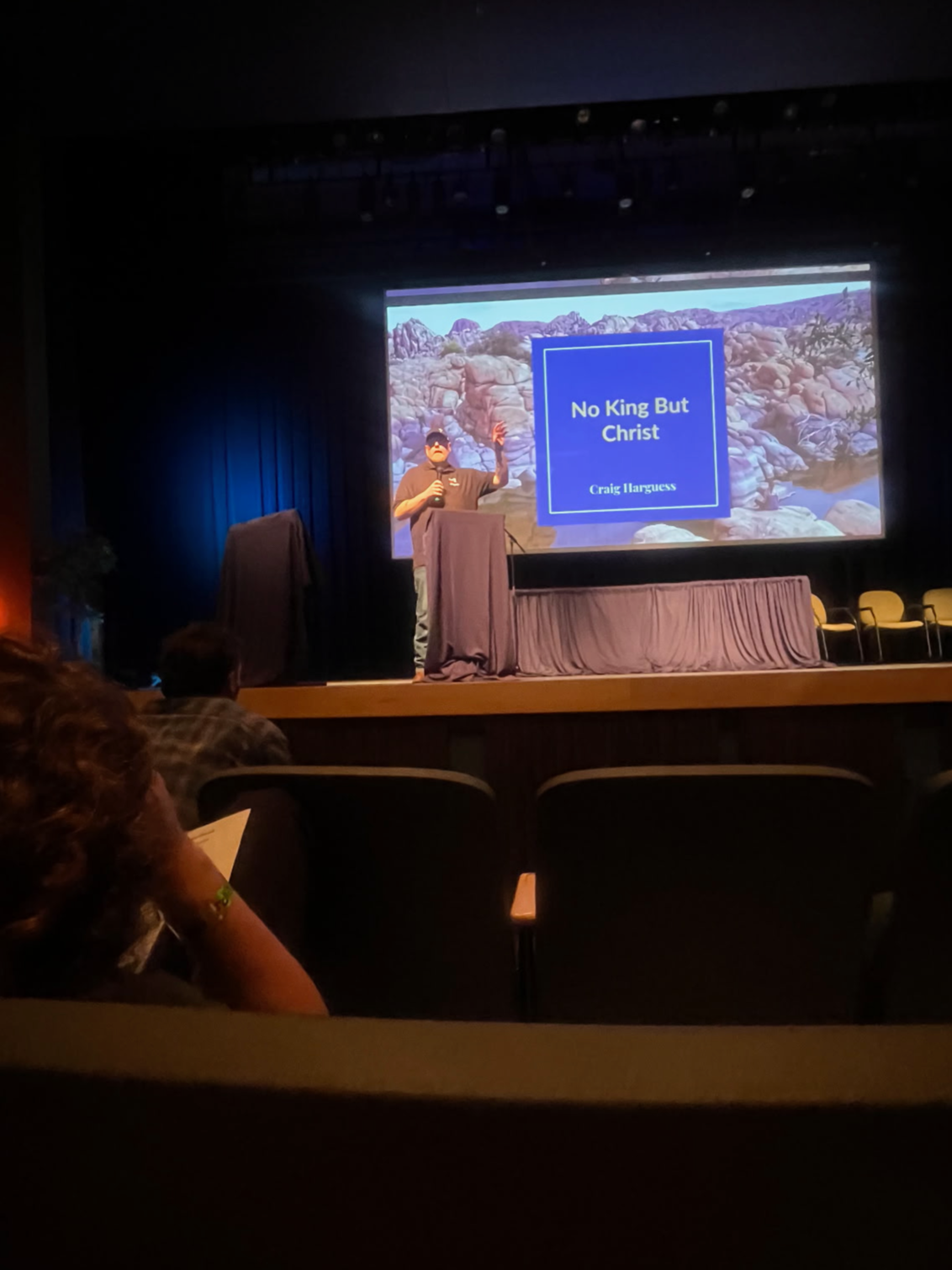
Craig has a name for where he finds himself these days: gray-pilled.
He's been red-pilled. He's been black-pilled. Now he's somewhere in between.
He sees the wars, surveillance, corruption, and people struggling to get by. He sees Christians defending the same government behavior he believes Jesus taught them to reject. And sometimes, after enough of that, it's hard to imagine things getting better.
But he also sees people asking questions they weren't asking before. Challenging authority. Refusing to accept the official explanation. Finding information and sharing it without waiting for permission.
So which is it? Are things getting worse, or are we watching something change?
That's why Craig wanted to talk with Mark Maresca, creator of The White PillBox.
The two met at the Approaching Humanity event in Sedona, Arizona, where Mark's talks left Craig intrigued by an unfamiliar approach to liberty: instead of spending all his time documenting the damage government does, Mark searches for reasons to believe people are becoming freer.
Not blind optimism. Not pretending the problems aren't real.
Mark calls those reasons white pills.
And he has a theory about why they might be more important than we realize.
What if the very system that seems impossible to escape is already losing the one thing it needs to survive, people's belief in its authority?
What Does It Mean to Be White-Pilled?
For someone who has spent years questioning government, staying hopeful isn't always easy. Craig knows that firsthand. He tells Mark how difficult it can be to watch people defend government surveillance, political violence, and policies that harm their neighbors. He wants to see progress, but he isn't willing to overlook what's happening right in front of him.
Mark doesn't ask him to. Instead, he makes a distinction between what he calls black pills and white pills. Black pills tend to be immediate. A war, an abuse of power, a family struggling, another example of government doing something destructive. You can see the consequences right now.
White pills are usually harder to recognize because they're about longer-term change. A growing willingness to question an institution. People becoming more skeptical of political claims. Technology making it harder for anyone to control what information reaches the public. The effects may be subtle. They may not offer relief from today's suffering. And that's exactly why Mark argues that hope needs something more substantial than reassurance.
At one point, Craig brings up his niece's cancer treatment. It's a deeply personal example of the difference between telling someone everything will be okay and giving them a meaningful reason to believe improvement is possible. Mark's point isn't that hope fixes the immediate problem. It's that hope becomes more useful when there's something real behind it.
The Myth of Political Authority
Mark has spent approximately five decades studying voluntaryism and anarcho-capitalist ideas. His work eventually led him toward a question he believes is more fundamental than debates over elections, policies, or individual politicians.
Why do people believe a relatively small group of human beings has the moral right to rule everyone else?
Mark calls that belief the myth of political authority. He argues that governments cannot sustain themselves through force alone. They also depend on people accepting the legitimacy of those who exercise power.
To explain the psychological side, Mark uses an unexpected comparison: Santa Claus. When children believe in Santa, the idea is real to them. Eventually, they stop believing. The decorations, costumes, and stories are still there, but something important has changed.
Mark draws a parallel between that change in belief and the way people understand political authority. He's not suggesting that courthouses, police, weapons, or laws are imaginary. He's asking what makes people accept those institutions as having a special moral authority that ordinary individuals don't possess. And he believes the answer lies in what people have been taught to believe.
That shifts the conversation away from finding a better political leader and toward examining the assumptions that make people want one in the first place.
The Cycle That Keeps the State Alive
Craig is especially interested in a diagram Mark created to explain the relationship between three things: political authority, the state, and propaganda.
Mark describes them as a self-reinforcing cycle. People believe political authority is legitimate, which helps sustain the state. The state then has an incentive to promote messages that reinforce its legitimacy. Those messages, in turn, help preserve the public's belief in political authority. Mark calls it a toxic loop.
What makes the argument interesting is where he believes the loop is vulnerable. You can't simply erase a belief from millions of people's minds. And removing one political leader doesn't necessarily change the system that put that person in power.
Craig points out that even after a revolution removes a government, someone is often left holding the sword. Mark agrees. Changing the person in charge isn't necessarily the same as changing people's relationship to authority.
But what happens if the messages that sustain that belief become less effective? That, Mark argues, is where the real opportunity lies.
The Internet May Be Changing More Than We Realize
For much of his life, Mark watched liberty advocates struggle with the same frustrating problem. They could explain their ideas to people who were interested. But persuading an entire population to become committed anarchists or voluntaryists was never realistic. Most people don't spend their free time studying political philosophy. Mark compares it to a chess club. The members may love chess, but that doesn't mean everyone else will.
Then he asks Craig to imagine something different. What if you didn't need to convince everyone? What if millions of people simply became a little more skeptical of political authority?
Mark thinks the internet is making that possible. He argues that the enormous expansion of available information has weakened the control once held by a relatively small number of institutions. People can encounter competing perspectives, investigate claims, and communicate directly in ways that were much harder before the internet.
From Mark's perspective, that decentralization could gradually weaken the belief that government is uniquely qualified to tell people what to think or how to live.
It's an ambitious theory, and it raises questions of its own. The internet also spreads misinformation, concentrates influence through platforms, and gives governments new opportunities for surveillance. But Mark's claim is worth examining on its own terms.
Could a society become less willing to accept political authority without most of its people ever becoming politically radical? For Mark, that's the white pill.
From COVID to Flock Cameras: Is Public Resistance Changing?
Craig brings the theory into the present. He's been watching opposition to Flock automated license plate readers grow in his community and elsewhere. People are raising questions about surveillance, privacy, accountability, and the use of information collected without their direct consent. He compares that resistance with what he remembers about government messaging during COVID-19.
Mark sees a possible pattern. He argues that institutions are having a harder time maintaining public acceptance of their messages, and that skepticism may be spreading faster than it once did.
The two discuss whether these examples suggest an erosion of confidence in authority. They also explore Mark's interpretation of changes in politics and law enforcement, including his view that diminished respect for political authority may be altering who chooses to enter those professions.
These are Mark's interpretations, not settled measurements of a society-wide trend. But they point toward the larger question Craig keeps returning to. If people are becoming less willing to accept what they're told, what happens next?
Could a Freer Society Arrive Faster Than We Expect?
Toward the end of the conversation, Craig asks whether the changes Mark describes could eventually accelerate. Mark points to the collapse of the Soviet Union as an example of how institutions can appear permanent until conditions change. He believes the erosion of political legitimacy could follow a similar pattern: difficult to recognize at first, then increasingly obvious.
Mark even offers a prediction that within the coming decades, the transition toward a freer society could become unmistakable. And within roughly fifty years, he thinks the world could be fundamentally different. It's a bold forecast, and Mark acknowledges that he's making a prediction.
Craig doesn't pretend to know whether he'll see that future. But the conversation has begun changing how he looks at the present. Military recruitment difficulties, public arguments about surveillance, younger generations encountering information outside traditional media, events he might once have interpreted only as evidence of things going wrong now look different through Mark's framework.
He begins to see why someone might find reasons for hope in developments that initially seem discouraging.
The Tree Is Still Standing
Near the end, Mark shares an analogy he credits to Larken Rose. Imagine a large tree with a cut that has begun the process of bringing it down. Someone standing nearby might look at the tree and conclude that nothing has changed. It's still standing. But the person who made the cut sees something different. The process has already begun, even if the outcome isn't visible yet.
Mark applies that image to his theory about political authority. He believes the underlying conditions for change are already developing. The institutions may still look powerful, but that doesn't necessarily tell us what's happening to the beliefs that sustain them.
Then he offers another thought. People committed to liberty often feel responsible for doing everything they can to bring about change. They spend years arguing, writing, debating, and trying to persuade others. Mark believes it's possible to care deeply about liberty without allowing that work to consume every other part of life. His message is that people can keep doing meaningful work while also making room for the things they love.
Craig began the conversation describing himself as gray-pilled. By the end, he's still aware of everything that troubles him. But he's a little more willing to believe there may be reasons for hope. That doesn't mean Mark's predictions are guaranteed to come true. It means the future may be worth investigating with the same determination we bring to exposing what's wrong today.
Maybe being awake to the problems doesn't require being convinced they'll never change.
About the Guest
Mark Maresca | The White PillBox
Mark Maresca is a longtime advocate of voluntaryist and anarcho-capitalist ideas and the creator of The White PillBox, a podcast and Substack exploring political authority, liberty, and reasons for optimism about the future of a freer society.
His work includes the 23-part Myth of Authority series, which examines his understanding of the psychological foundations of statism.
Craig met Mark at Approaching Humanity, an event in Sedona, Arizona, hosted by Larken Rose.
🤝 Connect with Mark
Mark’s YouTube Video Referenced on the episode:
Explaining my top White Pill: the transition to a free society has started...tangibly & sustainably!
Not left. Not right. Just following Jesus.
Highlights & Takeaways
White-pilling isn't the same as positive thinking. Mark argues that meaningful optimism needs a logical, tangible, or evidence-based reason behind it.
Craig's gray-pill perspective captures the tension. It's possible to recognize genuine suffering and injustice while still searching for signs of progress.
Political authority depends partly on belief. Mark's myth of authority framework examines why people accept government power as legitimate.
Mark describes a self-reinforcing cycle. His model connects political authority, the state, and propaganda.
The internet is central to Mark's optimism. He argues that decentralized access to information may gradually increase skepticism of political authority.
Flock cameras provide a contemporary example. Craig and Mark discuss surveillance and public resistance as possible signs of changing attitudes.
Small changes can have large consequences. Mark believes shifts in public belief could eventually lead to major institutional changes, though the outcome remains uncertain.
Hope and rest can coexist with a commitment to liberty. Mark's falling-tree analogy challenges the idea that people must personally carry the full burden of changing society.
Listen
Pay attention to the difference between Craig's experience of the present and Mark's interpretation of longer-term trends.
Where does Mark offer evidence? Where does he offer a theory? And where does he move into prediction?
Notice whether those distinctions change how persuasive you find his argument.
Reflect
When you look at the world today, what gets your attention first?
The harm you can see immediately, or the changes that might take years to become obvious?
Have you ever dismissed a positive development because it didn't solve the problem you were facing right then?
And how much of your understanding of political authority comes from something you've personally examined rather than something you've always been told?
Read & Explore
For more on Mark's ideas, explore his Myth of Authority series and The White PillBox podcast.
You can also return to the questions Craig and Larken Rose have discussed in earlier Bad Roman episodes about authority, consent, and moral responsibility.
For a complementary biblical perspective, read Matthew 20:25–28, where Jesus contrasts rulers who exercise authority over others with the call to serve.
The passage isn't offered here as proof of Mark's political predictions. It's an invitation to consider the kind of leadership Jesus describes.
Practice
Try a different kind of information audit this week.
As you encounter news or commentary, pay attention to how much of it focuses on what is going wrong.
Then look for one development that might represent genuine progress.
Don't settle for a cheerful headline. Ask what actually happened, what evidence supports it, whether the change is lasting, and who benefits. You may discover a reason for hope. You may discover that the optimistic interpretation doesn't hold up. Either way, you'll be doing something better than simply accepting the story that gets the most attention.
Episode Timestamps
Episode Timestamps
(00:00) Santa Claus and the Myth of Political Authority
The episode's opening analogy
Belief versus the physical machinery of government
What gives political authority its legitimacy
(00:46) Meet Mark Maresca and The White PillBox
Craig and Mark's meeting at Approaching Humanity in Sedona
Fifty years of anarcho-capitalist and voluntaryist thinking
The origins of The White PillBox and Myth of Authority series
(08:06) Why Political Authority Is a Psychological Question
The belief that some people have a moral right to rule others
Consent-based relationships versus political authority
Why changing beliefs may matter more than changing rulers
(12:33) From Black-Pilled to White-Pilled: Finding Real Hope
Craig's self-described gray-pill perspective
Immediate suffering versus long-term positive trends
The difference between wishful thinking and evidence-based optimism
(17:42) The Toxic Loop of Government and Propaganda
Political authority, the state, and propaganda
How each element reinforces the others
Propaganda as the fuel sustaining belief in government legitimacy
(23:40) Why Changing Leaders Doesn't Change the System
Revolutions and the persistence of political authority
The limits of persuading everyone to reject statism
Small increases in skepticism across an entire population
(28:45) Could the Internet Be Weakening Government Power?
Decentralized access to information
Mark's theory of diminishing propaganda influence
The possibility of a gradual transition toward greater freedom
(35:42) Politicians, Police, and the Erosion of Legitimacy
Craig's childhood admiration for Ronald Reagan
Changing incentives for entering politics and law enforcement
Mark's interpretation of declining institutional authority
(41:27) Flock Cameras, COVID, and Public Resistance
Comparing government messaging across different controversies
Privacy concerns surrounding automated license plate readers
Public skepticism and the speed of organized resistance
(48:19) Are We Already Moving Toward a Stateless Society?
The Soviet Union as Mark's example of institutional change
Gradual shifts in belief and sudden political transformations
Mark's predictions for the next ten to fifty years
(52:38) Younger Generations and the Future of Freedom
Growing up with smartphones and decentralized information
Traditional media compared with today's information environment
Everything beyond production costs supports local charities in Memphis, Tennessee.
No King but Jesus.
Related Episodes


Related Blog Post