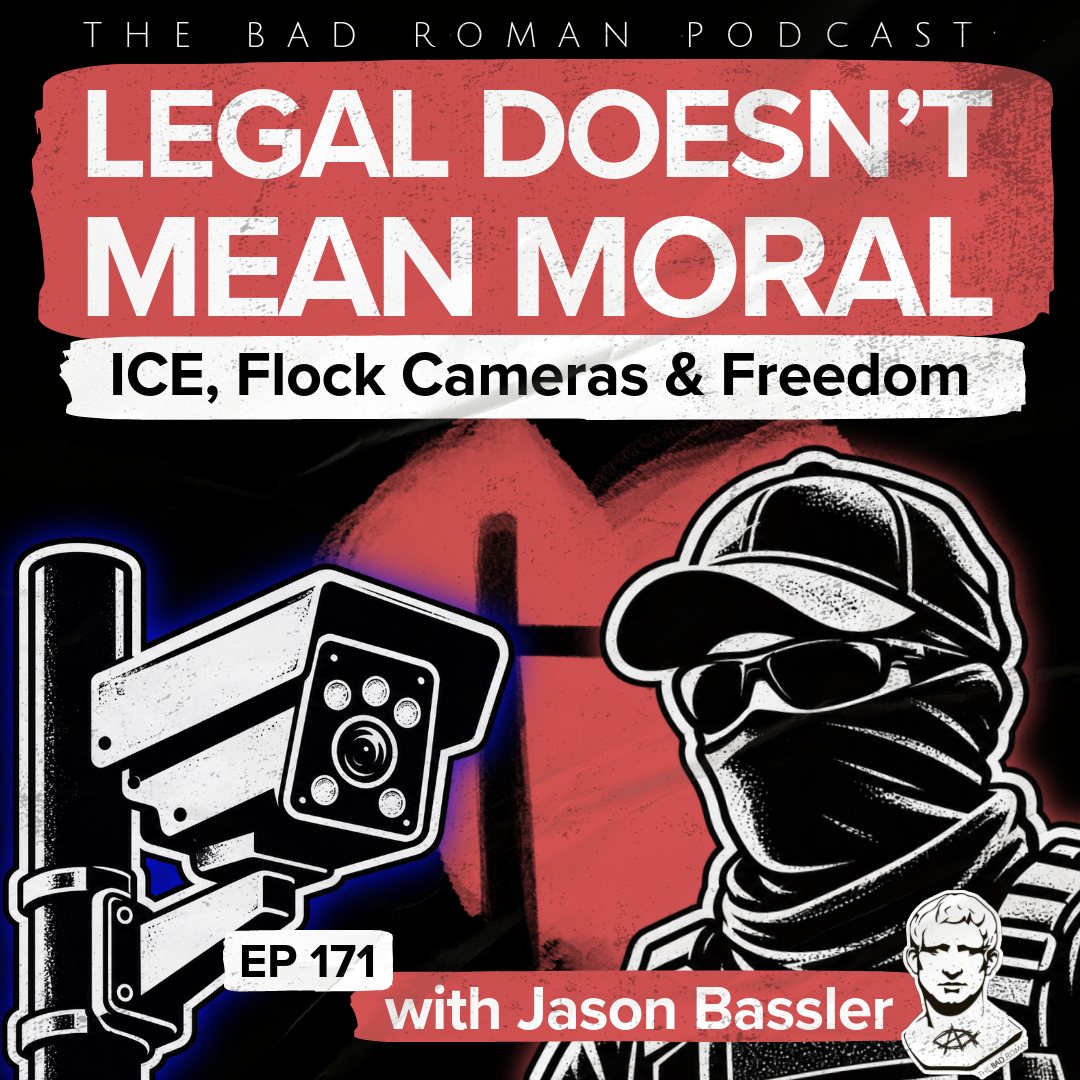
There is a moment about eight minutes into this conversation when Craig is trying to remember George Floyd’s name.
The name comes back, and so does the reason he was trying to remember it.
Craig used to be a “back the blue” guy. When someone was hurt or killed by police, he could reach for the explanation a lot of people still use now:
“If they would’ve just obeyed.”
He says it never sat completely right with him, but George Floyd was the moment when that answer stopped working.
“I can’t defend this all the time anymore,” Craig remembers thinking.
That history hangs over the rest of this episode with Jason Bassler, co-founder of The Free Thought Project. Because now Craig hears a similar argument being made about ICE.
They broke the law.
They should have complied.
The agents are keeping us safe.
Craig and Jason spend the first half of the episode pushing on where that reasoning leads when the people enforcing the law are masked, heavily armed, increasingly difficult to identify, and backed by a federal government with extraordinary power over the person standing in front of them.
Then, about halfway through, Craig changes the subject.
Sort of.
He starts talking about cameras.
The Mask Is the Point
The episode opens with a preview from later in the conversation.
Jason is talking about masked federal agents and the strange reversal they create.
The citizen can be stopped. Detained. Handcuffed. Transported. Required to identify themselves.
The person doing all of that on behalf of the government may remain anonymous.
Jason puts it this way:
“The more coercive power the state possesses, the more visible and accountable the person exercising it should be.”
He also acknowledges the obvious argument on the other side. Agents may be worried about being identified, threatened, doxxed, or having their families targeted.
That concern does not disappear just because someone works for the government.
But neither does the problem Jason is pointing to.
If someone has the legal authority to put you in handcuffs, how much anonymity should come with that authority?
And if something goes wrong, who exactly are you supposed to hold accountable?
Craig is much less sympathetic to the masks than Jason is. To him, scrutiny comes with choosing a job that gives you coercive power over other people.
That argument leads naturally into body cameras, and then into something that sounds like it belongs in dystopian fiction but does not: electrically shocking gloves being acquired for immigration enforcement.
Jason and Craig talk about the language surrounding them, particularly the idea that they are a “de-escalation” tool, and compare that promise with what happened after Tasers became common in policing.
A tool arrives as an alternative to something worse.
Then it becomes normal.
Then it gets used for things that would never have justified introducing it in the first place.
That possibility (mission creep) keeps showing up throughout the episode.
Not only with weapons.
With power itself.
Jason asks the people who support these powers under the current administration to imagine them surviving into the next one.
Trump will leave office.
ICE will still exist.
The surveillance infrastructure will still exist.
The authorities that people defend today do not vanish when their preferred president does.
Craig’s description is simpler: The Leviathan keeps growing.
“Is Legality Morality?”
Eventually the immigration conversation gets stripped down to four words.
Jason asks: “Is legality morality?”
That question does more work than arguing over immigration statistics for another hour.
A person can violate an immigration law.
That tells you something about their legal status.
It does not tell you everything about how another human being should treat them.
Jason says the debate has become so partisan that it is increasingly easy to lose “the human element.”
Craig takes that thought somewhere explicitly Christian.
He says he chooses to look at these questions through the teachings of Jesus because that is where he has placed his allegiance.
For him, that makes one fact impossible to erase with a political label:
The person being detained is still made in the image of God.
The person in handcuffs is still made in the image of God.
Even the person you believe entered the country illegally is still made in the image of God.
Craig is not especially gentle about this part of the conversation.
He tells Christians who celebrate people being harmed or killed to go back and read the red words of the Bible. It moves the argument away from, “Which immigration policy is correct?” and toward something harder to outsource to a politician:
What does your allegiance to Jesus require you to see in the person standing on the other side of the issue?
Then Craig Started Seeing Flock Cameras Everywhere
Craig’s interest in Flock is recent. He had heard people talking about the cameras without paying much attention. Then he started noticing them around town.
Once he knew what he was looking for, they seemed to be everywhere.
That led him into an argument in a local Facebook group, where someone gave him a version of an argument many people make when surveillance comes up:
You already carry a smartphone.
You probably use apps that collect your location.
Maybe you have a Ring camera on your house.
So why suddenly care about a camera reading license plates on a public road?
Jason answer is not that phones are private, rather the distinction is control.
He can chose to own the phone. He can turn it off. He can disable location services. He can leave it at home.
He did not choose the roadside camera.
That still does not settle the Flock debate. Cities do not hold a referendum every time they install a piece of public infrastructure.
But it gets closer to what actually bothers Jason.
It is not simply that a camera can see a license plate that was already visible from the road.
It is what happens after the camera sees it.
Where were you yesterday?
Where were you last week?
Which cameras saw your vehicle?
Can those observations be searched together?
Who gets access?
How long does the information remain useful?
Craig describes noticing one near his own neighborhood and realizing nobody had ever asked him what he thought about that system being there.
That discovery seems to have bothered him almost as much as the technology itself.
The cameras had become ordinary before he had really noticed them.
Safety Keeps Showing Up
This is where the two halves of the episode meet.
Both ICE and Flock are defended in the name of safety.
Let’s look at the facts: Governments really do investigate crimes. Police really do recover stolen vehicles. Immigration policy raises real questions that do not disappear because enforcement can be abusive.
The more interesting problem is what the word safety can make people stop asking.
Jason sees it as one of the easiest ways to normalize new authority.
First you establish the threat. Then you introduce the tool. Then questioning the tool begins to sound like questioning whether the threat matters.
Craig and Jason do not buy that logic.
You can want stolen vehicles recovered and still ask how a surveillance network operates.
You can believe a country may enforce immigration laws and still ask what agents should be allowed to do to another human being.
You can want officers to be safe and still ask whether officers exercising extraordinary power should be identifiable.
Those things can exist in the same thought.
The key is refusing to stop thinking once someone says, “This keeps you safe.”
Craig Invents the Gray Pill
For an episode that spends this much time on ICE, surveillance, Tasers, shock gloves, data collection, police encounters, and political power, it ends in a surprisingly hopeful place.
The Free Thought Project often tries to end difficult episodes with a “white pill,” something that gives people a reason not to surrender to despair after spending an hour looking at ugly things.
Craig says he struggles with that, and some days he feels black-pilled.
Then he sees people pushing back against something, asking better questions, showing up at city council meetings, or refusing to accept an explanation that used to work. And thinks maybe things are getting better.
So Craig decides he is something else.
A gray pill.
A little black.
A little white.
Aware of how bad things can get without concluding that nothing can change.
Jason likes it.
He is particularly hopeful about younger people, not because he thinks they have everything figured out, but because they grew up knowing how to find information that previous generations often depended on institutions to provide.
Jason’s generation came of age in what gets called the information age.
His hope is that the next one turns all of that information into something else:
an age of accountability.
Not another revolution.
He uses a different word.
Evolution.
Keep exposing things.
Keep asking questions.
Keep putting information somewhere people can find it.
Plant ideas even when it seems like nobody is listening.
Craig has his own name for those people who are listening quietly.
The remnant.
People who may never comment.
They may not argue online.
They may never start a podcast.
But something they hear today may make an old answer stop working tomorrow.
Craig knows that can happen.
It happened to him.
🤝 Connect with Jason Bassler
Highlights & Take Aways:
Jason argues that the more coercive power the government gives someone, the more visible and accountable that person should be, not less.
Powers created under a politician you trust do not disappear when someone you distrust takes office.
Body cameras may increase accountability; new enforcement tools like shock gloves also raise the question of how quickly an exceptional tool can become an ordinary one.
“Is legality morality?” becomes the simplest question in the immigration discussion. Breaking a law and determining how a human being should be treated are not the same decision.
Political and legal labels do not erase the image of God in another person.
A smartphone and a roadside surveillance camera can both collect information, but the distinction in choice: one can be turned off, location services disable, or leave it behind, the other can not.
Being visible in public is not necessarily the same thing as having your movements recorded, stored, combined, and made searchable later.
“Nothing to hide” does not answer who should have access to surveillance data, how it can be used, or what happens when the information is wrong.
“Gray pill” is an attempt to reject both denial and despair: acknowledge what is going wrong without becoming convinced that nothing can change.
Can the information age can become an age of accountability, not through another political revolution, but by people continuing to document, question, learn, and pass those ideas forward?
Listen
For the places where the same argument reappears in different clothes.
“They should have obeyed.”
“The agents need to be protected.”
“If you have nothing to hide, why do you care?”
“You already carry a smartphone.”
Craig and Jason are talking about very different technologies and situations, but much of the episode turns on what happens when the promise of safety becomes the point where questioning authority is supposed to stop.
Reflect
Would you support the same government power if someone you deeply distrusted controlled it?
When you hear that something is legal, how much moral work does that fact do for you?
And when a political label (illegal immigrant, criminal, protester, cop, federal agent) appears first, how easily does the human being underneath it disappear?
Read
Read Genesis 1:26–27 alongside Craig’s insistence that the person being detained remains made in the image of God.
Then read Matthew 5:43–48 and consider whether Jesus leaves Christians room to reserve concern for human dignity only for people they believe deserve it.
For the surveillance side of the conversation, read the Supreme Court’s Chatrie v. United States decision. The case concerns government access to Google location-history data rather than Flock cameras specifically, but it raises a related question about what changes when individual pieces of location information can be gathered together and searched.
Practice
The next time someone defends a government power because it is being used for a purpose you support, change one variable:
Give that same power to someone you do not trust.
Would you still want them to have it?
Then look locally.
If your community uses automatic license plate readers or similar surveillance technology, find the actual policy rather than relying on what supporters or critics say about it.
Who can search the system?
What gets stored?
How long is it kept?
Who else can access it?
You do not have to know your conclusion before you start asking questions.
Episode Timestamps
(00:00) Preview: Power & Accountability
coercive government power
masked agents
why greater authority should mean greater accountability
(00:38) ICE, Flock & the Surveillance State
Craig sets up the episode
ICE and Flock as connected questions about power
what happens when authority grows faster than accountability
(01:06) Jason Bassler Returns
nearly three years since Jason’s first Bad Roman appearance
The Free Thought Project
where the conversation is headed
(08:00) Craig’s “Back the Blue” Turning Point
“they should have just obeyed”
George Floyd
when Craig could no longer automatically defend police actions
(17:30) Why the Masks Matter
anonymous federal agents
identifying citizens while concealing government identities
safety for agents versus accountability to the public
(18:57) What Happens When Power Changes Hands?
authorities that survive presidential administrations
would you trust the same power under someone you oppose?
the Leviathan keeps growing
(20:37) Body Cameras, Shock Gloves & Mission Creep
body cameras as a possible accountability measure
electric shock gloves
how extraordinary tools can become ordinary enforcement
(26:23) “Is Legality Morality?”
immigration and the human element
whether breaking a law settles the moral question
what political labels can make us stop seeing
(29:35) Craig Brings It Back to Jesus
allegiance to Jesus
the image of God
what Christians should see before the political label
(31:09) From ICE to Flock Cameras
the police state and the surveillance state
Craig starts noticing cameras around his own town
a local Facebook argument over surveillance
(34:32) Phones, Consent & Location Privacy
choosing to carry a smartphone
turning location services off
what makes roadside surveillance different
(40:00) “Nothing to Hide”
“nothing to hide, nothing to fear”
public resistance to surveillance
who should have to justify expanded monitoring
(41:09) False Alerts & Real Consequences
automatic license-plate reads
inaccurate alerts
what can happen when bad data enters a police encounter
(48:23) The Gray Pill
black pill versus white pill
Craig finds a third category
seeing real problems without surrendering to despair
(55:10) From Information to Accountability
younger generations and institutional skepticism
the information age
Jason’s hope for an age of accountability
(57:50) Planting Seeds for the Remnant
podcasts, articles, and ideas that remain after us
the quiet people who are still listening
knowing information versus knowing how to find it
Everything beyond production costs supports local charities in Memphis, Tennessee.
No King but Jesus.
Related Episodes


Related Blog Post