Should Christians care about privacy?
That question may sound strange at first. After all, if our Kingdom is not of this world, why worry about cameras on poles, license plate readers, data brokers, or government contracts? But then we remember something important: Jesus did not teach us to ignore our neighbors. He taught us to love them.
And love does not shrug when people are watched, scored, tracked, sorted, and controlled.
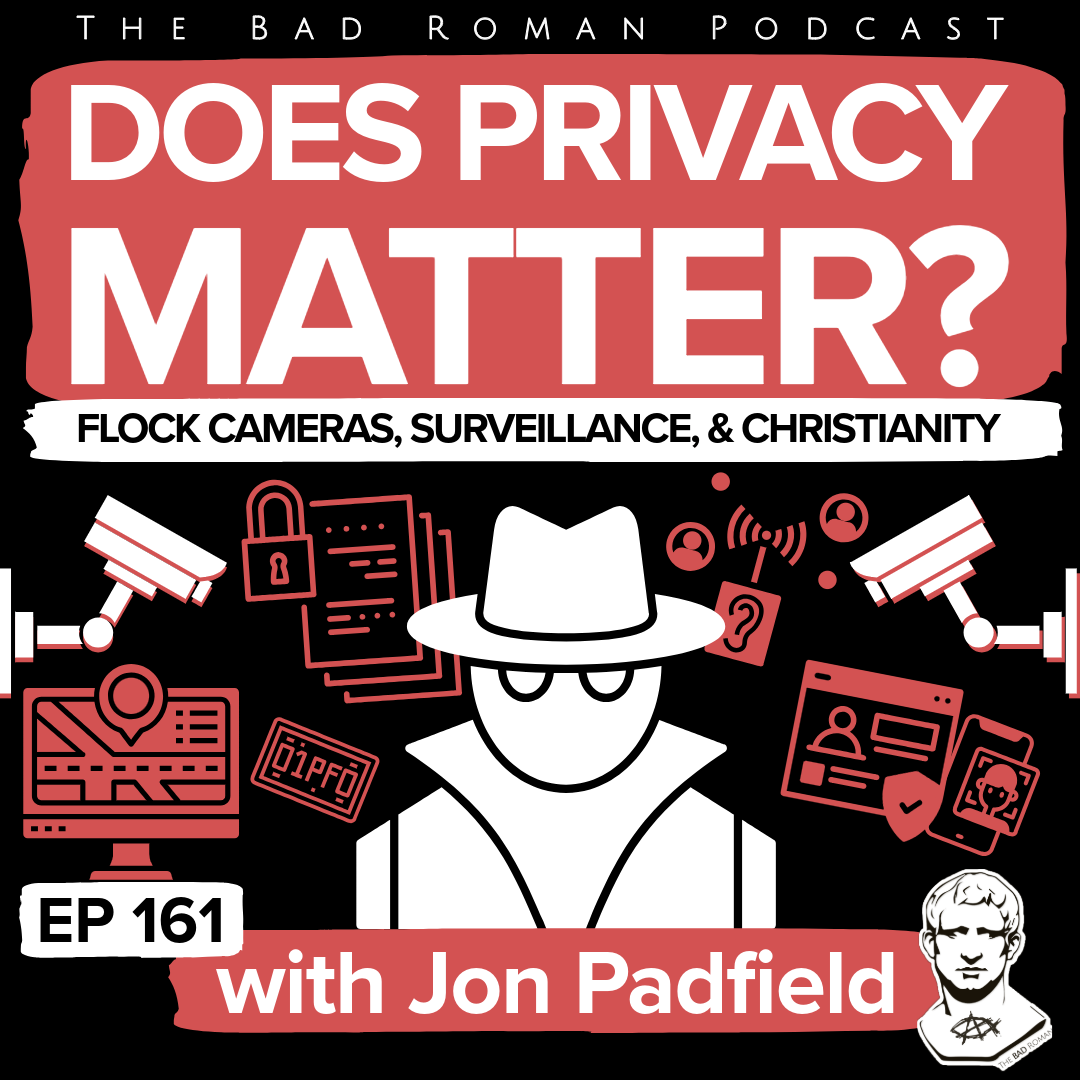
In this episode of The Bad Roman Podcast, Craig sits down with Jon Padfield, host of Business Reform, former Indiana state representative, engineer, professor, and privacy advocate. Jon brings a rare mix of tech knowledge, public policy experience, business insight, and Christian faith. His concern is simple: surveillance changes people. It makes them afraid to speak. It trains them to live like suspects.
As Jon says early in the conversation,
“When people know they’re being surveilled, it affects the way that people behave” (03:00).
That is not just a tech issue. That is a discipleship issue.
The Lie Behind “Nothing to Hide”
Most of us have heard it before: If you’re not doing anything wrong, why do you care who’s watching?
It sounds reasonable until you slow down. Who decides what “wrong” means? The same government that shut churches while calling other places “essential”? The same system that changes rules, shifts targets, and punishes people based on whatever fear is popular that week?
Jon calls that line a fallacy. It assumes guilt. It says if you want privacy, you must be hiding sin. But privacy is not guilt. Privacy is part of human dignity.
Jon gives a better answer he heard on the road:
“Who gave you the right to decide if you’re doing anything wrong?” (18:00).
That question cuts through the fog. Caesar always says he is only watching bad people. But Caesar also loves changing the definition of “bad.”
From Flock Safety to Flock Surveillance
Flock Safety is best known for license plate readers. Jon calls them “Flock Surveillance,” and he says their patent points to something bigger than simple traffic cameras: a “dynamic surveillance network” (06:00).
That matters because this is not only about stolen cars. Jon explains that Flock’s system can take in video from many sources: license plate readers, dash cams, doorbell cameras, police body cams, parking lot cameras, and other third-party cameras. The goal is not just to see one car. It is to catalog movement.
“Flock is tracking everybody doing everything, not just license plates,” Jon warns around the 11-minute mark.
That is the part that should make Christians pause. A society built on constant watching is not a society built on trust. It is a society built on suspicion.
When Safety Becomes a Sales Pitch
Nobody sells surveillance by saying, “We want to control you.” They sell it with fear.
What about stolen cars? What about a kidnapped child? What about danger in your neighborhood?
Those are real fears. Craig does not dismiss them. Living near Memphis, he knows crime is not imaginary. But the question is not whether evil exists. The question is whether we should hand more power to the same institutions that already abuse power.
Jon points out that many camera searches are logged under the vague word “investigation” (24:20). That can mean almost anything. And when audit logs showed an officer using Flock information to provide data to ICE, Jon says the system changed from a free-form reason field to a pull-down menu. In other words, the problem did not go away. The paper trail got cleaner.
That is empire logic: not repentance, just better optics.
The Daycare Question
One of the most disturbing parts of the conversation comes when Jon talks about a daycare in Dunwoody, Georgia. According to Jon, a concerned father used public records to review audit logs and found Flock employees accessing cameras inside the daycare during the day, including cameras over the pool and gymnastics area.
Jon’s response is sharp and needed: if little girls at daycare are not doing anything wrong, why should anyone care who is watching them?
That question exposes the sickness of the “nothing to hide” argument. We know children deserve protection. We know watching people without cause is not harmless. So why do we forget that when the state points the camera at everyone else?
Consent Without Knowledge Is Not Consent
Craig and Jon spend time talking about consent. Cities and counties often install cameras without real public debate. People find out after the system is already in place. Then officials act like silence means approval.
Jon puts it plainly:
“If you’re doing it without my knowledge, you are doing it without my consent” (49:00).
That line belongs on a shirt.
For Christians, consent matters because love does not force itself on people. Jesus invites. Caesar imposes. Jesus knocks at the door. Caesar installs a camera over it.
Christians, Voting, and Different Paths of Resistance
Craig brings the conversation back to a familiar Bad Roman tension: what should Christians do when they no longer consent to the government through voting?
Jon and Craig do not land in the exact same place. Jon still believes Christians should engage the political process. Craig explains why many Christian anarchists and voluntarists have stepped away from voting, especially when voting empowers rulers who can tax, spy, cage, and kill.
But the beauty of this exchange is that it never becomes a cable-news food fight. Jon says,
“You’re my brother in Christ. You’re not the enemy” (1:02:54).
That is how Christians should disagree. Not by trying to own each other. Not by forming new tribes. But by asking: how do we resist evil without becoming what we resist?
Craig’s answer leans toward removing consent, speaking truth, making podcasts, writing, building community, and refusing to crown another king. Jon’s answer leans toward public pressure, state-level limits, data retention laws, and legal accountability.
Both agree on the danger. Both agree the machine is real.
Practical Resistance Without Panic
This episode is not hopeless. Jon shares that cities and counties have canceled Flock contracts after citizens spoke up at meetings. He also talks about working with a state representative on language to restrict Flock statewide.
That does not mean the beast is tame. It means people are not powerless.
For those who do not vote, there are still ways to act: talk to neighbors, show up at meetings, request public records, share information, map cameras, support privacy advocates, and teach people how surveillance works. Christians do not need to worship the government to confront it.
We can be faithful without being frantic.
No King but Christ in a Watched World
The early church lived under empire, too. Rome had its own tools of control: soldiers, taxes, informants, prisons, crosses. Today’s empire has cameras, databases, data brokers, drones, and algorithms.
The tools changed. The temptation did not.
Will we trade freedom for safety? Will we cheer surveillance when it targets people we fear? Will we trust Caesar to define “good” and “bad”? Or will we remember that our King sees all things already, and unlike the government, He uses His power to heal, restore, and save?
Privacy is not about hiding sin. It is about resisting a world where every neighbor is treated like a suspect.
Sometimes being a good Christian means refusing to be a well-tracked Roman.
🤝Connect with Jon Padfield🤝
YouTube: Business Reform
Privacy tool mentioned: DeFlock Me
TikTok: businessreform
Topics Jon covers: business, technology, society, privacy, surveillance, public policy, and faith
Highlights & Takeaways
“Nothing to hide” is not a Christian argument; it assumes guilt and gives Caesar too much power.
Flock cameras are not just about stolen cars; Jon warns they are part of a larger surveillance network.
Safety language can hide control, especially when searches are logged under vague terms like “investigation.”
Consent matters. If cameras are installed without public knowledge, the public did not truly consent.
Christians can disagree on voting and still work together against surveillance, coercion, and state overreach.
Privacy protects human dignity, neighbor-love, and the courage to speak truth.
Local action can work: public pressure has helped some communities cancel Flock contracts.
“No King but Christ” means refusing to trust empire with powers only God should hold.
Listen & Reflect
Listen
Listen for the way Jon connects technology, public policy, business, and faith. Ask yourself where surveillance has already become normal in your own town.
Reflect
Where have you accepted “safety” language without asking who gains power from it? Have you ever used the phrase “nothing to hide” without thinking about who gets to define guilt?
Read
Read Matthew 10:16–31 and Psalm 146. Sit with Jesus’ call to be wise, fearless, and loyal to God above rulers.
Practice
Look up whether your city or county uses Flock cameras. Talk with one neighbor about privacy, consent, and what it means to love people without treating them like suspects.
Episode Timestamps
(00:00) Should Christians care about privacy?
Surveillance state concerns
Following Christ, not the government
(01:23) Meet Jon Padfield
Engineering, public policy, and business background
Faith and technology
(03:00) Surveillance changes behavior
Reputation scores and monitoring
Fear of speaking up
“Stained Glass Masquerade” connection
(05:25) The “nothing to hide” fallacy
Assumption of guilt
Privacy as dignity
Christians and concern for surveillance
(06:00) What Flock cameras are
(09:30) Beyond license plates
Dash cams, doorbells, body cams
AI cataloging movement
Facial and vehicle recognition
(12:00) Daycare camera concerns
Pool and gymnastics area cameras
Children and the privacy question
(17:54) Who decides what is wrong?
Better answer to “nothing to hide”
Lockdown memory
State power defining guilt
(20:37) Local, state, and federal use
Memphis and Fayette County examples
ICE and local law enforcement sharing
(22:30) Who owns the data?
Agency ownership claims
(24:20) “Investigation” as a search reason
Vague police search labels
ICE audit log example
Pull-down menus replacing written reasons
(27:08) Pushback and privacy laws
Thomas Massie and Lauren Boebert bill
Warrant requirements and Fourth Amendment concerns
(28:15) Local wins against Flock
Public pressure at meetings
State-level restriction efforts
(31:00) Federal privacy law concerns
Stronger state protections
California and Illinois examples
Private right of action
(34:21) Data brokers and insurance companies
Privacy policies as invasion policies
Sensitive personal data
Browsing, purchase, and search history
(41:30) How cameras appear without debate
Local implementation questions
Complacency and compliance
Safety versus privacy
(45:56) Consent and government power
Declaration of Independence language
Consent of the governed
Knowledge as part of consent
(49:30) The four boxes
Soapbox
Ballot box
Jury box
Ammo box warning
(52:32) Christian resistance and voting
Craig’s Christian anarchist position
Early church and empire
Removing consent from rulers
(55:00) Jon’s case for engagement
Christians in public office
Not ceding ground
Different paths, shared concerns
(1:02:54) Brothers, not enemies
Agreement on the goal
Different strategies
Privacy advocacy and Christian unity
(1:04:00) Pragmatic limits on surveillance
Data retention policies
Warrants and targeted searches
Higher chance of passing restrictions
(1:07:00) Safety arguments
Kidnapped child scenarios
Stolen vehicle concerns
Cost of “a little privacy”
(1:28:00) Where to find Jon
Business Reform on YouTube
Patreon community
Future conversation invitation
(1:29:13) Closing and support
If this conversation helped you rethink privacy, surveillance, and Christian faithfulness, share it with someone who still says, “If you have nothing to hide, why worry?”
Look up the cameras in your town. Ask questions. Talk to neighbors. Read the Gospels. And remember: our hope is not in better surveillance, better rulers, or better empire management.
No King but Christ
Related Episodes


Related Blog Post

