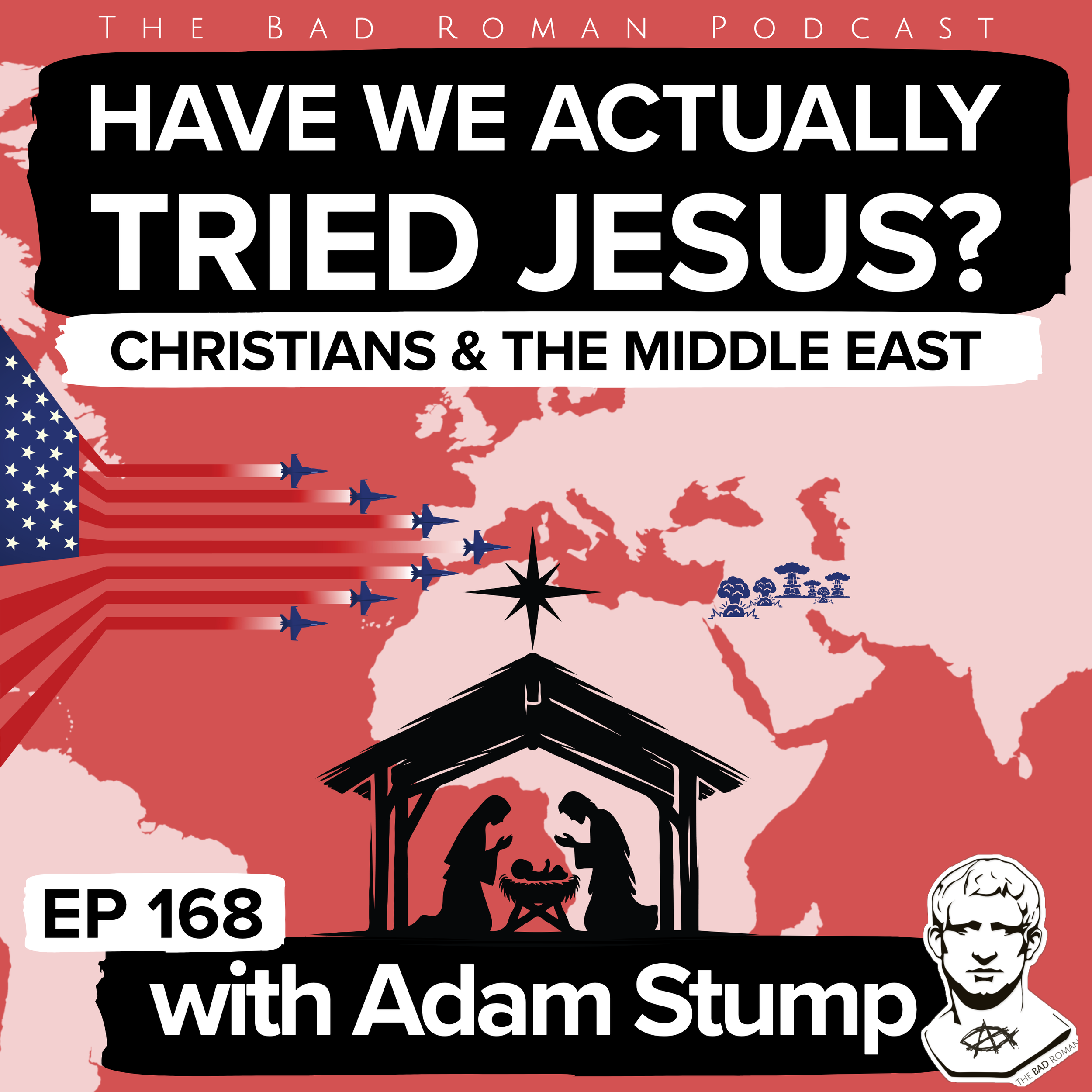
Adam Stump asked two congregations a pretty simple question.
Did they know there are Christians in Iran?
Not one hand went up.
Then he pushed a little further. Did they know some Christian communities in Iran have existed there for centuries? Did they know Christians live across the Middle East, including places Americans mostly hear about through war reports?
Again, almost nobody knew.
That little church pop quiz gets to the heart of this episode. What happens when Christians in America know more about the governments we are told to fear than the people who actually live under them?
And what happens when some of those people are our brothers and sisters in Christ?
Adam is a pastor with a background in sociology, anthropology, history, archaeology, and a long list of ordinary jobs before full-time ministry.
He also calls himself a “professional gadfly,” he likes asking questions that make comfortable answers harder to hold.
The People Missing From Our Map
For Adam, this did not begin as an academic interest in Middle Eastern history.
His wife started drawing his attention to Iranian Christians in the United States who were facing detention and possible deportation. Adam began reading. Then he began meeting people. He traveled to Washington, D.C., connected with an Iranian pastor and people from World Relief, and started paying closer attention to Christians whose stories rarely made it into his own church world.
What began as information became personal.
“That’s really where it all began with me… this chunk of human suffering that I had not previously been aware of.” — Adam Stump (14:43)
That sentence is uncomfortable because most of us have our own version of it.
There are people suffering right now whom we barely know exist.
It is easy to turn Iran into a word on a map. It becomes a government, a military target, a headline, or an “enemy.” Real people disappear inside the label.
World Relief has documented the struggle of Iranian Christians who fled religious persecution only to face immigration detention in the United States. World Relief — Iranian Christians, asylum, and detention
Once people have names and faces, foreign policy gets harder to discuss like a football game.
Christianity in Iran Is More Complicated Than We Think
Craig admits early in the conversation that he knew very little about Christianity in Iran.
That is probably true for a lot of us.
Adam explains that Iran contains old Armenian and Assyrian Christian communities as well as converts from Islam who often worship in much more dangerous conditions. Some historic Christian communities have a recognized place in Iranian society. Converts meeting in Farsi-speaking house churches can face a very different reality.
That means even the phrase “Christians in Iran” covers several different stories.
It also means the Middle East cannot be reduced to “Muslims over there.”
Christians, Jews, Muslims, and many other communities have shared those lands for centuries. Their history includes terrible persecution, but also ordinary seasons of living beside one another.
Adam makes a point that should be obvious but often is not: an entire country cannot be treated like one person.
Iran is not ninety million copies of its government.
Neither is America.
Can You Liberate Someone With a Bomb?
This is where the conversation turns from ignorance to power.
What happens when the United States says it wants to “liberate” people in another country through military force?
If Christians are already trying to survive quietly in a hostile environment, does bombing their country make them safer? Or can military action by a nation widely identified with Christianity make local Christians look like agents of the enemy?
The question is not whether the Iranian government deserves criticism. Both Craig and Adam are clear that defending human beings in Iran is not the same thing as defending the Iranian state.
The deeper issue is the strange phrase we have heard for decades: bombing for peace.
Adam offers a much simpler alternative.
“We have tried bombs and bullets and it doesn’t work. Why don’t we try love?” — Adam Stump (28:55–29:05)
It almost sounds too simple.
Then again, so does “love your enemies.”
Have We Actually Tried Jesus?
Craig hears Adam say “try love” and asks the question that eventually became the title of the episode:
“Have we actually tried Jesus when it comes to this stuff?” — Craig Harguess (32:12–32:25)
That deserves more than a quick answer.
Christians have tried political parties. We have tried presidents. We have tried military strength. We have tried Christian nations. We have tried laws, campaigns, coalitions, and the promise that the next ruler will finally put things back in order.
Have we tried Jesus?
Not Jesus as a mascot for the state.
Jesus as the man who told Peter to put away his sword.
Jesus as the King who told us to love our enemies and pray for people who persecute us.
Jesus as the Lord of a Kingdom that crosses borders without asking Caesar for permission.
Adam puts it this way:
“Christians ought to be kingdom people before they are… citizens of any country.” — Adam Stump (28:05–28:10)
That does not mean Christians stop caring about the world.
It means we stop letting the state decide whom we are allowed to love.
Because once we know there are Christians, human beings, beneath the bombs, we have to wrestle with Faith.
Once we know the person called an enemy is a mother, pastor, child, Muslim neighbor, or fellow believer, clean political categories start getting messy.
But, life is messy and Jesus calls us to follow him through it with love not fear.
When Politics Uses the Church
Adam calls himself a “recovering Republican.”
He is careful about what he means. He is not saying every conservative idea suddenly became evil. He is talking about the party structure itself and the way political movements can turn religion into a weapon.
“Our political parties in America have really used religion as a weapon… to increase political division rather than increasing unity.” — Adam Stump (45:10–45:30)
Christian nationalism tells us the nation needs Christianity in order to become strong. Jesus seems much more interested in whether Christians are faithful.
Those are not the same goal. A powerful nation can have weak disciples. A politically weak church can still love enemies, feed hungry people, forgive persecutors, welcome strangers, and refuse to kill.
No King but Christ means the church does not need Caesar to make Jesus Lord. He already is.
Constantine's Trade
Eventually Adam reaches back nearly seventeen centuries.
His judgment is strong: one of the worst things to happen to Christianity was Constantine and the rise of Christendom.
Before Christianity gained imperial favor, Christians lived for centuries without controlling Rome. They were sometimes tolerated and sometimes persecuted. They did not have the machinery of empire available to enforce the faith.
Then Christianity gained political power.
Adam argues that something was lost in the trade.
“Even though it grew in political and earthly power, the spiritual power waned.” — Adam Stump (55:48–55:55)
That is worth sitting with. What if political strength and spiritual strength are not the same thing?
What if they can even move in opposite directions?
The church may gain access to rulers and still lose sight of Jesus. It may win a culture war and forget how to love the people on the other side. Empire always offers the church something shiny. Jesus keeps handing us a cross.
People Are Made to Love and Be Loved
One of Adam’s clearest statements comes as the conversation turns back to the people we call enemies.
He does not pretend governments are harmless. He does not pretend violence and injustice are imaginary.
He simply refuses to let those things erase the humanity of ordinary people.
“Those people are all people created in the image of God, and they are actually created to love and be loved.” — Adam Stump (51:40–51:55)
That changes the starting point. We do not begin with, “What does America need from these people?” We begin with, “How does God see them?”
That is harder than nationalism because nationalism gives us categories. Friend. Enemy. Ally. Threat. Citizen. Foreigner. Jesus keeps turning categories back into people.
Get Out of the Bubble
Adam's final advice is refreshingly ordinary: meet somebody.
Talk to Muslims instead of only talking about Muslims. Visit an international grocery store. Meet someone from another country. Ask questions. Listen to how America looks from outside America.
Adam says that when he sees someone attacking Muslims online, he often asks one question:
How many Muslims do you actually know? The answer usually is silence.
His own shift began decades ago when he met Muslim classmates and became their friend. Real relationships made it harder to accept opinions that had simply been handed to him.
And learning cannot stop at “now I know more facts.” It has to change how we live. Adam urges listeners to use whatever influence they have to speak for people who are easier for society to ignore. But he also warns against becoming so angry that nobody can hear us.
“I think that we’re gonna change this thing through relationships.” — Adam Stump (1:10:50–1:11:00)
Maybe changing the world looks less like taking control and more like opening a table. Listening. Learning a name. Refusing to call millions of strangers our enemies. And then trying the strange, difficult thing Jesus told us to do all along: Love them.
Connect with Adam Stump
Linktree: https://linktr.ee/Pastor.Adam.Stump
Substack: https://pastoradamstump.substack.com/
Instagram: https://instagram.com/pastor_adam_stump/
TikTok: @pastor.adam.stump
Facebook: https://facebook.com/p/Pastor-Adam-Stump-100095132295636/
YouTube: https://www.youtube.com/@PastorAdamStump
Email: adam.joseph.stump@gmail.com
Western Pennsylvania UMC Profile: https://wpaumc.org/clergydetail/479051
Central Highlands UMC: https://wpaumc.org/churchdetail/218250
Highlights & Takeaways
The Middle East is not one religious block; ancient Christian communities are still part of the region
Meeting real people can break political categories that survive easily from a distance
Christian nationalism confuses the worldwide Kingdom of God with the interests of one nation
“Bombing for peace” deserves special scrutiny from people commanded to love their enemies
Political power and spiritual power are not the same thing
The church does not need state power to make Jesus King
People called “enemies” remain image-bearers created to love and be loved
Lasting change usually grows through relationships, listening, and honest questions rather than coercion
Listen
Pay attention to Adam’s church pop quiz and the silence that follows. Notice what happens when a political category like “Iran” turns back into real Christians, Muslims, families, pastors, and children.
Reflect
Who have you learned to think of mainly as an enemy? If you knew that person face to face, what might become harder to say about them?
Read
Read Matthew 5:38–48, John 17:20–23, and John 18:10–11. Sit with Jesus’ commands about enemies, unity, and Peter’s sword.
For a current look at Iranian Christians facing asylum and detention questions in the United States, read World Relief’s reporting on the issue. World Relief — From the Pulpit to the Capitol
Practice
This week, talk with someone whose culture, religion, or national background is different from yours. Do not begin with a debate. Ask about their life. Listen long enough to learn something you did not already know.
Episode Timestamps
(00:00) Meet Adam Stump
West Virginia roots and Nazarene upbringing
archaeology, anthropology, history, and ministry
relational approach to pastoring
(04:27) A Long Road Into Ministry
resisting the pastor path
secular work and cross-cultural experience
ministry beyond professional clergy
(09:10) Christians in the Middle East
American blind spots
Iran as the immediate focus
U.S. power and regional war
(14:43) Iranian Converts and Underground Churches
asylum and deportation fears
house churches and Farsi worship
historic Armenian and Assyrian communities
(20:11) A More Complicated Middle East
Christians, Jews, and Muslims across centuries
“people of the book”
ancient communities behind modern headlines
(25:17) Bombs, Liberation, and Christian Nationalism
danger of foreign intervention
“bombing for peace”
kingdom people before national citizens
(32:12) Have We Actually Tried Jesus?
politics tangled with faith
Peter's sword and Christian nonviolence
U.S.–Israel policy and Christian witness
(41:35) The Church Pop Quiz
zero hands in two congregations
Christians in Iran and Lebanon
ignorance, discomfort, and small-group learning
(48:11) Love Your Enemies Gets Uncomfortable
trying love instead of another political savior
comfort-driven Christianity
image-bearers beyond enemy labels
(55:10) Constantine, Christendom, and Empire
Christianity gaining political power
spiritual power versus state power
empire, party movements, and global perception
(1:00:19) Seeing America From Outside America
Adam's 2002 experience in France
political personality and national reputation
shrinking American perspective
(1:05:23) How We Actually Change Things
“How many Muslims do you know?”
meeting people outside the American bubble
listening, using influence, and changing through relationships
Keep the Conversation Going
If this episode challenged the way you see Christians in the Middle East, share it with someone who may have the same blind spot.
For another angle on the same region, listen to Episode 166, Christianity in the Middle East: U.S. Foreign Policy vs. The Holy Land with Nathan Perrin. Episode 166 with Nathan Perrin
You can also hear Iranian pastor Ara Torosian’s story in Episode 162, Iranian Christians, ICE Raids, and the Cost of Following Jesus. Episode 162 with Ara Torosian
Read the Gospels. Meet people face to face. Love the person behind the label.
No King but Christ.
Related Episodes



Related Blog Post