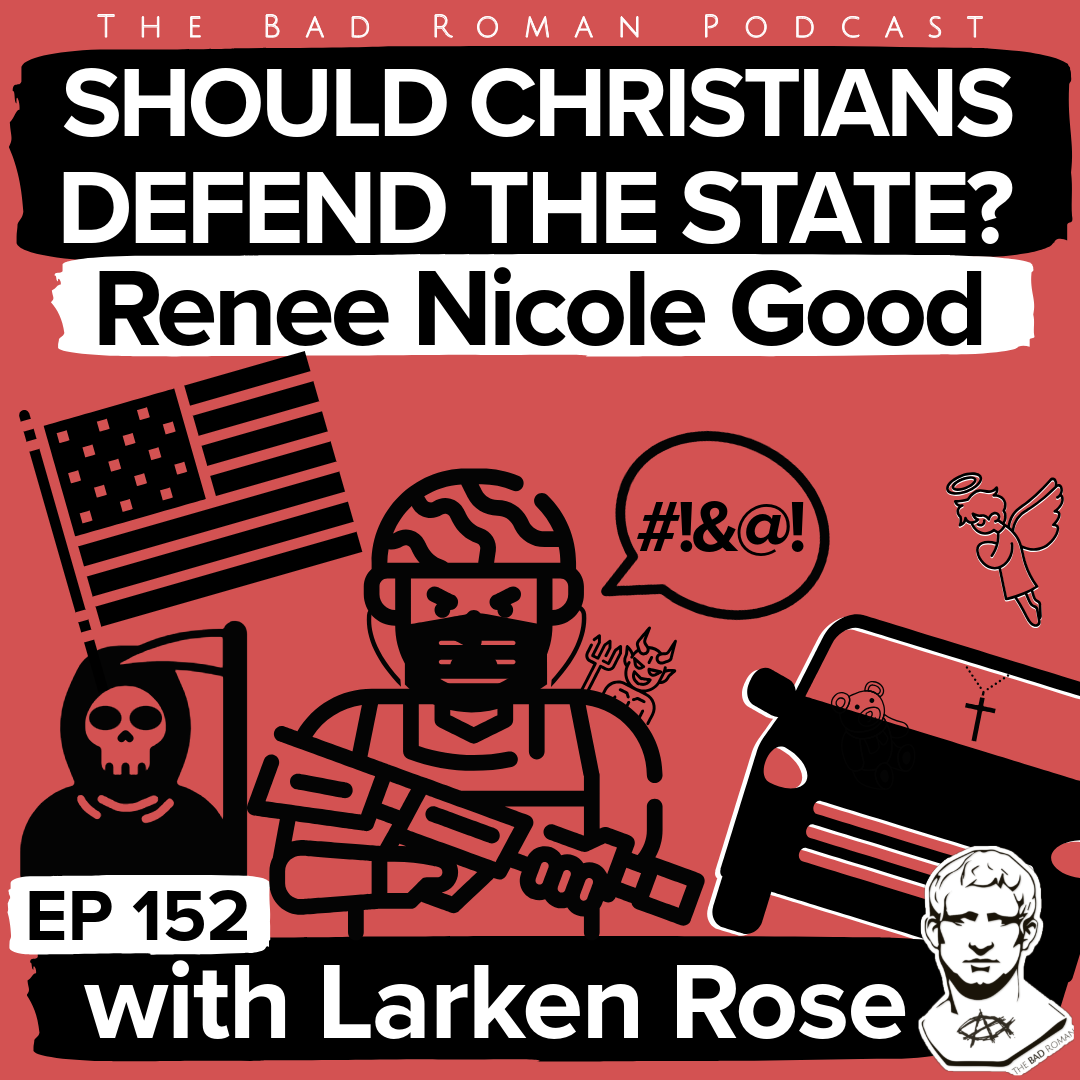
Was the shooting of a Christian mother of three, Renee Nicole Good, murder or self-defense? When Christians cheer for state violence, can we claim it is God we actually worship?
Craig sits down with author and provocateur Larken Rose, not to tally clips or dunk on strangers online, but to face a deeper sickness: our culture’s worship of “authority.” The story that played out on an icy street – ICE agents, a woman in a car, three bullets – exposes something far older than any badge. It exposes a rival religion. In that light, this episode is not merely commentary. It’s a mirror for the American church and a call to return to the Sermon on the Mount.
A House Divided: Flag or Cross?
Followers of Jesus have always had to choose between two rival kingdoms. One hangs its hope on power, control, and the threat of punishment. The other takes up a cross and washes feet. One calls enemies “targets.” The other calls enemies “neighbors.” When a woman is shot through a car window by an agent of the state, the first kingdom asks whether the procedures were followed. The second asks whether love of neighbor has been abandoned.
Many Christians don’t like that contrast. It feels unfair, even accusatory. But the Gospels force the question. Jesus blesses peacemakers, not power-brokers. He rebukes the sword. He refuses to call down fire. He walks through Samaria instead of around it. He tells us that the way we treat the least of these is the way we treat Him.
If that is the King we confess, then any event involving state violence is not just a legal question; it’s a discipleship question. What we defend in public reveals what we worship in private. When a badge is enough to change our moral standard, we have traded the Kingdom for the empire and slapped Jesus’ name on it. That is not orthodoxy. That is idolatry.
What Actually Happened Matters, but Why We Defend It Matters More
Yes, facts matter. Video matters. Angles matter. In this case, people argue over the “first shot” like it’s a courtroom riddle, then skip past the unarguable reality of two more shots fired into a vehicle at a woman who posed no lethal threat. Some admit those facts and then slip into the great American shrug: if the state did it, it must be justified. That reflex is the problem.
Larken names it without blinking: the belief in authority trains ordinary people to excuse evil when their team does it. That is not a left-versus-right issue. It is a worship issue. You can hear it whenever someone says, “Well, she should have obeyed,” as if obedience to a man with a gun is identical to obedience to God. You see it whenever the conversation dodges the moral center, “You shall not murder,” “love your neighbor as yourself,” “blessed are the merciful,” and runs to procedures, politics, and public relations.
The church must refuse that dodge. The Kingdom does not baptize bullets because the shooter is wearing a government costume. The cross does not create exceptions for uniforms. If something is murder without a badge, it is still murder with a badge.
Badges Don’t Make New Morals
Imagine this scene without uniforms. Masked, armed men surround your car, try doors, yell commands, and one of them moves into the lane in front of your hood. If any gang behaved like this, nearly everyone would call it reckless, immoral, and criminal. So why, when the label reads “federal agent,” do some believers flip their ethics upside down? The answer is ugly: many of us believe the state has divine permission to do evil that would be evil for anyone else. We won’t say it that bluntly, but our defenses give it away.
Scripture gives us no such permission. Romans 13 cannot be read against Romans 12 or the Sermon on the Mount. Paul does not cancel Jesus. The early church did not arm itself with Caesar’s sword to spread the Gospel. The fathers we quote on holiness would laugh at the idea that a title grants moral immunity. “No King but Christ” means one moral law for everyone, from the poor to the powerful. Anything else is a golden calf in red, white, and blue paint.
This is why arguments about “procedure” miss the point. Procedures do not create righteousness. Policy manuals do not erase the image of God. If the second and third shots cannot be reconciled with neighbor-love, then they cannot be reconciled with the way of Christ. Period.
Milgram in the Pew: How Training Beats Conscience
Why do otherwise decent people defend what they know is wrong? Larken points to the Milgram experiments for a grim answer. In those studies, ordinary participants believed they were shocking strangers. They trembled. They begged to stop. They knew it was wrong. But a man in a lab coat told them to continue, and their training overpowered their conscience.
The details differ, but the mechanism is the same. Our culture trains us to obey official voices and to distrust our own moral sight. We are deputized by television dramas, press conferences, and patriotic ceremonies until our instinct is to side with uniforms and treat victims as problems. Christians are not immune. We should be. We have a King who heals the ear of His enemy in a garden and rebukes the disciple holding the blade. Yet our formation is often more Fox, CNN, and campaign season than Matthew, Mark, Luke, and John.
Repentance here looks like deprogramming. It looks like reading Scripture as if Jesus actually meant it. It looks like confessing that we’ve excused evil because it felt safe and our team was in charge. It looks like choosing to say out loud, “That was wrong,” even when our political friends frown. In Milgram’s study, the moment one person refused, many others found courage to stop too. The Church can be that person, that voice, that pause button on cruelty.
Tactics Are Not Morals
Some Christians try to solve their discomfort by shifting the conversation: “Maybe she shouldn’t have been there.” “Maybe she should have complied.” “Maybe she should have driven away faster… or slower.” You can say a choice was unwise. You can coach your kids on better tactics when approached by armed men. But none of that baptizes murder. None of it justifies bullets.
The moral center does not move with our tactical advice. Wisdom can help us survive a sinful world; it cannot make sin righteous. When we talk about tactics to avoid talking about morals, we confess our idolatry. We tell on ourselves. We admit that we want to protect the system more than we want to protect the weak.
A healthier church would tell a different story. It would grieve a life lost. It would comfort a neighborhood. It would ask whether our habits and budgets make this kind of violence more likely. It would bless the peacemakers and retrain the reflexes that cheer for force. It would teach children that bravery looks like stepping out of the cycle of retaliation, not doubling down on it.
What the Church Should Have Said
If pastors and Christian leaders had been formed by the Sermon on the Mount, the first public words after the video surfaced would have been simple:
“This is a tragedy. We grieve with the family.”
“A badge does not change the image of God in a victim.”
“Even if procedures were followed, that does not make it moral.”
“We will not baptize state violence. We will not slander the dead.”
“We call our people to peacemaking, not to performative outrage.”
Instead, many Christians ran interference for power. Some called the dead a terrorist. Some cherry-picked statutes. Some mocked the neighbors recording the scene. Some asked “Have you not learned?” like a playground bully, as if the point of government is to frighten the populace into submission. This language betrays a different savior. It teaches a different gospel. The cross is replaced by the sword, the pastor’s stole by the riot shield.
We can do better. We must do better. Not to score points against an agency, but to keep our own souls.
The Oldest Lie in Politics: “We’re the Good Guys”
Both major parties baptize violence when it suits their platform. The rhetoric changes. The victims change. The television graphics change. The machine does not. Larken testifies that he too once wore the stickers, cheered the raids, and trusted the system. Many of us did. Repentance looks like telling the truth about that past and refusing to repeat it. It looks like saying, out loud, “I was wrong,” then learning to see our neighbors again without the costume of ideology.
This is not cynicism. It is Christian realism. Jesus did not trust Himself to the crowds because He knew what was in man. He knew the appetite for power would twist even “good policy” into coercion. He knew fear could turn worshipers into executioners. He knew that the devil’s offer, “all the kingdoms of the world if you will bow,” still tempts believers today. That is why He called us to a narrow road.
Constitutions, Laws, and the Kingdom That Outlasts Them
Some listeners want the constitutional angle. Even there, the ground is shaky. The federal charter lists enumerated powers. It does not list a police power to regulate every person’s movement under threat of death. But the deeper Christian point is prior to all constitutions. Even if a law allowed an immoral act, it would not cease to be immoral.
The early Christians didn’t need a bill of rights to love enemies, rescue the vulnerable, and refuse idolatry. They needed a Lord. We have the same Lord. Our public discipleship should look like it.
The Kingdom Answer: Neighbor Love With Skin On
If our loyalty is to the crucified King, our answer is not primarily a hot take. Our answer is a way of life. It looks like walking toward those who are hurting. It looks like letting the doctor check a pulse instead of blocking him with the threat of pepper spray. It looks like telling truth over team loyalty. It looks like Christians becoming the people who can be trusted in a crisis because they are too busy serving to score points.
It also looks like refusing to dehumanize the agents who pulled the trigger. That does not mean excusing evil. It means telling the truth about the act while refusing to hate the actor. It means praying for justice and for their repentance. It means knowing that the same training that crushed a conscience on a street has also numbed consciences in our pews.
The way forward is not complicated, but it is costly: lay down the idolatry of political saviors and take up the cross. Pray for the courage to refuse wicked orders at every level of society. Become a people who would rather lose a platform than lose our soul.
Scripture Trail for the Church Today
Matthew 5–7: Jesus’ constitution for the Kingdom. Peacemakers. Mercy. Enemy-love. No exceptions for uniforms.
Romans 12 before Romans 13: Love without hypocrisy. Bless persecutors. Overcome evil with good. Read Chapter 13 in the light of Chapter 12.
Psalm 146: Do not put your trust in princes. Their plans perish. God guards the sojourner.
John 4; Luke 10: Jesus walks through Samaria; the neighbor is the one who shows mercy.
Let Scripture reform the reflexes shaped by talk radio and campaign seasons. Let your imagination be drenched in the Kingdom, not the headlines.
Listen & Reflect
🎧 Listen: Anywhere you find your podcasts
💬 Ask: When you see a badge, do you change your moral standard? What does that reveal about your discipleship?
📖 Read: Matthew 5–7; Romans 12–13; Psalm 146; Luke 10.
🤝 Practice: This week, serve a neighbor with no questions asked. No status check. No proof. Just love that acts.
Highlights & Takeaways
A badge does not create a new morality. Jesus does not grant exceptions for uniforms.
If you defend the first shot, you still must explain the others. You cannot. The second and third shots indict the soul of our authority-worship.
Milgram wasn’t a myth. Training often beats conscience. Discipleship must train the conscience to fear God more than men.
“Tactically unwise” is not a synonym for “deserved death.” Stop shifting the target.
Romans 13 does not cancel the Sermon on the Mount. The cross judges empire, not the other way around.
“No King but Christ” means one standard of love for everyone—from the poor to the powerful.
🤝Connect with Larken ROSE:
Platforms: Available on Apple TV, Amazon Prime, Tubi, Xmou Play, The Roku Channel, PLEX
Episode Timestamps:
(00:00) Framing the question: murder or self-defense? Larken returns for “Swearing Sunday.”
Christian allegiance vs. state power.
Moral frame; allegiance check
murder vs self-defense; authority; “No King but Christ”
Previous Episodes with Larken Rose:
(00:41) Banter and burden:
The week’s exhaustion and why it still matters to speak.
Choosing faithfulness over comfort; stewardship of voice
lament; courage; speak
(01:26) Why people cheer evil: authority myths and plantation logic.
Authority-worship; compliance culture
How team colors override conscience
obedience; idolatry; “plantation logic”
(03:40) When evil shows itself, some finally wake up.
Shock as moral catalyst
exposure; repentance; awakening
(07:01) COVID parallels: neighbors revealed their true loyalties.
(10:00) Badges and gangs: why morality cannot change with uniforms.
Uniforms ≠ new morals
Luke 10; early church witness
badge; uniform; consistency – one standard for everyone.
(13:00) Craig’s Memphis test: you won’t stop to check a badge when guns are in your face.
First agent opens the door; second moves in front of the car.
Threat perception; staged risk
Use-of-force: imminence
(14:17) “That was murder.”
Why shots two and three indict the shooter.
No imminent threat; lethal overreach
Matthew 5:21; proportionality
second shot; third shot; homicide
(16:20) The physician they turned away; the shooter who fled.
Aid refusal; post-incident flight
Luke 10 (duty of care)
physician; pulse check; left scene
(17:40) “Few bad apples?” Where are the good apples denouncing murder.
Institutional silence; complicity
accountability; culture; complicity
(20:00) “Have you not learned?” Obedience by threat is not freedom.
Intimidation ≠ authority
coercion; threat; tyranny
(21:15) Milgram: training vs. conscience and why people excuse murder.
Training overrides conscience
Milgram Experiments (1963) obedience study
obedience; conditioning; conscience
(24:13) No other gods: when Christians side with Caesar over Christ.
State-worship vs Kingdom allegiance
idolatry; Caesar; worship
Laws/titles don’t alter morality
Sermon on the Mount synthesis
legalism; morality; authority claims
(33:34) “Was it murder?” clarified.
No threat posture; face shot
Self-defense: imminence/necessity
face shot; no danger; overkill
(34:29) Watch his feet.
No movement = manufactured “threat”
Video-analysis heuristic
feet; staging; false threat
(41:17) Tactics vs. morals: unwise choices don’t justify cages or bullets.
Prudence ≠ moral guilt
tactics; morals; prudence
(47:17) Bootlicking theology called out.
Excusing abuse = state worship
princes; loyalty; idolatry
(55:55) Constitutional limits & ICE.
Enumerated powers; no general police power
Federalist 45 (Madison) summary
constitution; federal power; jurisdiction
(1:06:56) Prosecution theater.
Sacrificial pawn; delay and forget
Prosecutorial discretion patterns
show trial; delay; memory
(1:10:04) Signs of moral progress.
Public conscience awakening
Culture-shift indicators
outrage; repentance; awareness
(1:12:37) Keep saying stuff
Encouragement; close; credits
Community action; sharing
keep talking; outro; next steps
Related Episodes


Related Blog Post