Not Left vs. Right: Ancap Tim Returns with a New Album and an Old Question
What happens when following Jesus starts making us uncomfortable?
Not uncomfortable in the easy ways. Not the kind where we nod during a sermon about being nicer, then go home and keep doing what we were already doing.
What happens when Jesus steps across the lines our tribe has drawn?
What happens when He refuses to wear our colors, repeat our slogans, or bless the people we have chosen to fear?
Many of us were taught that faith and politics fit together like two pieces of the same puzzle. We learned to place the cross beside the flag. We learned to speak about God and country in the same breath. We learned that being a good Christian meant supporting the right leaders, opposing the right enemies, and protecting the right way of life.
Then Jesus starts talking.
He tells us to love our enemies.
He blesses the meek.
He warns us not to seek power over others.
He kneels and washes feet.
And suddenly, the puzzle pieces do not fit as neatly as they once did.
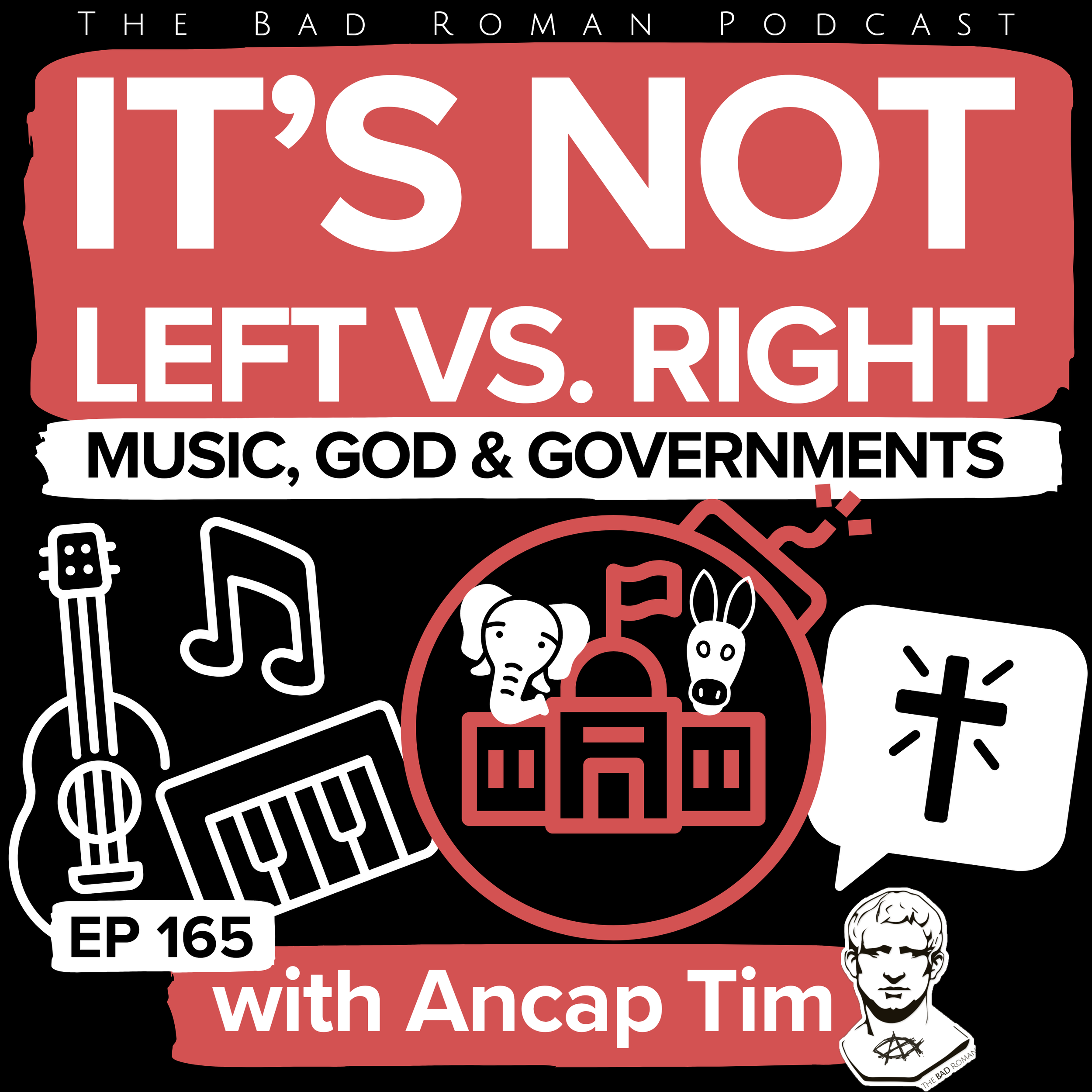
In this episode, Craig welcomes back musician, homesteader, and homeschooling father Ancap Tim. Tim has a new album called It’s Not Left vs. Right. One of its songs grew from a phrase at the heart of this project:
Sometimes being a good Christian means being a bad Roman.
That line may sound political. But this conversation is not focused on politics. It is about allegiance.
Politics only reveals what we already trust.
The deeper question is simple: When Caesar and Christ point in different directions, which one will we follow?
The Kingdom We Already Belong To
Tim’s life does not begin in a recording studio or behind a microphone. It begins with family, fields, animals, and old machines that may or may not start when they are supposed to.
He and his family homeschool and homestead. They raise lambs. Tim has been learning to cut his own hay with farm equipment built before many of us were born. He bought a 1953 Ford Jubilee tractor and has spent time fixing it with his dad.
There is something holy in that picture.
A father and son with grease on their hands. A stubborn piece of old iron. Hay waiting in the field. Children learning at home. Food being raised close to the table.
It may not look like a grand movement. It probably does not make the news. No one is standing behind a podium announcing it.
But much of the Kingdom of God looks like this.
It looks like daily faithfulness.
It looks like repairing what is broken.
It looks like caring for the people and animals placed in front of us.
It looks like sharing work with our parents and passing wisdom to our children.
We often want the Kingdom to arrive with banners and thunder. Jesus kept comparing it to small things: yeast in dough, a seed in dirt, a tiny mustard seed that grows while no one is watching.
Maybe we miss the Kingdom because we are looking for a stage while Jesus is standing in a field.
Tim also spends his week making short videos with names like Two Kingdoms Tuesday, Wills of War Wednesday, and Free Market Friday. He knows many people will not listen to a three-hour lecture. They may, however, stop for two minutes.
“If we’re gonna reach people, the short format is an underused tool,” he says around 2:45.
That sounds a lot like Jesus too.
Jesus taught with seeds, sheep, coins, birds, bread, and farmers. His stories were short enough to remember on the walk home. They carried deep truth without needing a lecture hall.
The Kingdom is not made real because we explain it perfectly.
It becomes visible when we live it plainly.
At the farmer’s market.
At the dinner table.
In the field.
In the repair shop.
Beside a folding table covered with jars of salsa.
Sometimes Being a Good Christian Means Being a Bad Roman
The song began with the idea at the center of this project:
Sometimes being a good Christian means being a bad Roman.
When Tim heard it, something clicked.
“That’s a song. We gotta do this,” he remembers thinking at 12:25.
The phrase carries weight because it names a tension many Christians feel but struggle to name.
The phrase “Bad Roman” does not mean being cruel, reckless, or hostile toward our neighbors. It does not mean we spend our lives shaking our fists at every public office.
It means we refuse to confuse Caesar with Christ, and that refusal is exactly what Tim set out to capture in the song itself.
Rome wanted people to believe Caesar was lord. The early Christians answered with a dangerous sentence:
Jesus is Lord.
That statement was not a private feeling. It was an allegiance. And in the song, that allegiance becomes something you can hear and repeat, not just agree with in theory.
To call Jesus King means other rulers are not.
They may hold office. They may command armies. They may print money, write laws, and place their faces on screens.
But they do not own our conscience.
They do not decide whom we are allowed to love.
They do not get to turn our enemies into people who no longer matter.
Tim’s song doesn’t just describe that tension—it puts it into words meant to be sung out loud: “I won’t bow down to Caesar’s throne,” and, “I serve a King who will never die.” The chorus becomes a kind of declaration, a reminder that allegiance to Christ is not abstract—it’s something we live, speak, and even sing.
That is the heart of being a Bad Roman.
It is not that we hate Rome.
It is that Rome is not our lord.
It is not that we are against our neighbors.
It is that our neighbors are too precious to place beneath the demands of a political tribe.
We belong to another Kingdom already.
Not So With You
In Matthew 20, two disciples approach Jesus with a request that feels familiar to anyone who has ever wanted to matter. They ask for seats of honor beside Him when His Kingdom comes. They are not asking for something strange or unusual. They are asking for what people have always asked for: proximity to power, recognition, significance.
The other disciples hear about it and become angry. Not because the request is outrageous, but because it exposes something in all of them. They wanted those seats too.
That moment sounds a lot like the instincts we still carry, whether we call ourselves left, right, libertarian, or anything else. We want our side to win. We want influence. We want to be close to the people making decisions.
This is exactly what Tim is wrestling with in his music and what the conversation keeps circiling back to throughout the episode.
When Tim sings lines like “I won’t bow down to Caesar’s throne” and “I serve a King who will never die,” he’s not just making a political statement. He’s asking a deeper question: if Jesus is really King, what does that actually change about how we live, especially when it comes to power?
That’s where Craig brings the conversation to Matthew 20.
Jesus does not pretend that power structures do not exist. He names them clearly. The rulers of the nations exercise authority over people. Those in high positions make sure their importance is seen and felt. Power, in the world’s system, is something to be held, displayed, and used.
Then Jesus says something that cuts straight through every attempt to baptize that system:
“Not so with you.”
He does not offer a softer version of domination. He does not suggest a more compassionate form of control. He does not tell them to take the same structure and simply behave better within it.
He draws a line.
Not so with you.
For those who follow Him, greatness is not measured by how many people you can direct, but by how many you are willing to serve. Status is not found in climbing higher, but in lowering yourself for the sake of others. Whoever wants to become great must become a servant. Whoever wants to be first must become a slave.
Then Jesus points to Himself as the example. The Son of Man did not come to be served, but to serve, and to give His life as a ransom for many.
This is exactly the tension Tim is naming in his songs and Craig is pressing in the conversation. If Jesus defines greatness this way, then a lot of what we chase in politics—control, influence, dominance—starts to look out of place.
The world builds systems that elevate. Jesus kneels.
The world secures power. Jesus gives Himself away.
The world protects its own. Jesus touches the untouchable.
The world eliminates enemies. Jesus prays for His.
When we hold that picture clearly, many of our assumptions begin to fall apart. Especially the assumption that the Kingdom of God advances through the same mechanisms as every other kingdom.
This is where the tension with Christian nationalism becomes unavoidable—and why it keeps surfacing in the episode. Christian nationalism asks how Christians can gain enough influence to shape or control a nation. It assumes that if the right people hold power, the right outcomes will follow.
But Jesus never points His followers in that direction. He forms people who embody a different way entirely. He does not train them to rule over others. He teaches them to serve, to sacrifice, to love without coercion.
Christian nationalism looks for victory through laws, elections, courts, and strong leaders. Jesus enters Jerusalem on a donkey. He does not seize the throne. He walks toward a cross.
Jesus looked at the way rulers used power and said, “Not so among you.”
Not so with you when everyone else is chasing control.
Not so with you when fear is used to secure loyalty.
Not so with you when a leader promises safety in exchange for unquestioned obedience.
Not so with you when cruelty is excused because it benefits your side.
Not so with you when people are reduced to categories—voters, threats, outsiders, enemies, instead of neighbors made in the image of God.
This kind of life is not passive. It requires a different kind of courage. It takes courage to serve when serving is seen as weakness. It takes courage to love enemies when hatred is rewarded. It takes courage to refuse revenge when revenge feels justified.
It also takes courage to speak honestly to your own tribe. It is far easier to criticize those on the other side than to confront the ways your own side has drifted from the way of Christ.
Jesus does not call His followers to withdraw from the world. He calls them to live within it without becoming shaped by its patterns of power.
That path is harder than winning an argument or an election.
But it is also the only path that actually looks like Him.
Love, Songs, and the Stories We Tell
The conversation moves from one song to another, and each one carries a different angle on the same tension: what it means to follow Jesus in a world that keeps asking for our loyalty.
When Tim talks about “Enemy of the State,” there’s a different energy. It’s faster, sharper, almost restless. He jokes about not being a rapper, but there’s something honest in the attempt. He’s trying to say something that doesn’t fit neatly into a single genre, just like the ideas behind it don’t fit neatly into left or right.
Then there’s the AIPAC song, which Craig laughs about, a kind of call-and-response gospel piece where every question gets the same answer. It’s funny, but it’s also uncomfortable. That tension runs through a lot of Tim’s work. Humor opens the door, but the point lingers after the laugh fades.
And then we circle back to the line that started it all: “The law of love breaks their chains.”
Craig pauses there, not to lecture, but because it feels like the thread tying everything together.
Tim doesn’t unpack it like a theologian. He just says, almost offhand,
“Love is, I think, the Christian’s best alternative to coercion.”
You can hear it in the way they talk about real life, not theory. A neighbor bringing food. A friend showing up. A parent caring for a child. None of those things happen because someone was forced to do them.
They happen because someone chose to.
That’s the difference.
And it’s why the stories matter more than the arguments.
Craig brings up conversations he’s had with atheists, people who didn’t leave because they studied their way out of faith, but because something didn’t line up. What they saw in Christians didn’t look like Jesus.
That’s not a statistic. That’s a story.
And it’s harder to dismiss.
Because it raises a quieter question: what are people actually seeing when they see us?
Not what we say we believe.
Not what we post.
But how we treat people when it costs us something.
The songs don’t answer that question directly. They just keep pointing back to it.
The Quiet Revolution
By the end of the episode, the biggest picture isn’t political or even musical. It’s Tim heading back home.
Back to the tractor that still needs fixing.
Back to the lambs.
Back to his kids.
Back to making music without a big machine behind him.
There’s something grounding about that.
Because for all the talk about systems and power and influence, most of life doesn’t happen there. It happens in small places, with real people, doing ordinary things.
Jesus seemed to think that mattered.
He kept telling stories about seeds and bread and fields, things people already understood. Not because they were impressive, but because they were real.
And that’s where this conversation keeps landing.
Not in a grand solution, but in a different way of living.
A way that shows up in small decisions.
In how we treat the person in front of us.
In whether we choose control or care.
In whether we need to win, or we’re willing to serve.
It doesn’t look like much at first.
But neither does a seed.
And yet, that’s how the Kingdom grows.
Quietly.
Patiently.
Through people who decide, in the middle of ordinary life, that their allegiance really does belong to another King.
Sometimes being a good Christian really does mean being a bad Roman.
Not because we’re trying to fight the world.
But because we’re learning, slowly, to live differently inside it.
Gest BiO: Ancap TIm
Tim Wade, who performs and posts as Ancap Tim, is a singer-songwriter, homesteader, and homeschooling father whose music blends outlaw folk, southern rock, and country with a voluntaryist and Christian-anarchist point of view. His weekly short-form video series, Spooner Sunday, Two Kingdoms Tuesday, Wheels of War Wednesday, and Free Market Friday, covers history, Scripture, war, and economics in two- to three-minute doses. Tim first appeared on The Bad Roman Podcast in “Stateless Psalms: Songs for Liberty with Ancap Tim” (Episode 142), discussing his debut album, The State's Just a Mafia. He returns here to talk through his second album, It's Not Left vs. Right, including a track titled “Bad Roman.”
Links
Website: ancaptim.crd.co
Apple Music: music.apple.com/us/artist/ancap-tim
YouTube: youtube.com/@AncapTim
Instagram: instagram.com/ancaptim
Facebook: facebook.com/p/Ancap-Tim-61571241265825
Playing the Midwest Peace & Liberty Fest, Aug 6–9, Laingsburg, MI: mplfest.org
Previous episode: “Stateless Psalms: Songs for Liberty with Ancap Tim,” Episode 142
Also Mentioned in This Episode
Scott Horton: antiwar commentator and host of The Scott Horton Show, who shared Tim's AIPAC song on X
Justin Raimondo's An Enemy of the State: The Life of Murray N. Rothbard: the biography that inspired Tim's song “Enemy of the State”
Aree Spivey and Brian Grant of Failed Kingdoms: musicians who first appeared on The Bad Roman Podcast in Episode 7 and whose song has long served as the show's theme
Highlights & Takeaways
Jesus defines greatness as service. Matthew 20 does not teach Christians to rule more kindly. Jesus says, “Not so with you.”
Allegiance comes before politics. Our political choices often reveal whether we trust Christ’s way or the world’s way of power.
The Kingdom is already present in ordinary faithfulness. Family, work, meals, music, repairs, and neighborly care can all become places where Christ’s rule is made visible.
Love cannot be forced. Jesus invited people to follow Him. He did not use political power to create disciples.
Christian witness matters more than Christian control. People should be able to see Jesus in the way we treat atheists, enemies, outsiders, and those wounded by the church.
Truth does not need hatred. We can challenge war, propaganda, nationalism, and injustice without dehumanizing those who disagree.
Small acts are not small in the Kingdom. Mustard seeds, yeast, shared meals, repaired tractors, and honest songs can carry more life than a thousand angry speeches.
No King but Christ is a way of life. It means serving rather than ruling, loving rather than coercing, and trusting the cross more than the sword.
Listen
Listen for the moments when the conversation moves from political language back to the words of Jesus. Notice how the meaning changes when Matthew 20 becomes the starting point rather than a political label.
Reflect
Where have you been tempted to excuse behavior from your own political tribe that you would condemn in another? What would “not so with you” change?
Read
Read Matthew 20:20–28 slowly. Then read Philippians 2:1–11. Pay attention to how Jesus uses power and what kind of greatness He asks us to seek.
Practice
Choose one ordinary act of discipleship this week. Repair something with someone. Share food. Call a person who feels forgotten. Serve a neighbor without posting about it. Let the Kingdom grow quietly.
Epsiode Timestamps:
(00:00) Welcome Back, Ancap Tim
New album, It's Not Left vs. Right, announced
Catching up on homesteading, hay season, and old tractors
Why Tim keeps his content short: Spooner Sunday, Two Kingdoms Tuesday, Free Market Friday
(03:37) Banned, Throttled, and Watched
Getting banned from TikTok over central-banking history
Who really owns TikTok now
YouTube throttling and walking on eggshells
(09:07) Ungovernable
An arrest over a single word
Free speech that isn't actually free
Snowflakes on every side
(11:42) The Salsa Table
Selling Bad Roman salsa and talking to a pastor
The sentence that became a chorus
Writing the “Bad Roman” song
(14:12) Caesar's Throne and a Sky You Can't Chain
Unpacking the first verse
A line borrowed from Firefly
Contrasting Caesar and Christ
(17:18) The Law of Love
Why voluntary love disarms the state
Coercion versus consent
Room for atheists inside a voluntary society
(19:26) Leviathan and the Meek
The second verse, unpacked
Obey versus resist
A kingdom that's here but doesn't belong
(25:56) Loving Your Atheist Friend
Tearing down the walls Christians build
Common ground through voluntarism
A years-long dialogue over Romans 13
(27:41) When Party Loyalty Overrides Jesus
Matthew 20:25–28 and “not so among you”
Losing principles when your tribe is winning
Statism, anarchy, and no in-between
(35:33) But I'm Extreme
Taxing a man to death and calling it civic duty
Why voluntarism gets called chaos
Writing for people who already agree vs. everyone else
(40:16) Enemy of the State and the AIPAC Choir
Rothbard, Raimondo, and a nu-metal chorus
Building an AI choir of Ancap Tims
Scott Horton, Dave Smith, and a congressman's lost primary
(49:52) Cracks in the Coalition
Libertarians who voted for Trump anyway
The Iran war and broken promises
Republicans drifting toward “just leave people alone”
(52:51) Two Empires, One Playbook
Controlled opposition and blackmail theories
The Strait of Hormuz and a modern Suez Canal
A tragedy neither side can spin away
(1:02:19) The Road Ahead
Where to find ancaptim.crd.co
The new album's July release
Playing the Midwest Peace & Liberty Fest
(1:06:37) Outro
Supporting the project through Spotfund
No King but Christ
Related Episodes



Related Blog Post