What happens when the thing shaking your faith is not Jesus, but what Christians have told you about Jesus?
Maybe it starts small.
You hear something from a pulpit that does not sit right anymore. You notice the American flag standing beside the cross and wonder if it belongs there. A teaching you once accepted without question suddenly sounds cruel. You open your Bible and realize that what Jesus says does not always fit neatly with what your church, political party, or favorite preacher taught you.
Then comes the scary question:
If I start pulling on this thread, will my whole faith fall apart?
Jon Kinder knows that feeling.
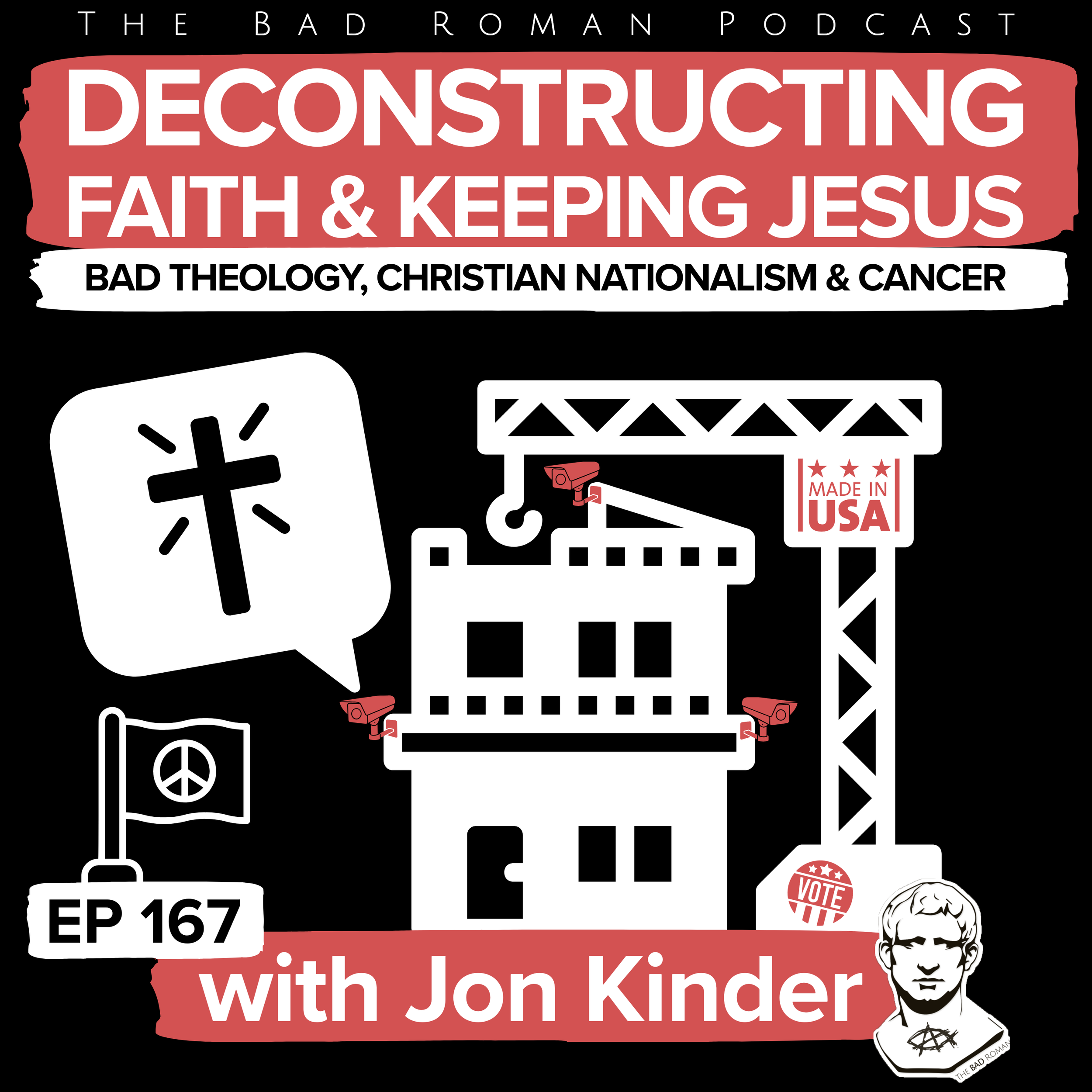
Jon has spent much of his life in ministry. He served in church leadership from a young age and later created The Geeky Preacher, a project that looks for God in movies, gaming, horror, anime, and other places church culture sometimes tells us not to look. His story of deconstruction did not end with him abandoning Christ. It pushed him to ask what was actually built on Christ, and what had simply been built around Him.
This conversation moves from Dungeons & Dragons and Satanic Panic to cancer, Christian nationalism, church flags, universal restoration, pacifism, voting, the rapture, and the strange freedom that comes when we finally admit: Maybe asking questions is not an act of rebellion. Maybe it is part of faith.
When Everything Strange Becomes “Demonic”
Jon’s story begins in a surprisingly geeky place: Dungeons & Dragons.
For years, many Christians were told D&D could lead children into witchcraft or demon worship. Jon remembers church leaders going pale when he suggested playing the game with other ministers.
His explanation is much less dramatic:
“It is math… with little dice and people doing funny accents.” 03:34
Craig remembers the same kind of warnings around rock music, horror films, Harry Potter, tattoos, and even yoga.
Jon actually built part of The Geeky Preacher around challenging that fear. He once used the horror film It to talk about courage. The monster feeds on fear. The children become stronger when they stop letting fear control them. Jon connected that to the biblical reminder that God has not given us a spirit of fear.
That is a small example, but it points toward a much larger problem. Sometimes Christians call something evil simply because it is unfamiliar. And once fear becomes our method for deciding what is true, questioning becomes dangerous. What if curiosity is not the enemy of faith? What if fear is?
Deconstructing Politics Before Theology
Jon did not begin by questioning hell, the rapture, church structure, or Pentecostal theology. He started with politics.
He grew up in a rural setting where Republican politics and Christianity seemed almost welded together. Being Christian meant being conservative. Being conservative meant voting Republican. Pulling those identities apart could make a person feel like an outsider in both church and community.
Then a friend challenged him.
Jon was already reading different theological views and comparing them. Why was he not willing to do the same thing with politics?
That question led him to Greg Boyd’s The Myth of a Christian Nation. It became a turning point.
Jon began reading voices that questioned war, nationalism, and Christian allegiance to government. He mentions Boyd’s The Crucifixion of the Warrior God and Brian Zahnd’s A Farewell to Mars as books that pushed him toward Christian pacifism and Christian anarchism. He had always tested theological arguments by asking which view seemed closest to Christ. Now he began doing that with politics too. That is when a problem appeared. The politics he had inherited did not always look much like Jesus.
Cancer and the Sermon Playing in the Hospital Room
Then theology became personal. In 2018, Jon was hospitalized with stage-three lymphoma. One night, with little to do in the hospital, he turned on a Christian television program. He does not remember who was preaching. The preacher said that if someone was sick, it was because that person did not have enough faith. Jon was lying in a hospital bed with cancer.
“Stage three cancer, laying in a hospital, but I don’t have enough faith?” 11:25
Suddenly, this was not an abstract theological debate. Jon had been in ministry. He had believed. He had prayed. He had served. Was his cancer really evidence that he had failed God?
That moment forced him to face something many of us avoid: bad theology can sound harmless until life makes us live inside it. A teaching may work fine when we are healthy. Then somebody gets cancer. A doctrine about eternal punishment may feel normal until someone we love dies. A sermon about obeying government may sound harmless until that government starts killing people. A theology of fear may feel powerful until we realize we have spent our whole Christian life terrified of the Father Jesus told us to trust.
Jon decided it was time to examine the house.
Don't Burn Down the House: Remodel It
One of the best pictures in this episode is Jon's way of describing deconstruction.
He does not picture a wrecking ball. He pictures a house. If one room needs work, you do not have to bulldoze the whole building. You can take one room at a time.
Hell. Salvation. The end times. Speaking in tongues. Politics. Violence. Church.
Whatever the question is, examine it. Study it. Listen to people who disagree with you. Then move to the next room.
“If you remodel a house, you don't take the foundation too… Christ is the foundation of the house.” 36:28
That matters because deconstruction has become a loaded word. For some Christians, it sounds like code for leaving Christianity. Jon describes something different.
He was not trying to escape Jesus. He was trying to find out which parts of his belief system were actually Jesus. That distinction may save someone a lot of fear. You are allowed to discover that a pastor was wrong without deciding Christ was wrong. You are allowed to change your mind about hell without abandoning Jesus. You are allowed to question nationalism without abandoning the Kingdom of God. You are allowed to repair the room.
Is Fear Really the Point?
Universal restoration became one of the rooms Jon spent years studying. Craig understands why. Both grew up around versions of Christianity where fear could become a tool of evangelism:
What if you die on the drive home? What if Jesus returns tonight? What if you believed the wrong thing? What if you are left behind? What if God burns you forever?
That kind of preaching can produce decisions. But does it produce trust?
Craig points back to the way Jesus treated people. Jesus did not seem interested in terrorizing people into loving His Father. Jon talks about studying different biblical uses of fear and considering whether “fear of God” always means the mortal terror many Christians were taught. The larger point is worth sitting with.
Do we worship God because He is good? Or because we are scared of what He might do if we do not?
Those are very different relationships. And if Jesus reveals the Father, then perhaps our picture of God should look more like Jesus.
Pacifism Gets Personal Too
As Jon's politics changed, so did his understanding of violence. He began moving toward Christian pacifism. That does not mean Jon pretends dangerous situations are simple. He has children. He admits that protecting them would create hard choices. But his first instinct is no longer violence. He wants restraint, escape, de-escalation, and every other option on the table before hurting someone.
Craig says something similar. We spend so much time imagining the moment when we may “have to” kill someone that we rarely train our minds to ask what else we could do. If Jesus calls us to be peacemakers and love enemies, shouldn't avoiding violence at least be something Christians seriously practice?
Instead, churches sometimes spend more energy defending violence than imagining peace.
The Flag Behind the Pulpit
Jon eventually began bringing his changed political theology into church. That is where things got tense.
Around Memorial Day, he preached a message comparing the way ancient Israel mixed the worship of Yahweh with other loyalties to the way churches can mix devotion to Jesus with devotion to America. His provocative image was the American flag standing behind the pulpit like a modern “Asherah pole.” It did not go over well.
Jon was pulled aside.
The concern was not mainly whether his argument was biblical. He was asked whether he understood how many veterans he had offended. That exchange gets to the center of the episode: What happens when protecting patriotic feelings becomes more important than asking whether patriotism belongs in Christian worship?
Jon was not telling people to hate their neighbors or despise the place where they live. He was questioning allegiance, and there is a difference.
Craig sees the same problem every time Christians defend the Pledge of Allegiance by saying it is simply about loving your country. The pledge does not say, “I care about my neighbors.” It pledges allegiance to a flag and “the republic for which it stands.”
Jon says the language always made him uncomfortable.
“Why am I swearing my fealty to something? I thought we don't have kings anymore.” 23:40
That question will make a lot of church rooms quiet. Good. Some quiet rooms need questions.
What If the Truth Can Handle Questions?
Over time, Jon says church leaders urged him to back away from these subjects. He tried (at least from the pulpit), but behind the scenes, the questions continued.
Why should a nation have special spiritual status? Why should Christians join nationalism to worship? Why should government loyalty determine whether someone belongs? Why should certain doctrines be protected from examination?
Jon eventually landed on a simple rule:
“If anything is true, it's gonna survive scrutiny, it's gonna survive questions. If it's not, then it's meant to burn down.” 29:20
Craig brings up Jacob wrestling with God. Jon points out that Jacob received the blessing after the wrestling.
Faith has a strange history of being strengthened by difficult questions. Yet some church cultures treat questions as rebellion. Why? If the answer is true, what are we afraid of?
Maybe the greater danger is building a faith so fragile that one honest question can destroy it.
Reading the Bible Toward Jesus
The conversation eventually reaches one of the hardest questions for Christians committed to nonviolence: What do we do with the violence attributed to God in parts of the Old Testament when Jesus teaches enemy-love?
Jon introduces Craig to the idea of progressive revelation.
Jon's explanation is that people did not receive the full picture of God all at once. He compares it to taking a man who has spent his whole life in a dark cave and suddenly placing him in the noon sun. The light itself could overwhelm him. Jon sees Jesus as the fullest revelation of God. Earlier biblical stories, in this view, show humanity gradually being led toward that clearer picture.
You may agree, disagree, or need more self-study (that is almost the point). The episode does not demand that every question be solved, it asks whether we are willing to wrestle honestly and still keep our eyes on Christ.
Leaving the Building Without Leaving Jesus
Jon no longer participates in a brick-and-mortar church the way he once did. Yet he tells Craig that he feels closer to Christ. For some of us, that may sound impossible.
How can someone stop attending church and become more serious about faith?
Jon describes how church life can become a formula: songs, sermon, prayer. go home, and repeat next week.
Outside that structure, he found himself reading, praying, studying, and worshiping without waiting for a schedule. He is also careful not to portray himself as a lone theological genius. He still talks with trusted ministers and friends. He asks others what they think. He wants accountability.
What changed is the pressure to fit inside a denomination's approved box.
“Whenever you can worship and engage without expectation, it makes a difference.” 33:30
That is an important distinction. Community matters, but control is not community.
The Ship of Theseus and the “Anarchist Mutt”
So what does faith look like after years of changing one belief at a time? Jon uses the old philosophical puzzle known as the Ship of Theseus.
Imagine an ancient ship in a museum. A board rots, so you replace it. Then the mast. Then another board. Then another. Eventually every part has been replaced. Is it still the same ship?
Jon sees his faith journey that way.
“I started out a Republican Pentecostal and ended up an anarchist mutt.” 37:15
The joke carries something important. He changed (a lot), but Christ remained the foundation. We do not have to tackle everything at once. Pick the questions that will not leave you alone. Study them one at a time. Find people who have walked the same road. You may be surprised how many are out there. Craig and Jon both thought they were nearly alone when they began separating Christianity from nationalism and statism. Then they found other people asking the same questions. Sometimes community begins when one person finally says out loud: Does this seem wrong to anybody else?
Deconstruction Doesn't Have to Mean Losing Jesus
There is a popular fear that once Christians start questioning, they will never stop. Maybe they will question hell. Then the rapture. Then nationalism. Then church authority. Then war. Then politics. Then everything.
Jon would probably say: good. Ask. Test. Study. But keep Christ beneath the house. Deconstruction does not have to be a funeral for faith. Sometimes it is what happens when we finally separate Jesus from the things we were told were Jesus. The flag is not Jesus. Republicanism is not Jesus. Pentecostalism is not Jesus. A particular theory of hell is not Jesus. The rapture is not Jesus. A church building is not Jesus. Your pastor is not Jesus. Your nation is not Jesus.
Jesus is Jesus, and maybe that is enough foundation to start rebuilding.
God Outside the Four Walls
Jon shares why he started The Geeky Preacher. The idea behind the project is simple: God is not trapped in church. Jon looks for glimpses of truth in movies, anime, video games, horror, fantasy, books, nature, and whatever else gets his attention.
“I think God is outside the four walls more than He is inside the four walls.” 41:57
That is not an attack on every local church. It is a reminder about scale: The Creator of the universe is bigger than a Sunday schedule.
🤝Connect with Jon Kinder / The Geeky Preacher🤝
The Geeky Preacher (Linktree for YouTube, Podcast, Facebook, TikTok, Twitch & Instagram)
Highlights & Takeaways
Christian deconstruction does not automatically mean abandoning Jesus. Jon describes it as examining inherited beliefs while keeping Christ as the foundation.
Fear can protect bad theology. From Satanic Panic to hell and rapture preaching, fear often stops Christians from asking whether a teaching is actually true.
Political deconstruction can be theological. Jon's movement away from Republican identity began when he judged politics by the teachings of Jesus.
Bad theology becomes clearer when life gets painful. Hearing that sickness comes from weak faith while fighting stage-three lymphoma forced Jon to reconsider what he had once accepted.
Christian nationalism often hides in ordinary church habits. Flags behind pulpits and pledges of allegiance can feel normal precisely because few people stop to ask what those symbols teach us about loyalty.
Truth does not need protection from honest questions. If a belief cannot survive study, scrutiny, and disagreement, fear should not be used to keep it alive.
Take deconstruction one room at a time. Trying to rebuild everything at once can overwhelm us; Jon recommends studying individual questions deeply and finding trusted community.
Leaving a church structure is not the same as leaving Christ. Jon's spiritual life continued through prayer, study, relationships, and accountability outside traditional church membership.
Listen
Listen for the moments when Jon's inherited beliefs collide with real life: cancer, church conflict, politics, and fear. Which collision sounds most familiar to your own story?
Reflect
What Christian belief have you never truly examined because questioning it felt dangerous? Is the fear protecting Christor protecting a tradition?
Read
Read Genesis 32:22–32 and notice Jacob wrestling with God. Then read Matthew 5–7 and ask what happens when Jesus becomes the measuring stick for our theology, politics, and use of power.
Practice
Choose one “room” in your theological house. Do not try to solve everything this week. Read one thoughtful voice you agree with and one you do not. Write down what each gets right, then return to Jesus.
Episode Timestamps:
(00:00) Christian deconstruction and The Geeky Preacher
Jon Kinder's ministry background
No King But Christ Network
Faith, gaming, movies, and geek culture
(03:01) Dungeons & Dragons and Satanic Panic
Churches warning against D&D
Horror films, rock music, tattoos, and fear
Finding Christian themes outside church media
(07:50) Deconstructing Republican Christianity
Rural Christianity and Republican identity
Greg Boyd and The Myth of a Christian Nation
Movement toward pacifism and Christian anarchy
(10:36) Cancer exposes bad theology
Stage-three lymphoma
“Not enough faith” preaching
Beginning theological deconstruction
(13:00) Hell, fear, and universal restoration
Fear-based salvation preaching
Different meanings of “fear of God”
Slow movement toward apokatastasis
(15:05) Christian pacifism and alternatives to violence
Christian anarchy and nonviolence
Self-defense, restraint, and de-escalation
Firefly and the “kneecaps” joke
(18:47) The American flag behind the pulpit
Memorial Day sermon
Asherah pole comparison
Veterans, offense, and national loyalty
(23:15) Pledging allegiance to empire
Flag rituals in Christian spaces
Loyalty to republic versus love of neighbor
Growing conflict inside Jon's church
(28:35) Why Christians need to ask hard questions
Questions treated as heresy
Jacob wrestling with God
Truth surviving scrutiny
(30:21) The Old Testament, violence, and Jesus
Difficulty reconciling biblical violence
Progressive revelation
Christ as the fullest picture of God
(31:40) Closer to Christ outside a church building
Worship without formula
Prayer and study outside weekly structure
Accountability without denominational control
(35:30) How to deconstruct without losing your foundation
“You're not alone”
Room-by-room reconstruction
Christ as the foundation
(36:45) The Ship of Theseus and changing faith
Gradual replacement of inherited beliefs
“Republican Pentecostal” to “anarchist mutt”
Finding community after theological change
(38:45) “I don't vote. It's against my religion.”
Rural expectations around voting
Christian objections to political allegiance
Face-to-face conversations about faith and politics
(41:20) Finding God outside the four walls
The Geeky Preacher's mission
Theology through movies, anime, games, and culture
Returning to writing after church conflict
(45:43) Coming through deconstruction
Discomfort followed by greater peace
The Matrix “waking up” comparison
Community for people asking similar questions
(46:43) Deconstructing the rapture
Rapture teaching tied to salvation
Inherited beliefs versus studied beliefs
Jon Darby and the history of the doctrine
(48:04) Universal restoration and future conversations
Hell compared with cancer treatment
Jon's early Substack writing
Possibility of a future Bad Roman roundtable
Related Episodes



Related Blog Post


Support the Bad Roman Project
If this episode gave language to questions you have been afraid to ask, share it with somebody else who feels alone.
Help us keep No King But Christ in the conversation by donating. One time donations or even $5 or $10 a month helps cover production, with donations beyond production costs supporting charities in Memphis, Tennessee.
You can also support the project one jar at a time at by trying a jar of Bad Roman Salsa.