“What if the problem isn’t that we haven’t found the right rulers, but that we keep assuming someone needs to rule us at all?”
There’s a moment that shows up in almost every conversation about politics and faith. It usually comes right after someone says, “Okay, but what about bad people?” The room tightens. The air shifts. Because underneath the question isn’t policy, it’s fear. Fear of chaos. Fear of losing control. Fear that without someone in charge, everything falls apart.
This episode lives inside that moment.
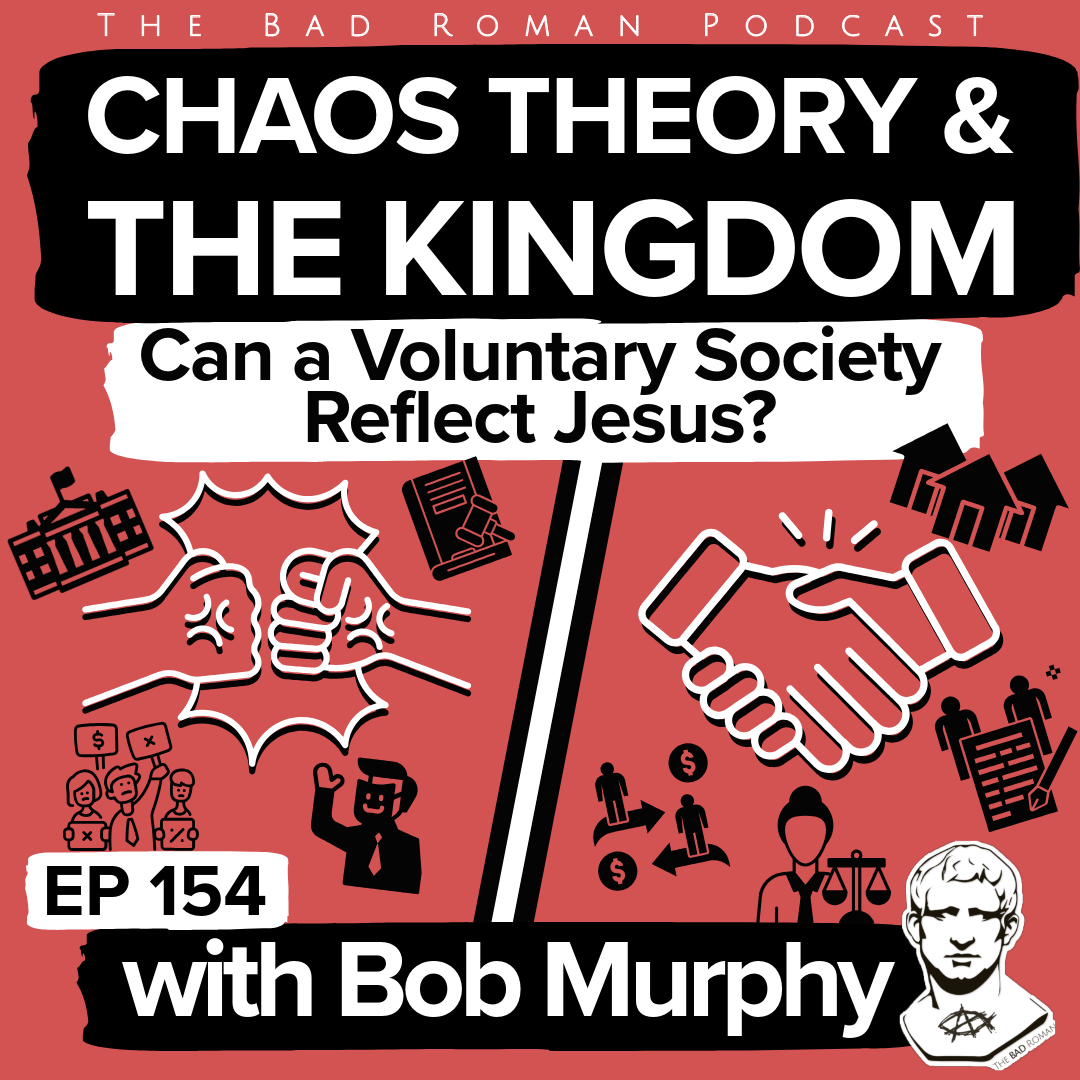
Craig sits down with economist and author Bob Murphy to talk about Bob’s short book, Chaos Theory. On the surface, it’s about how law, courts, and public safety might work without a centralized state. But that’s not really why Craig wanted the conversation. What he’s really asking is something Christians rarely slow down long enough to face: Why are we so sure that force is necessary for order, and what does that say about what we believe Jesus actually taught?
Bob doesn’t come in trying to convince anyone. He comes in careful. Thoughtful. Almost pastoral. He knows the ideas he’s talking about can trigger alarm bells. So instead of starting with labels or slogans, he starts with a question that keeps circling back throughout the episode: Should anyone be allowed to do things that would be wrong for everyone else?
Craig Meets Bob Murphy
Craig opens with honesty. He’s familiar with these ideas. He’s heard them before. But he also knows where people get stuck. It’s not usually in theory. It’s in the details.
“How does this actually work?” Craig asks. “Not in a perfect world, but in this one.”
Bob nods. He doesn’t promise a world without sin or harm. “The goal isn’t utopia,” he says. “The goal is removing what I call an institutionalized aggressor.”
That phrase lands heavy.
Bob explains that every system has problems because people have problems. The difference is whether the system itself assumes that violence and threats are necessary tools. A voluntary society, he says, doesn’t eliminate wrongdoing. It eliminates the idea that some people are allowed to do wrong by design.
Craig pauses there, not because he disagrees, but because he recognizes how deeply that assumption runs. For Christians, this isn’t an abstract argument. It cuts straight into how we’ve learned to think about safety, authority, and obedience.
Why Bob Steps Around the Word “Anarchy”
Early in the conversation, Bob explains why he rarely leads with the word “anarchist,” especially among Christians. The word comes loaded. Too many images. Too many misunderstandings.
“I actually believe in order,” Bob says. “I just don’t think order requires rulers.”
Instead, he uses the phrase voluntary society. It sounds less dramatic, but it’s more accurate. A voluntary society isn’t about tearing everything down. It’s about cooperation without coercion. Rules without rulers. Agreement without threats.
Craig connects this to Christian nationalism almost instinctively. When Christians say “Jesus is King,” do we really believe it? Or do we still assume someone else needs to enforce things for Him? Jesus refused power when it was offered. He didn’t seize control. He invited people to follow.
That contrast lingers.
A Boring Word That Changes Everything
Midway through the episode, Craig opens Bob’s book and lands on a section that doesn’t sound very spiritual at all: contracts.
It almost feels like a letdown at first. No revolution. No big speeches. Just agreements.
But Bob leans in. Contracts, he explains, are how most of our lives already work. Jobs. Housing. Insurance. Services. We trust them not because someone is holding a gun, but because incentives, reputation, and accountability matter.
“Insurance companies don’t want to write million-dollar checks,” Bob says. “So they care about safety. They ask questions. They check training. They look at track records.”
Craig pushes back with the concern many listeners will feel. What about the vulnerable? What about people without power or money?
Bob doesn’t pretend this system fixes everything. He simply points out that our current system already fails the vulnerable, often while claiming moral authority. A voluntary system doesn’t solve sin. It just stops pretending that force is love.
Consent, Compliance, and the Ballot Box
One of the most uncomfortable turns in the conversation comes when Bob challenges the idea that voting equals consent.
“In normal life,” Bob says, “consent means you can say no. You can walk away.”
You can’t really do that with the state.
Markets depend on persuasion. Governments depend on compliance. Craig lets that contrast sit without rushing to resolve it. Because Jesus never appealed to majorities. He appealed to hearts. To repentance. To truth.
“If we wouldn’t do this to our neighbor,” Craig reflects, “why are we okay with a system that does?”
That question doesn’t get answered. And that’s the point.
Live the Question Jesus Calls us To Ask
This episode doesn’t give you a platform to stand on. It gives you a question to carry. And following Jesus has always meant carrying questions that cost us something.
If this conversation unsettled you, sit with that. Keep asking what it really means to follow a crucified King.
🤝 Connect with Bob Murphy 🤝
Read the Book: Chaos Theory (buy on Amazon), Chaos Theory (pdf)
Bob’s other books: Contra Krugman: Smashing the Errors of America’s Most Famous Keynesian; Lessons for the Young Economist; Choice: Cooperation, Enterprise, and Human Action
Bob’s Podcasts: Human Action Podcast and The Bob Murphy Show
X (Twitter): @BobMurphyEcon
Bob’s YouTube Channel:@BobMurphyAncap
Highlights & Takeaways
A voluntary society doesn’t promise a perfect world
It refuses to give moral exemptions to people in power
Order and control are not the same thing
Consent requires the real option to walk away
Jesus never modeled threat-based transformation
Christian nationalism trusts force where Jesus trusted faithfulness
You don’t need a political plan to name a moral problem
Listen & Reflect
Listen: Pay attention to where fear enters the conversation. What are we afraid would happen if control loosened?
Reflect: Where have we accepted systems that do things we would never justify in our own lives?
Read: Read Matthew 5–7 slowly. Notice which teachings feel “impractical,”and ask why.
Practice: This week, choose persuasion over pressure in one real situation. Let go of leverage and see what remains.
Episode Timestamps:
(00:00) Voluntary Society: “Wouldn’t That Be Chaos?”
bad actors, security, fear of “chaos”
why Bob Murphy + Chaos Theory today
frame: Christ over the state
(00:45) Welcome Bob Murphy
Craig’s intro + how they got connected (Dominic)
(06:19) Why Bob Avoids the “Anarchist” Label
two kinds of “anarchists”
“I have a king… not an earthly king”
prefers “voluntary society” language
(07:19) Sermon on the Mount + Politics That Fit Jesus
“dovetail… best with what Jesus told Christians”
Craig’s shift from “looking for somebody to vote for”
discipleship vs ideology
(10:57) “I Don’t Have to Have a Plan”
refusing the election-pressure test
“this current system… is crazy”
Craig: “yeah, you’re allowed”
(11:33) Salsa Break: No King but Christ
put the politics down
support the show
“no king but Christ” hook
(12:14) Chaos Theory: Contracts
why contracts matter in a voluntary society
how contracts already matter
(14:37) “Institutionalized Aggressor” + Imposed Rules
no “my guy loses → stuff imposed on me”
what the booklet is trying to show
contracts “on the front end”
(33:14) Insurance as Due Diligence
“standard package” idea
insurance companies = background checks
malpractice example bridge
(34:03) Incentives: Background Checks + Risk
“we might have to pay $2 million”
vetting training, history, reputation
why incentives shape behavior
(46:57) “Give the Experts Guns” Problem
“very naive” assumption
experts can be the bad guys
quick support spotfund message + Memphis charities
(58:27) “Aren’t Insurance Companies the Government?”
“they seem like they play an important part”
Bob: not government because it’s voluntary
competition + no power to block new entrants
(1:03:24) Where to Find Bob + What He’s Building
how to get Chaos Theory (PDF or physical)
Human Action Podcast + other work
(1:04:22) Wrap-Up + Possible Part 2
“small book… packed tight”
Bob open to coming back
Craig: “we didn’t get to cover everything”
Related Episodes


Related Blog Post