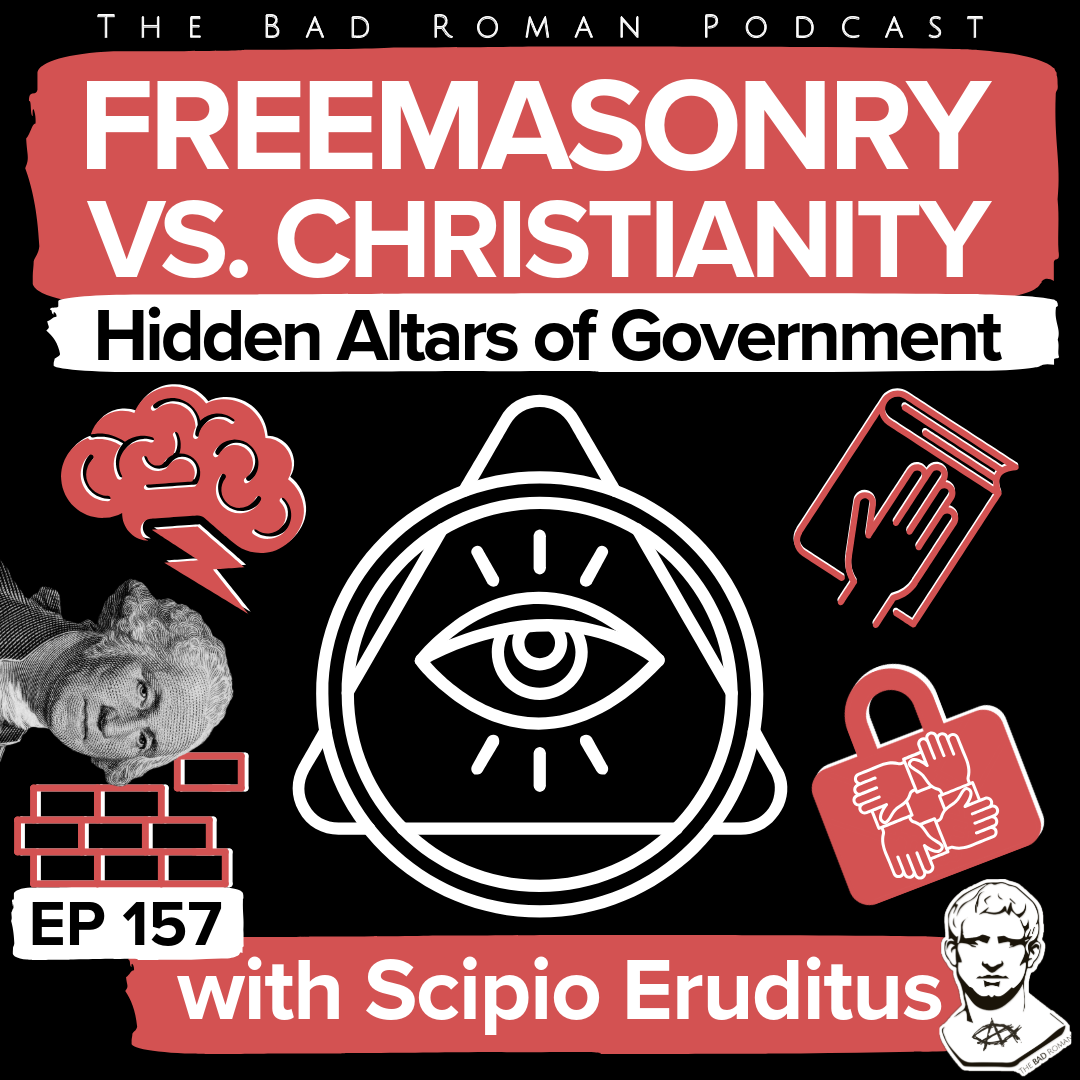
What happens when we start asking where our public myths came from? Not just our slogans, but our symbols. Not just our laws, but the spiritual imagination sitting underneath them.
In this episode of The Bad Roman Podcast, Craig sits down with Scipio Eruditus of Dispatches from Reality to talk about the historical and theological entanglements between Freemasonry, Christianity, and the state. On the surface, that might sound like a niche topic. But the deeper the conversation goes, the more it starts to feel like a mirror. Why are Christians so quick to trust power? Why do symbols on currency, patriotic myths, and secret oaths seem easier for many people to defend than the plain teachings of Jesus?
This is not a light conversation, but it is an important one. Scipio shares how his own journey, from military service and patriotism to deep suspicion of government, forced him to rethink the stories he once believed. And as the episode unfolds, the bigger question comes into view: can followers of Jesus stay awake in a world built on hidden loyalties, or will we keep baptizing government and calling it righteousness?
From patriotism to disillusionment
Scipio’s story begins with the kind of loyalty many Americans understand. He joined the Air Force in the wake of 9/11 believing he was fighting for freedom. But war has a way of exposing the distance between what we are told and what is true. What happens when the script falls apart in real time? What do we do when the nation we trusted starts to look less like a protector and more like a storyteller protecting its own image?
That experience became a crack in the wall. The guest describes Afghanistan as a turning point, not only because of the violence, but because of the lies that seemed to surround it. Later, his involvement in a fraternity opened another door, this time into rituals, symbols, and hidden inheritances that would lead him into researching Freemasonry in much greater depth. Sometimes awakening does not come all at once. Sometimes it comes in layers, one false promise at a time.
“It was an absolutely major paradigm shift for me... and has forced me to look at the constitution and the founding of this nation in a much more critical light.” (10:03)
The mystery beneath the surface
Craig wisely begins with the language of mystery, pulling from 2 Thessalonians and asking whether the foundations of the United States are more spiritually loaded than most Christians realize. That is where the episode gets especially provocative. Scipio argues that Freemasonry is not just a fraternal club or harmless social network, but a modern expression of a much older spiritual rebellion, one that promises enlightenment, self-perfection, and power apart from God.
Whether listeners agree with every historical claim or not, the deeper challenge lands hard: Christians must learn to ask what kind of story a symbol is telling. A cross calls us to die. A flag calls us to rally. A secret oath calls us to conceal. Those are not small differences. And once we stop treating public life as neutral, we may begin to see how easily spiritual compromise wears respectable clothes.
“This is really the oldest heresy... the same temptation that the serpent tempted Eve with... ‘ye shall be like gods.’” (14:25)
Power loves secrecy, Jesus works in the light
One of the clearest themes in this conversation is that power protects itself. Secret societies, elite networks, and mutual loyalty structures are useful precisely because they shield influence from public accountability. That is one reason the discussion of the Morgan Affair matters so much in the episode. For Scipio, it becomes a case study in how a relatively small group can exercise outsized influence through shared secrecy, political relationships, and cultural fear.
That raises a very Christian question: what kind of kingdom does Jesus build? Not one held together by hidden handshakes, blood oaths, and carefully managed access. The Kingdom of God moves in truth, confession, mercy, and open proclamation. Jesus says let your yes be yes. Government says keep the inner circle protected. Jesus washes feet. Systems of domination guard the ladder.
“A more perfect agent for the devising and execution of conspiracies against church or state could scarcely have been conceived.” (11:05, quoting Charles Francis Adams)
Why Christians still cling to government
Maybe the most sobering part of the episode is not the discussion of Freemasonry itself. It is the repeated question underneath it: why do Christians keep trusting the very systems that train them away from Jesus? Craig returns more than once to the frustration of seeing believers recognize evil in the abstract, yet continue supporting government in practice. We can spot corruption, but we still want our side to run it.
And that may be the real spiritual danger here. We like visible strength. We like belonging. We like the feeling that if the right people held the levers, things would finally become righteous. But Jesus never told us to seize Caesar and clean him up. He told us to love enemies, tell the truth, reject hypocrisy, and follow Him. That path is slower. It is less glamorous. It gives us less control. Maybe that is why it feels so hard.
False light and true light
Late in the conversation, Craig asks directly about the guest’s claim that Masonic thought points toward Luciferian themes. However listeners hear that part of the discussion, the contrast that follows is deeply Christian and worth sitting with: what counts as light? Is it secret knowledge? Elite access? Self-deification? Or is it Christ Himself, the true Light who enters the world without coercion, spectacle, or domination?
That contrast matters far beyond this topic. Every age has its version of “further light.” New techniques. New access. New power. New ways for humanity to save itself. But Jesus does not offer enlightenment as a ladder for the strong. He offers Himself to the poor in spirit, the meek, the merciful, and the peacemakers. He does not flatter our pride. He crucifies it.
“What do you most desire? Not Christ, but the further light in masonry...” (53:17)
No king but Christ still matters
By the end, the conversation widens back out. Freemasonry may be the subject, but allegiance is the deeper issue. What are we really trusting? What stories have formed us? What are we willing to overlook because the symbols feel familiar and the system feels normal?
This episode does not ask us to become obsessed with hidden things. It asks us to become faithful in plain things. Tell the truth. Refuse idolatry. Be skeptical of power. Measure every claim, symbol, and system against Jesus. If something needs secrecy, coercion, and flattery to survive, it probably does not belong to the Kingdom.
And maybe that is the final invitation here: stop chasing the machinery of government and return to the Lamb. The Church does not need better hidden networks. It needs clearer allegiance.
🤝Connect with Scipio Eruditus🤝
Substack: Dispatches from Reality — dfreality.substack.com
YouTube: Dispatches From Reality / @ScipioEruditus
Podcast: Dispatches from Reality - Narrated (Spotify and Apple Podcasts)
Highlights & Takeaways
Patriotism can feel holy until lived experience reveals how deeply government depends on myth.
Hidden rituals and public symbols both disciple people; neither is neutral.
Jesus builds His Kingdom in truth and light, not secrecy and elite protection.
The temptation to “be like gods” still shows up anywhere power is pursued apart from God.
Christians often condemn corruption in theory while still defending it when their tribe benefits.
“Further light” is a dangerous promise when it pulls us away from Christ, the true Light.
The real issue is not curiosity about secret societies, but clarity about allegiance.
No reform of government can replace the call to simple obedience to Jesus.
Listen
Listen for the deeper thread running through the whole conversation: not just Freemasonry, but the way power forms our imagination and teaches us what to trust.
Reflect
Ask yourself where your own loyalties have been shaped more by national myth, institutional respectability, or cultural fear than by the words of Jesus.
Read
Read 2 Thessalonians 2:7, Genesis 3, John 1, and Matthew 5–7. Notice the contrast between mystery, false light, and the way of Christ.
Practice
Take one symbol, slogan, or civic ritual you have always treated as normal, and honestly ask: does this move me closer to the Lamb, or closer to the logic of government?
Episode Timestamps:
(0:00) Opening the question: Freemasonry, Christianity, and the state
Craig’s curiosity and caution
Searching for truth beyond documentaries and TV narratives
(1:15) Meeting Scipio Eruditus
Pseudonym and writing background
Long-form essays as method
Entering the subject through research, not spectacle
(2:12) War, patriotism, and the breaking of trust
Air Force service after 9/11
Afghanistan as paradigm shift
Propaganda, freedom-talk, disillusionment
(5:16) Fraternities as a gateway into deeper questions
Former membership in Fiji Fraternity
Masonic overlap in ritual and symbolism
Secret oaths, handshakes, initiation patterns
(6:43) The initiation experience that shook him
Hooded transport to a lodge
Sense of dread, evil, spiritual unease
Checkerboard floor, all-seeing eye, symbols everywhere
(8:28) Freemasonry and the making of the modern world
History hidden in plain sight
Influence on the last 300 years
Mainline scholarship, not just fringe material
(9:24) Patriotism losing its innocence
“American chauvinist” past
Scales falling from the eyes
Constitution and founding myths reconsidered
(10:14) The “mystery” question
2 Thessalonians 2 as framing text
Freemasonry as hidden foundation
Cornerstones, symbols, and spiritual undercurrents
(11:05) Secret societies and conspiracy against church and state
Charles Francis Adams quote
Elite men sworn to secrecy
Bloody oaths, hierarchy, insulation from accountability
(12:26) Ancient religion, Babylon, and Egypt
Mystery religion language
Ritual parallels and symbols
Ancient rebellion carried forward
(13:32) The unfinished pyramid and “the great work”
Human self-perfection apart from God
Theosis without Christ, rebellion dressed as progress
(14:25) The oldest heresy returns
Genesis 3 and “ye shall be like gods”
False light, false liberation
Christ vs self-divinization
(18:04) Lower ranks, hidden knowledge, and the shield of charity
“We do good works” defense
Scouting for the amenable
Ignorance below the top levels
(29:01) Why such a small group carries so much influence
Elite appeal, movers and shakers
Influence on state and Christian imagination
Surface-level Christianity confronted
(30:30) The Morgan Affair
Competing public narratives
Kidnapping and cover-up claims
John Quincy Adams as outspoken critic
(31:46) Political dominion and suppression of scandal
Public press influence
Governors, senators, secret orders
Small network, outsized power
(34:57) Support the Bad Roman Project
(49:09) Symbols on the currency
Subtle and bold at once
Masonic imagery in plain sight
Public apathy, normalized corruption
(50:39) Allegiance, Lucifer, and false light
Craig’s question about satanic allegiance
Digging into Masonic literature
Albert Pike and the language of light
(53:17) “Further light in masonry”
Oath language contrasted with Christ
Morning star imagery
False knowledge vs true light
(58:58) Is Freemasonry still driving government today?
Influence changing form
Other occult groups taking cultural space
Institution fading, deeper logic remaining
(59:17) Can Christians make government righteous?
Voting to “improve” Caesar
State reform vs Kingdom fidelity
The limits of political salvation
(1:12:20) Where to find Scipio’s work
Dispatches from Reality on Substack
Weekly roundups and long-form essays
YouTube: @ScipioEruditus
Podcast: Dispatches from Reality - Narrated (Spotify and Apple Podcasts)
Related Episodes


Related Blog Post