What happens when the beliefs we were handed no longer look like Jesus?
Maybe we were taught that America was God’s special nation. Maybe we were told that supporting war was patriotic, voting was a Christian duty, and questioning a pastor showed weak faith. Then one day, we opened the Gospels and noticed something strange: Jesus did not sound much like the system built in His name.
Josif Wright knows that feeling. He is a public-school teacher, longtime coach, hospice chaplain, former youth minister, and church speaker. He has spent years helping young people think, grieving with families, and asking hard questions about what Christians have been taught. He is also the author of The War Within: My Story, a father’s account of his son Ryan’s long struggle with addiction.
At first, Christian nationalism and addiction may sound like two separate subjects. Yet the same thread runs through both parts of this conversation: our desire to control people.
The state controls through laws, fear, taxes, borders, and violence. Religious leaders may control through shame and claims of unquestionable authority. Families facing addiction may try to control a loved one because they are scared to death of losing them.
But Jesus shows us another way. Truth without coercion. Grace without denial. Love that stays close without trying to play God.
“Don’t Trust the Government and Be Kind to People”
Josif teaches Jobs for America’s Graduates, or JAG. There is a curriculum, but no single textbook. That gives him room to discuss work, current events, faith, and life with his students.
After one test, Josif asked his class what they had learned so far. One senior wrote:
“Don’t trust the government and be kind to people.” — Student response, around 04:25
That is a pretty strong report card.
The line is funny, but it also gets close to the heart of this episode. Government asks us to believe that force will keep us safe. Jesus asks us to love our neighbors. Empire teaches suspicion. Christ teaches mercy.
Josif’s classroom sometimes turns into a kind of group therapy session. His students ask why people are being bombed. They question the stories adults have handed them. Josif does not demand that they copy his answers. He wants them to think.
That may be one of the most loving things a teacher, or a pastor, can do.
When Questions Become an Act of Faith
Josif’s change did not happen in one dramatic moment. One question led to another.
He began looking again at teachings about tithing, women in ministry, Israel, government, and Romans 13. The more he studied, the more he wondered how much of his old certainty had come from Scripture and how much had come from people with microphones.
He now tells both his students and his church congregation to do their own research. Do not accept a claim just because it comes from a pulpit, a podcast, or a person with a title.
“God wants us to think and ask questions,” Josif says.
God can handle those questions. The harder question may be whether we can handle the answers.
Real faith does not need us to hide from truth. It does not fall apart when we examine it. Sometimes asking better questions is how we clear away the rubble and find Jesus again.
God Is Pro-People
The hardest part of Christian nationalism may be the way it divides human beings into teams.
We are told that one nation is righteous, another nation is evil, and the people living under each flag somehow inherit those labels. Once we accept that story, violence becomes easy to excuse. Dead children become “collateral damage.” Grieving parents become members of the wrong group.
Josif offers a simpler answer:
“I’m not pro-Israel, pro-Palestine. I think God is pro-people.” — 08:30
That does not erase history or pain. It does not mean every action is good. It means every person remains an image-bearer.
No modern nation-state gets a blank check from Jesus. The command to love does not stop at a border. Christ does not ask for our enemy’s passport before telling us to pray for them.
As Josif later says, we are called to love people “no matter who they are.”
The Flag Beside the Cross
Josif remembers churches where people stood, faced the American flag, and pledged their allegiance during worship. At the time, it felt normal.
That is how idols often work. They do not walk into the sanctuary wearing devil horns. They arrive wrapped in tradition.
Josif now sees the conflict clearly:
“We should be pledging allegiance to the King—to King Jesus—and not to a flag.” — 22:42
The Pledge of Allegiance is not only a promise to a piece of cloth. It is a promise to “the republic for which it stands.” That raises a question Christians cannot avoid: can our highest allegiance belong to both Jesus and an empire?
Jesus said we cannot serve two masters.
This does not require hatred for our neighbors, veterans, or the land where we live. Josif speaks with care about those who returned from war with lost limbs, trauma, homelessness, or despair. His concern is not contempt for people. It is the worship of the machine that used them.
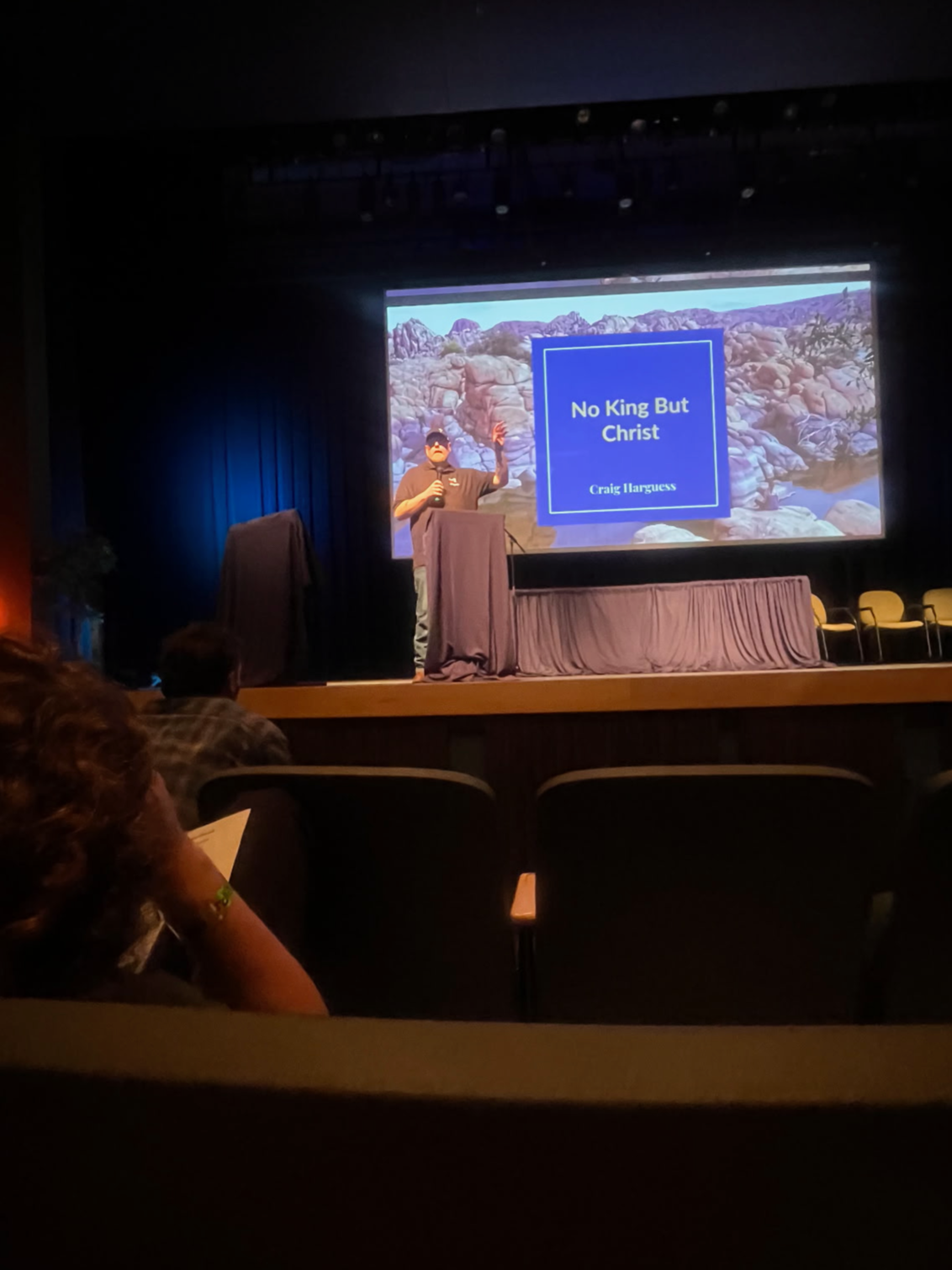
“No King but Christ” means what it says. No president, nation, pastor, party, or flag gets the loyalty that belongs to Jesus.
When Pastors “Call the Shots”
Josif’s questions also led him to challenge church authority built on fear.
He remembers pastors saying things such as, “Don’t challenge me,” and, “I call the shots.” But that is not the leadership Jesus modeled. Jesus knelt. Jesus washed feet. Jesus warned His disciples not to rule like the kings of the nations.
Josif no longer stands behind a pulpit when he speaks. He comes down to the same level as the people in the room. The movement is small, but the message is clear: we are learning together.
Religious control and state control often speak the same language. Both demand submission. Both punish questions. Both build systems that benefit the people at the top.
Josif believes much of this is fear-based. Fear of punishment. Fear of disorder. Fear that everything will collapse unless a strong leader takes control.
But Christians already have a King. We do not need to manufacture another one.
Walking Away from Political Salvation
Josif once considered running for local office. He voted because that was what responsible Christians were expected to do. He even heard pastors suggest that a person was not a real Christian unless they voted.
Today, his view is different.
He no longer expects the political system to bring the Kingdom of God. He has watched systems change people more often than people change systems. Craig makes the point plainly: being “the light of the world” does not mean ruling over our neighbors.
Light looks like enemy-love. It looks like feeding people, telling the truth, forgiving, serving, and refusing to repay evil with evil.
We do not become more Christlike by gaining the legal power to force people to behave as we wish. Jesus changes hearts through invitation, truth, sacrifice, and love, not through a ballot-backed threat.
The Other War Within
Around the middle of the episode, the conversation shifts. The flag gives way to a father’s journal. Political control gives way to the helplessness of watching someone you love suffer.
Josif’s son Ryan dealt with childhood migraines and chronic pain. Pills were available. Pain relief slowly became something else. Feelings of being unloved, painful losses, broken trust, and the death of his grandmother added to the weight.
Josif wrote The War Within from a parent’s point of view. He did not want to write it at first. Returning to old journal pages brought the fear and grief back to life. Yet writing also became part of his healing.
For years, addiction shaped the whole family. Josif and his wife described their condition in medical terms. Sometimes they were stable. Sometimes critical. Sometimes on life support.
“I had a knot in my stomach for a decade,” Josif says. “Addiction is a beast.”
Love Cannot Force Someone Free
Families dealing with addiction know the terrible urge to fix everything.
Find the right rehab. Make the right phone call. Drive another three hours. Say the right prayer. Watch more closely. Try harder.
Josif drove across the state again and again during one terrible month. Ryan told him, “The hooks are in so deep. I don’t know how I’m going to get out of this.”
Then someone at a church service offered Josif a hard word:
“You’re trying too hard. You’re trying to control the situation. Just step back. Just let God be God.” — 44:05
Letting go did not mean Josif stopped loving Ryan. It meant admitting that a father could not become his son’s savior.
Three days later, Ryan called and asked Josif to come get him. Recovery was not smooth or simple. There were setbacks. There was detox, long treatment, reading, faith, and a slow rebuilding of life. Josif says Ryan had been clean for eight years at the time of the recording.
The story is not a formula. Every person and every recovery path is different. It is a witness to grace that kept showing up.
More Than a Label
Josif challenges the shame often placed on people with addictions.
Churches may call people dirty, hopeless, or permanently defined by the worst part of their lives. Josif points instead to the New Testament language of new creation, saints, and a royal priesthood.
That does not mean pretending harm never happened. Grace tells the truth. But grace also refuses to reduce a human being to a label.
Craig connects this to his brother TJ, who died after struggling with alcohol and depression. TJ was not a bad person. He was a peaceful man who carried pain and could not find a way out.
The stories of Ryan and TJ remind us that addiction touches more than one body. It reaches parents, siblings, spouses, children, and friends. Yet shame does not heal anyone.
Love may not control the outcome, but it can keep the door open.
“God Just Calls Us to Love”
Near the end, Josif talks about the people he has met in treatment centers and recovery spaces.
“They are wonderful people,” he says.
Addiction can lead people to say and do awful things. Families need boundaries. Harm should not be denied. But the addiction is not the whole person.
Josif remembers hearing someone use cruel terms for people struggling with drugs. After she read his book, her language changed.
“We’re all struggling with something… God doesn’t call us to judge. He just calls us to love.” — 54:40
There is the thread connecting both halves of this episode.
Christian nationalism looks at enemies and asks how the state can control them. Religious legalism looks at sinners and asks how the church can shame them. Fearful families may look at addiction and ask how they can force someone to change.
Jesus meets people without turning them into projects.
He tells the truth. He protects the wounded. He resists coercion. He loves without pretending. He lays down His own life rather than taking someone else’s.
Flags demand allegiance. Shame demands hiding. Jesus invites us into truth, freedom, mercy, and love. That is the Kingdom.
🤝Connect with Josif🤝
Email: thewarwithinmystory@gmail.com
Instagram: @Josifwright
X: @Josifwright
Nostr/Damus: @j3
Highlights & Takeaways
Questioning inherited teaching can be an act of faith, not rebellion.
No modern nation deserves unconditional Christian loyalty or support.
A flag in a sanctuary can quietly teach divided allegiance.
“Be the light” means loving and serving people—not gaining power over them.
Fear-based pastors often mirror the control methods of the state.
Addiction affects entire families, and recovery cannot be forced from the outside.
People struggling with addiction are still image-bearers, not insults or labels.
Grace tells the truth while refusing to abandon the person.
Listen
Notice where Josif’s political awakening and his family’s addiction story overlap. Listen for the moments when control fails and mercy begins.
Reflect
Where has fear shaped your faith? Have you placed more hope in a political leader, pastor, program, or personal plan than in the patient way of Jesus?
Read
Read Matthew 5:43–48, Galatians 3:26–29, John 18:33–38, and 2 Corinthians 5:17. Ask what these passages say about enemies, identity, nations, and new creation.
Practice
Sit with someone who is struggling without trying to fix them in the first five minutes. Listen, learn their story, and offer one form of help they are willing to receive.
Episode Breakdown:
(00:00) Leaving Christian nationalism
Josif Wright’s changing beliefs
Craig’s connection through TJ
(02:42) Meet Josif Wright
Public-school educator and coach
Hospice chaplain and church speaker
Rare-disease advocacy
(04:20) “Don’t trust the government and be kind”
JAG classroom lessons
Student questions about war
Thinking beyond the curriculum
(07:02) Questioning old church teaching
Doing your own research
Pastors and microphones
Tithing, ministry, and inherited claims
(08:30) God is pro-people
Israel and Palestine
Galatians and human identity
Love beyond political teams
(11:22) Nation-state Israel and Christian nationalism
Allegiance to Jesus
Violence without a Kingdom blank check
(16:19) Josif’s slow change of mind
No single conversion moment
Five years of deep rethinking
Regret without hiding
(19:14) Digging deeper into Scripture
Original-language study
Romans 13 questions
The Bible beyond American assumptions
(21:40) Legalism, flags, and fear
National symbols in worship
Authoritarian pastors
Submission benefiting institutions
(25:18) Two masters and the pledge
Allegiance to the republic
Craig’s personal conviction
Flag beside the cross
(27:37) Students who will not stand
Classroom Pledge of Allegiance
Respect without forced participation
Younger people questioning nationalism
(29:10) Voting and political identity
“Real Christians vote”
Leaving party categories
Josif’s changing civic habits
(33:17) Being light without ruling
Neighbor-love and enemy-love
Political office and coercion
Trust in Christ beyond collapsing systems
(34:53) Introducing The War Within
Ryan’s decade-long addiction
Craig’s memories of TJ
Grief as shared ground
(36:10) Writing from a father’s view
Journals and painful memories
Ryan’s permission
Writing as therapy
(37:10) Pain beneath addiction
Childhood migraines
Pills and chronic pain
Loss, loneliness, and grief
(40:00) A family on life support
Years of fear
Multiple treatment programs
Limits of short-term fixes
(42:35) “The hooks are in so deep”
December 2016
Repeated drives to help Ryan
Belief, struggle, and grace
(44:05) Letting God be God
Releasing control
Prayer across states and nations
Trust without clear answers
(45:00) “Come get me”
Leaving the heroin house
Home detox
A new opening
(46:00) Building a life after addiction
Reading and new interests
Setbacks without surrender
Finding the next step
(47:10) Eight years and a new identity
Recovery and freedom
New-creation language
Saints instead of shame
(51:00) Craig remembers TJ
Depression and alcohol
COVID-era isolation
Limits of family control
(53:40) Changing how churches speak
People beyond their addiction
Cruel labels challenged
Love where people are
(55:56) Where to find Josif
Book retailers
Social media and email
Free copies for people in need
Related Episodes


Related Blog Post