115. Policing Without the State: Rethinking Law Enforcement with Jeff Perry

About this Episode

What would security look like in a society without government? In this episode of the Bad Roman podcast, host Craig Harguess sits down with Jeff Perry from Voluntarism in Action to explore this intriguing question. They delve into the concept of voluntary society security, discussing how private security firms, insurance-based models, and community-based solutions could replace traditional policing.

The conversation begins with a critique of the current government-run police system, highlighting significant issues such as qualified immunity, police militarization, and the lack of accountability. Jeff and Craig argue that the existing system often fails to protect citizens and instead perpetuates a cycle of fear and control. "The police protect you from what they'll do to you if you don't pay them," Jeff asserts, challenging listeners to rethink the foundational myths surrounding government and security.

Moving beyond critique, the discussion shifts to how free market principles could offer better incentives and outcomes for security services. Jeff explains how private security firms and insurance-based models could create a more efficient and ethical system. "In a free market, everyone together is smarter than anyone working alone," he notes, emphasizing the potential for innovation and improved services when competition is allowed to flourish.

The episode also explores community-based solutions, such as neighborhood watch programs, which could provide localized and responsive security. These solutions, Jeff argues, would be more accountable to the people they serve, unlike the current system where police are often insulated from consequences.

From a Christian perspective, Craig and Jeff delve into how voluntary solutions align more closely with Christian principles than coercive government systems. They discuss the moral implications of using force and coercion, contrasting it with the teachings of Jesus. "Jesus wants your heart. He doesn't want to force you to obey his commands," Jeff explains, highlighting the ethical alignment between Christianity and voluntaryism.

Episode Quotes:

"The police protect you from what they'll do to you if you don't pay them."

"In a free market, everyone together is smarter than anyone working alone."

Quick Takeaways:

  • Understanding the potential of private security firms and insurance-based models in a voluntary society.

  • Recognizing the flaws in the current government-run police system, including issues of accountability and militarization.

  • Exploring how free market principles can create better security outcomes.

  • Challenging the myth that government inherently protects its citizens.

  • Aligning Christian principles with voluntary, non-coercive solutions for societal issues.

This episode is sure to provoke thought and encourage listeners to reconsider their views on security and governance. Tune in for a compelling discussion that questions the status quo and envisions a freer, more ethical society.

Connect with Jeff:

Episode Timestamps:

00:02 Welcome and Introduction

  • Craig kicks off the Bad Roman podcast.

  • Today's topic: What would security look like in a voluntary society?

  • Special guest: Jeff Perry from Voluntarism in Action (VIA).

00:22 Recurring Question on Security in a Voluntary Society

  • Craig talks about the common question he gets about security in a voluntary society.

  • Reintroduces Jeff Perry, who previously appeared with his wife, Sarah.

01:53 Jeff Perry's Article on Voluntary Society Security

  • Jeff wrote an article on voluntary society security that Sarah shared in their discussion group.

  • Craig found the article insightful and wants to dive deeper into it.

3:07 Personal Experiences and Reflections

  • Craig and Jeff share their personal journeys towards understanding voluntarism.

  • Craig talks about his initial struggle with the concept, especially regarding police.

4:20 Police and State Power

  • They discuss the imbalance of power between police and the public.

  • Craig and Jeff debunk the myth that police are there to protect you.

7:14 Qualified Immunity and Police Accountability

  • Jeff explains qualified immunity and how it shields police from accountability.

  • They compare police behavior to that of ordinary citizens and highlight the unfairness.

11:07 Voluntary Society and Security Models

  • Jeff outlines potential security models in a voluntary society, like neighborhood watches and private security agencies.

  • The role of insurance companies in providing security services to reduce claims and enhance protection.

16:32 Economic Incentives and Market Solutions

  • Discussion on how market incentives would drive better security solutions.

  • The potential for various security agencies catering to different community needs and values.

20:22 Addressing Concerns about the Poor

  • How would poorer communities get security services in a voluntary society?

  • The role of community efforts and pro bono services.

24:56 Misconceptions about Lawlessness

  • Clarifying that a voluntary society would still have rules and agreements.

  • The importance of mutual respect and cooperation in maintaining order.

30:34 Private Prisons vs. Private Policing

  • Jeff addresses concerns about private prisons and distinguishes them from true market-based security solutions.

  • Focus on restitution and compensation rather than punishment.

36:49 Military and National Defense

  • Brief discussion on the myth of national defense and how voluntary solutions could address security without a standing army.

  • Reference to the book "The Myth of National Defense" by the Mises Institute.

40:39 Closing Thoughts

  • Craig and Jeff reflect on the importance of spreading the message of voluntarism.

  • Encouragement for listeners to support Voluntarism in Action and other voluntary efforts.

43:06 Contribution to The Show

  • Craig invites listeners to donate to the Bad Roman project through Spotfund.

  • Information on how donations support local charities in Memphis, Tennessee.

47:28 Final Remarks

  • Craig thanks Jeff for the insightful conversation.

  • Encouragement for listeners to engage with the Bad Roman podcast and share their thoughts.


Related Episodes
Related Blog Post

114. Who Would Jesus Bomb? Questioning War Through Song with Jordan Smart

About this Episode

Musician Jordan Smart shares his journey from growing up in a religious household in Ohio to becoming a touring musician. He discusses his early disillusionment with the church, his deep connection to music, and how punk rock influenced his worldview. The conversation centers around Jordan's song "Who Would Jesus Bomb?", which caught Craig's attention and led to this discussion. Jordan explains that while he isn't vocally anti-war, his frustrations with how religious traditions can be manipulated for propaganda inspired him to write the song.

Jordan reflects, "I was raised to believe Jesus loves everyone, but seeing how that message gets twisted to justify violence really pushed me to write this song." The episode delves into the troubling support for war among Christians, the manipulation by governments, and the importance of compassion and humanity. Jordan also highlights his project, Songs Not Bombs, which raises funds for Palestinian children.

Craig and Jordan discuss poignant lines from the song, such as, "Would Jesus bomb the atheist, the Muslim, or the Jew?" and "Would you still believe in Jesus if you found out he was brown?" These lines challenge listeners to reconsider their views on war, politics, and faith. This episode is a thought-provoking listen for anyone interested in these critical issues.

Connect with Jordan Smart:

Episode Timestamps:

Timestamps:

(00:45) Jordan's Background

  • Jordan shares his upbringing in Ohio and his religious family background

  • His journey with music, starting from a young age

  • Background with Christianity and anarchy

(02:00) Music as a Form of Protest

  • Discussion on Jordan's project "Songs Not Bombs"

  • Efforts to raise funds for the Palestinian Children's Relief Fund (PCRF)

  • The impact of music in processing and responding to world events

  • Anti-War Sentiments

    • Jordan's long-standing anti-war beliefs were influenced by punk rock

  • Reflections on the current state of global conflicts

(7:27) The Power of Music

  • Craig and Jordan discuss the emotional impact of music

  • Music as a medium to express complex feelings and ideas

  • The ability of music to resonate with diverse audiences

(9:40) Christianity and War

  • The troubling support for the war among some Christians

  • The disconnect between Jesus' teachings and modern Christian behavior

  • Reflections on the pro-war stance of certain Christian groups

(11:59) Generational Perspectives

  • The younger generation's growing disillusionment with the current system

  • The potential for the younger generation to drive change

  • The impact of social media and 24-hour news cycles on youth

  • Political Disillusionment

    • Failures of both major political parties in the U.S.

    • The need for a new approach to governance and societal issues

    • Personal experiences with political disillusionment

(16:45) Personal and Political Pushback to Jordan’s Song “Who Would Jesus Bomb?”

  • Jordan shares experiences with pushback from friends and family

  • The challenges of speaking out on controversial issues

  • The importance of staying true to one's beliefs.

(20:51) Echo Chambers and Authenticity

  • The importance of breaking out of echo chambers

  • Staying authentic and true to one's message

  • The impact of authenticity on audience engagement

(24:26) The Role of the Military

  • Discussion on military recruitment and its implications

  • The true threats to freedom and liberty

  • Reflections on the U.S. military's global impact

(30:43) Compassion and Humanity

  • Emphasizing the need for compassion towards all people

  • The interconnected nature of various social justice issues

  • The role of compassion in creating a better world.

34:59 Challenging Beliefs

  • Jordan's song as a tool to challenge deeply held beliefs

  • The importance of questioning and re-evaluating one's views

  • The impact of music in provoking thought and discussion

(39:40) Personal Journeys

  • Craig shares his journey from neoconservatism to Christian anarchism

  • The influence of early church writings on his views

  • The role of personal experiences in shaping beliefs

(43:17) The Influence of Social Media

  • The role of social media in shaping public opinion

  • The dangers of misinformation and propaganda

  • The impact of social media on political and social views

(47:27) Interconnected Issues

  • The interconnected nature of various social justice issues

  • The importance of addressing these issues collectively

  • The role of music and activism in highlighting these connections.

(52:19) Political Theater

  • The manipulation of public opinion by the ultra-wealthy ruling class

  • The need for unity among the oppressed.

  • The impact of political theater on societal divisions

(57:52) Blonde Hair and Blue Eyes: Jesus and Race

  • The significance of recognizing Jesus' true background

  • The implications of Jesus' ethnicity for modern Christianity

  • The importance of challenging racial stereotypes in religious contexts.

(1:00:13) Encouragement and Support

  • Jordan shares the overwhelming support he has received for his music

  • The importance of continuing to speak out on important issues

  • Reflections on the impact of his song "Who Would Jesus Bomb?"

(1:03:21) Final Thoughts

  • Craig encourages Jordan to keep leaning into his message

  • The importance of making a difference through music and activism

  • Reflections on the need for boldness and authenticity in advocacy.


Related Episodes

Related Blog Post

113. From Mormon LDS to Freedom in Christ: Unveiling Lies in Medicine, Government, and Religion

About this Episode

In this episode of the Bad Roman podcast, host Craig Harguess speaks with Claire Dalton, the host of the Clarity podcast. Claire shares her journey of leaving the LDS Church, her battle with chronic Lyme disease, and her views on the influence of government and institutional corruption. This episode explores faith, freedom, and the pursuit of truth, offering listeners a comprehensive understanding of these issues.

Claire begins by discussing her background, including her upbringing in Utah within the mainstream LDS Church. She delves into the cultural and religious environment she grew up in and the factors that led her to question and eventually leave the LDS Church. Claire also shares her professional experiences as a farmer, nonprofit president, and sales representative, explaining how these roles have shaped her perspectives and contributed to her current projects.

A significant portion of the conversation addresses common misconceptions about Mormonism, particularly the belief that polygamy is a central tenet of the faith. Claire provides historical context and evidence to challenge these mainstream LDS teachings, arguing that the original teachings of Joseph Smith did not endorse polygamy. She also highlights the experiences of those who leave the LDS Church to follow Christ, differentiating them from those who leave religion entirely, and discusses the importance of creating platforms to share their stories.

Claire's personal and family struggles with chronic Lyme disease are another focal point of the episode. She details the symptoms, misdiagnoses, and the long journey to finding the correct diagnosis for both herself and her mother. The conversation delves into the controversial origins of Lyme disease, including theories about government involvement and bioweapon experiments. Claire discusses the historical context, such as Operation Paperclip and the release of weaponized ticks, and criticizes the medical system for its inability to properly diagnose and treat chronic illnesses like Lyme disease. She shares her journey of seeking alternative treatments and emphasizes the importance of partnering with God for healing.

The episode also explores the influence of government and institutional corruption. Claire argues that government control has infiltrated numerous sectors, including the food industry, education, the medical system, and even religious institutions. She provides examples of how this corruption manifests and its effects on society. Claire argues that statism is inherently satanic, highlighting how government control contradicts Christian teachings and discussing the importance of recognizing and resisting this influence to live a life aligned with Christ's teachings.

Faith and freedom are central themes throughout the episode. Claire and Craig emphasize the significance of the message "No King but Christ" in contemporary Christianity, discussing how this principle guides their lives and the importance of prioritizing Christ over state and institutional allegiances. Claire shares her vision for creating authentic Christian communities that are not bound by traditional church structures, advocating for home churches and genuine fellowship centered around Christ's teachings.

Listeners will gain insights into the personal and spiritual challenges faced by those who leave the LDS Church and seek to follow Christ. They will learn about the controversial origins of Lyme disease, the failures of the medical system, and the importance of seeking alternative treatments. The episode also provides an understanding of the influence of government in various aspects of life and its implications for personal freedom and societal well-being. Finally, listeners will discover the importance of prioritizing Christ over state and institutional allegiances and the value of building authentic Christian communities.

This episode explores the intersections of faith, health, and societal structures, providing listeners with insights and encouraging them to question and explore their own beliefs and experiences. Claire's storytelling, combined with Craig's questions, makes this a valuable listen for anyone interested in the complexities of faith, freedom, and truth.

Connect with Claire Dalton:

Episode Timestamps:

Timestamps:

1:04 Guest Introduction

  • Claire Dalton shares her background: raised in Utah, former LDS member, farmer, nonprofit president, and sales representative.

  • Claire's journey from mainstream LDS to her current faith and projects.

2:22 Entanglement of Churches with the State

  • Discussion on how the events of 2020 revealed the deep entanglement of many churches with the state.

  • Claire's observations on the disillusionment of many Christians with their churches during this period.

1:41 Claire's Personal Journey

  • Claire's story of leaving the LDS church and starting her podcast.

  • The importance of sharing stories of those who leave the LDS church to follow Christ.

5:28 Misconceptions about Mormonism 

  • Claire addresses common misconceptions about Mormonism, including the belief that Joseph Smith practiced polygamy.

  • Historical evidence and personal beliefs that challenge mainstream LDS teachings on polygamy.

26:35 The Impact of Chronic Illness

  • Claire's personal and family experiences with chronic Lyme disease.

  • The political and controversial history of Lyme disease, including its origins and the government's role.

30:18 Critique of the Medical System

  • Discussion on the failures of the medical system to address chronic illnesses effectively.

  • The role of vaccines and other medical interventions in exacerbating health issues.

53:04 Statism and Its Influence

  • Claire and Craig discuss the pervasive influence of statism in various aspects of life, including food, education, and healthcare.

  • The idea that statism is inherently satanic and contrary to Christian teachings.

59:20 Closing Remarks

  • Seek the truth and question the systems they are part of

  • The importance of community and supporting those who are chronically ill or marginalized.

  • Craig and Claire reflect on the importance of living out Christian values authentically


Related Episodes

Related Blog Post

112. Inflation, Tariffs, & the Faith-Filled Path to True Independence with Mike (Michael) Maharrey

About this Episode

In this episode of the Bad Roman podcast, host Craig Harguess is joined once again by Mike Maharrey for a deep dive into the world of Christianity, government, and economics. If you’ve ever wondered how inflation and taxation really affect your daily life, this episode is for you.

Mike kicks things off by breaking down the history of monetary policy, starting from the Great Recession of 2008 all the way to today. He explains how the Federal Reserve’s actions, like printing money and keeping interest rates super low, have led to some serious economic issues. And here’s the kicker: both major political parties are on board with these practices. So, whether you’re Team Red or Team Blue, the underlying economic policies are pretty much the same.

Craig and Mike also tackle the topic of tariffs, especially those that were a big deal during the Trump years. Mike makes it clear that tariffs are basically a tax on us, the consumers. So, while they might sound like a good way to penalize foreign producers, they end up hitting our wallets the hardest. This leads to a broader chat about the real cost of government policies and why it’s so important for us to understand what’s going on.

But it’s not all about economics. The episode also dives into the idea of resisting unconstitutional laws. Mike argues that saying “no” to unjust laws is a powerful form of resistance. He points out that Christians, in particular, have a moral duty to stand up against laws that go against their faith and the teachings of Jesus.

As this is the Fourth of July, Craig and Mike take time to reflect on what independence really means. Spoiler alert: it’s not just about fireworks and barbecues. True independence, they argue, is about having the courage to stand up for your beliefs and question the status quo. They encourage listeners to get educated about economic and political issues and to take action to protect their freedoms.

This episode of the Bad Roman podcast is a mix of history, economics, and a good dose of moral questioning. It’s informative, thoughtprovoking, and will definitely make you rethink some of your views on government and faith. So, grab your headphones and get ready for a conversation that will add a little more spark to your sparklers.

Connect with Mike Maharrey:

Episode Timestamps:

00:01:06: Welcoming Back Mike Maharrey

  • Mike Maharrey's Background

  • Journey as a Christian and anarchist

  • Involvement with the 10th Amendment Center and focus on decentralization.

  • Work in sound money and precious metals.

00:06:20: Independence Day and Election Year

  • Frustration with repetitive political cycles.

00:08:17: Monetary Policy and Inflation

  • Federal Reserve's role in creating money and its impact on inflation.

  • Historical context: Monetary policy during the Great Recession and COVID19.

  • Analysis of how monetary policy benefits those in power, regardless of political affiliation.

00:13:09: Economic Misconceptions

  •  Common misunderstandings about the causes of inflation.

  •  Federal Reserve's influence on economic cycles and price inflation.

  •  Political blame games and the reality of economic policies' longterm effects.

00:19:46: Historical Context of Monetary Policy

  •  PostGreat Recession monetary policy and its longterm consequences.

  •  Quantitative easing: Definition and impact on the economy.

  •  Effects of maintaining low interest rates for an extended period.

00:23:50: Tariffs and Their Impact

  • Tariffs as a form of taxation on consumers, not foreign producers.

  • Economic impact: Increased prices for imported goods.

  • Comparison of Trump and Biden's tariff policies and their effects on the economy.

00:31:58: Gun Control Policies

  • Analysis of Trump's and Obama's records on gun control.

  • Specific policies: Trump's bump stock ban and its implications.

  • Misconceptions about political stances on gun rights and their realworld effects.

00:35:28: The 10th Amendment and State vs. Federal Law

00:39:34: Resistance to Government Overreach

  • Historical examples of successful resistance to government overreach.

  • Role of public noncompliance in maintaining liberty.

  • Importance of individual action and civil disobedience in checking government power.

00:46:17: COVID-19 and Church Shutdowns

  • Churches' varied responses to government mandates during the pandemic.

  • Early church's stance on state authority and civil disobedience.

  • Biblical reference: Acts 5 and the principle of obeying God rather than man.

00:50:14: Immigration and Christian Perspective

  • Moral implications of current immigration laws and policies.

  • Personal experiences working alongside immigrants and their struggles.

  • Christian duty to love and support neighbors, regardless of legal status.

00:55:52: Independence Day Reflections

  • Comparison of American independence to other countries like Canada.

  • Critique of the true extent of American freedom and independence.

  • Argument that true independence is found in faith and the kingdom of Christ, not in political systems.

01:01:11: Mike Maharrey's Projects and Resources

01:04:42: Supporting the Bad Roman Project


Related Episodes

Related Blog Post

111. God vs MAGA: The Dangers of Mixing Christianity with American Nationalism

About this Episode

What happens when political figures are compared to religious icons? Join us on the Bad Roman Podcast as we explore this provocative question with our special guest, singer-songwriter Josh Nichols. In this episode, we dive into the unsettling comparisons between Donald Trump and Jesus, especially during election season on social media.

Comparing Donald Trump to Jesus is not just misguided—it's deeply problematic. Through his powerful song "God vs MAGA," Josh challenges the troubling idolatry of political figures and sheds light on the toxic rhetoric that equates Trump with Christ. We'll explore how these false comparisons harm our faith and divert our focus from the true essence of Jesus' teachings.

American nationalism has often cloaked itself in the guise of Christianity, but what does this mean for our spiritual integrity? We dissect the disturbing tendency to merge faith with national pride, examining how this threatens to turn patriotism into idolatry. Josh, through his song "God vs MAGA," unpacks the manipulation of religious beliefs by political entities and how such actions lead to a misguided faith in political leaders. Together, we scrutinize the parallels between Trump's portrayal and the biblical figure Barabbas, emphasizing the crucial need to discern truth amidst the political noise.

We highlight the conflict between personal rights and biblical principles of humility and selflessness by unpacking the theological implications and contrasting earthly citizenship with eternal values. Josh’s poignant lyrics, including the line "God doesn't want to make America great again," serve as a stark reminder that our allegiance should be to God's kingdom, not a nation.

Critical thinking and independent thought are crucial in navigating the noise of corporate media and political propaganda. We discuss the liberating power of relinquishing control to faith and how critical thinking fosters confident, independent opinions. From addressing the idolatry of political beliefs to critiquing the hypocrisy within pro-life stances, this episode is a call to elevate our faith above nationalism and strive for a greatness rooted in God's infinite and unconditional love, not a nation-state’s past.

We wrap up with personal reflections and broader societal critiques, highlighting the tension between national identity and spiritual integrity. Join us for this eye-opening dialogue that underscores the ultimate greatness found in God's kingdom and His unconditional love.

Connect with Josh Nichols:

Episode Timestamps:

Timestamps:

(00:00:02) God vs MAGA

  • Comparison of Donald Trump to Jesus and its implications

  • Insights from Josh Nichols on political manipulation

  • Analysis of Trump's portrayal and parallels with Barabbas

  • Discussion on Josh's song "God vs MAGA"

(00:09:37) Jesus, Nationalism, and Idolatry

  • Examination of the blending of Christianity and American nationalism

  • Discussion on the theological implications of national pride

  • Insights into the idolatry of associating Jesus with American symbols

  • Analysis of the contrast between earthly citizenship and the kingdom of God

(00:22:52) Navigating Critical Thinking in Society

  • Importance of critical thinking and relinquishing control to faith

  • Impact of corporate media on public opinion

  • Advocacy for independent sources over divisive media channels

  • How critical thinking fosters confidence in beliefs without alienating others

(00:32:38) America and Christianity

  • The intersection of faith and patriotism and potential conflicts

  • Discussion on political beliefs as modern idols

  • Reference to the song "Clear the Stage" and the dangers of elevating anything above God

  • Addressing hyperpolitical theology and the importance of understanding

(00:42:49) American Hypocrisy and Eternal Greatness

  • Tension between American freedom and spiritual constraints

  • Church responses to government mandates during the COVID-19 pandemic

  • Examination of political actions versus genuine Christian values

  • Discussion on hypocrisy within pro-life stances and national identity versus spiritual integrity

(00:51:42) Greatness in God and Music

  • True greatness in God's kingdom versus making America great again

  • Role of music in glorifying God and addressing faith issues

  • Josh's passion for creating a community discussing faith, church hurt, and belief

  • Emphasis on respectful dialogue within diverse Christian beliefs

(01:02:15) Faith in Modern Society

  • Challenges of maintaining faith in a rapidly changing world

  • Influence of social media on religious beliefs and practices

  • The role of the church in addressing contemporary social issues

  • Strategies for fostering a supportive faith community

(01:12:03) Balancing Faith and Personal Beliefs

  • Personal stories of reconciling faith with modern values

  • The impact of personal experiences on religious views

  • Navigating disagreements within the church community

  • Encouragement for open-mindedness and growth in faith

(01:22:48) Future of Christianity in America

  • Predictions on the evolution of Christianity in a diverse society

  • The potential for interfaith dialogue and cooperation

  • The role of young people in shaping the future of the church

  • Final thoughts on hope and perseverance in faith


Related Episodes

Related Blog Post

110. The True Reason Behind Jesus' Crucifixion: A Thought-Provoking Discussion with Reverend Caleb Lines

About this Episode

Are you among those who grew up with traditional Christian values yet find yourself questioning the relationship between your faith and political matters? If so, you're not alone. In this energetic episode of the Bad Roman Podcast, host Craig engages with the thought-provoking Reverend Caleb Lines in a discussion that may challenge the core of your theological understanding.

Why was Jesus crucified? Was it a political statement against the empire, or was it a divine act of atonement for humanity's sins? Reverend Lines, coming from a progressive Christian standpoint, proposes a provocative notion in his sermon "Jesus was crucified for standing up to empire and not to atone for the sins of humanity." This episode delves into the rich historical and political backdrop of Jesus' crucifixion, compelling listeners to revisit and potentially revise their conventional beliefs.

The conversation further delves into the concept of atonement as depicted in the New Testament. We examine the contrasting portrayals of Jesus in the Synoptic Gospels versus John, raising the question: Is there a harmonious theological stance within the New Testament, or does it contain significant discrepancies? Challenging the development of penal substitutionary atonement theory, Reverend Lines and Craig illuminate the intricate nuances found in the New Testament writings, with the aim of fostering a more layered understanding of Jesus' teachings and their modern-day relevance to Christian faith and conduct.

As the episode progresses, we delve into the essence of progressive Christianity. Reverend Lines discusses its foundation in the core teachings of Jesus—advocating for peace, justice, and inclusivity—and its application in today's world, particularly regarding contemporary humanitarian issues. He provides insights into how pastors can lead their congregations in navigating the complex terrain of faith intertwined with politics.

The concept of Christian anarchy is also brought to the fore, examining whether voluntary charity could offer a more effective solution to societal challenges than government interventions. This segment questions the effectiveness of political leaders and suggests that perhaps a more Christ-like approach to societal problems could be more fruitful.

Whether you're firmly rooted in your beliefs or on the cusp of a spiritual reassessment, this episode is a must-listen. It invites you to join a conversation that not only digs deep into theological discourse but also touches upon the pressing social justice issues of our time.

Discover a new perspective on Jesus' crucifixion and its implications for the contemporary Christian journey. Engage with this critical episode of the Bad Roman Podcast, where faith, politics, and social justice intersect.

Connect with Reverend Caleb Lines:

Episode Timestamps:

01:07 Christians' Entanglement With the State

  •  Reverend Caleb Lines introduces his background in progressive Christianity

  •  Jesus' crucifixion, discussing it as a political act against empire as opposed to only for atonement

  • Historical context of Jesus' execution by the Roman Empire

  •  Conversation on the intersection of faith and politics and the challenge to traditional theological interpretations

07:15 Jesus' Subversive Message

  •  Detailed exploration of Jesus' radical message in its historical context

  •  How this message clashed with the political powers of the time

  •  The role of the crucifixion in the broader political struggle

15:02 Understanding Atonement in New Testament

  •  Unpacking the concept of atonement and contrasting views of Jesus in the Synoptic Gospels and John

  •  Clarification of misconceptions about a unified New Testament theology

  •  Emphasis on historical and political context over penal substitutionary atonement

  •  Examination of Jesus' message of loyalty to God's reign over Roman rule

22:10 Jesus as a Political Figure

  •  Explores the political implications of Jesus' message

  •  How this message was perceived by Roman authority

  •  Jesus' death as a result of his political activism

27:37 Interpretations of Scripture and God

  •  The complexities of being labeled "woke" and addressing humanitarian crises like the situation in Gaza

  •  Role of pastors in facilitating dialogue within their congregations

  •  Conversation on biblical inerrancy and interpretive choices in translations

  •  Stress on the importance of questioning and wrestling with faith

32:45 The Problem of Biblical Literalism

  •  Discussion on the issues with taking biblical text at face value

  •  How different translations can alter meanings and interpretations

  •  Encouragement for a more nuanced approach to biblical interpretation

38:55 Progressive Christianity Defined Through Conversation

  •  Clear articulation of progressive Christianity's core values

  •  Emphasis on Jesus' original teachings of peace, justice, and inclusivity

  •  Misrepresentation of Christianity by the religious right

  • Communion as a symbol of unity and the breaking of social barriers

44:25 Tackling Misconceptions about Progressive Christianity

  •  Addresses common misunderstandings and criticisms about progressive Christianity

  •  Explores the nuances of the movement's values and beliefs

  •  Highlights the importance of dialogue and understanding

49:39 Christian Anarchy vs Government Accountability

  • Leveraging nonprofits and social programs in alignment with Jesus' teachings

  • Concept of Christian anarchy and voluntary charity as alternatives to government intervention

  •  Critically examines political leaders' failures to end military conflicts

  •  Unity among Christians on common issues despite different approaches

54:45 The Call to Social Justice

  •  Discussion on the Christian mandate for social justice

  •  How this mandate can be fulfilled in a modern context

  •  Reflection on the responsibility of the Church in addressing social issues


Related Episodes

Related Blog Post

109. Divine Renegade: Creed, Power, Living in Christian Anarchy

About this Episode

Join host Craig on a revolutionary exploration of Christian Anarchy with the provocative thinker known as the Royal Priest in this daring episode of the podcast. With over two decades of ministry experience, the Royal Priest, an author and host of eight podcasts, provides a rare perspective that pierces through the fabric of traditional Christian dogma. This episode is a must-listen for anyone poised on the precipice of spiritual awakening, yearning to explore the harmony of divine law and human governance.

This episode isn't just a conversation; it's a journey into the heart of what it means to be a follower of Christ in a world governed by man-made structures. Craig shares his transformation from an anarchist skeptic to a believer in a Christ-centered way of life, challenging the church's status quo and redefining what it means to truly serve a higher authority.

The Royal Priest's journey from established church leader to a nomadic truth-seeker provides a captivating backdrop to this dialogue. We examine the tension between comfortable doctrines and the radical truths of Jesus’s teachings. Are you prepared for the "great jubilation" and the reformation it heralds? 


It's an introspective look at the role Christians play in the political landscape and a contemplation of our allegiance: is it to God, state, or both?

As we round off this provocative dialogue, the spotlight turns to law enforcement and its alignment with divine justice. From unwavering support to critical reevaluation, Craig shares how his  journey mirrors a larger questioning within our society. For officers of faith, this is a call to measure your duties against the unyielding yardstick of divine righteousness.

People of faith, are you ready to confront these questions head-on? This episode is not just a passive listening experience; it's an invitation to challenge your perspectives, to stir your spirit, and to join a community seeking to align their earthly walk with the teachings of Christ. It's an invitation to weigh the constructs of governance against the immutable scale of divine righteousness. Don't miss out on this transformative dialogue that's bound to awaken, challenge, and inspire you.

Connect with the Royal Priest:

The graphic includes an illustration of a cross, a chess pawn with a crown reflection, and a small portrait of a person in the bottom right corner.

Episode Timestamps:

00:57 Exploring Christian Anarchy

  • Journey through 21 years of ministry and engaging with diverse audiences

  • Emphasis on kingdom values over traditional Christian narratives

  • Anarchic pursuit of God's will against state governance

  • Therapeutic aspect of vocalizing inner truths and guided prayer

09:06 Anarchy vs. Christ

  • Tension between Christian teachings and governmental support

  • Transition from anarchist principles to living for a higher king

  • Biblical insights on earthly governance, referencing 1 Samuel 8

  • Conflict between church doctrines and the radical message of Jesus

13:39 Government, Righteousness, and Christian Growth

  • Discussion on the authority of Christ in governance post-resurrection

  • Responsibility of infusing righteousness into political structures

  • Dealing with uncomfortable truths for spiritual maturity

  • Recognizing the cost of advocating for divine righteousness

23:49 Spreading the Message

  • Concept of "great jubilation" and the manifestation of God's kingdom

  • Preparedness for the transition and the risks of opposing divine direction

  • The contrast between public reliance on government and advocating for God's governance

  • Resistance from the church to kingdom-focused narratives

36:10 Reevaluating Views on Law Enforcement

  • Personal shift from supporting to questioning the police

  • Conflict of funding law enforcement through taxation

  • Encounters with "road pirates" and discussions within communities

  • Encouraging deeper understanding of policing issues

39:11 Questioning the Righteousness of Law Enforcement

  • Moral dilemmas for officers enforcing laws against religious ethics

  • Potential for power abuse within law enforcement

  • Historical church views on members in violent positions

  • Importance of aligning police actions with divine righteousness

46:41 Critiquing Justice and Proclaiming Righteousness

  • Struggle between human judgment and spiritual guidance

  • Spiritual warfare and the scriptural balance of peace and conflict

  • Growth challenges of outreach projects and importance of consistent messaging

  • Valuing criticism for growth and providing resources for divine empowerment


Related Episodes

Related Blog Post

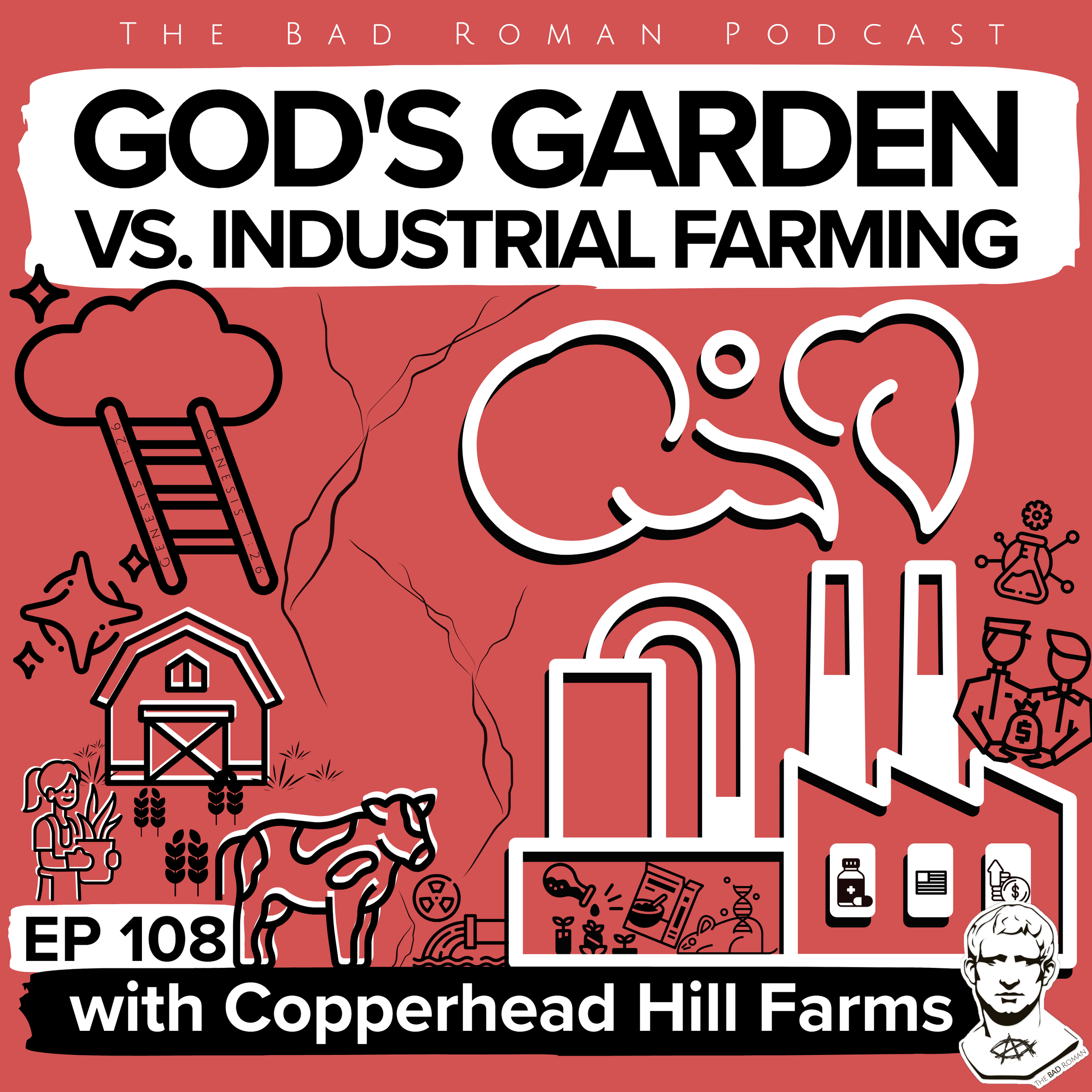
108. God's Garden vs. Industrial Farming

About this Episode

When Michael from Copperhead Hill Farms traded his suburban lifestyle for the pastoral rhythms of farm life, he didn't expect a couple of gifted pigs to sow the seeds for a revolution in local farming. His tale is a testament to the power of community and self-sufficiency, a narrative we unpick throughout this episode. Unfolding Michael's evolution alongside the challenges and triumphs of establishing a farm with his wife, Carrie, our conversation is a clarion call to reconnect with our food sources and empower our communities through conscientious consumption.

We've all felt the pinch of regulations and red tape, but have you considered how it affects the tomato on your plate or the salsa in your jar? Our discussion takes a turn toward the limitations faced by those who dare to venture into local food production. It's a candid look at the struggles to maintain integrity and quality in our food systems, punctuated by heartening tales of community resilience and the practical magic of trading eggs for tomatoes. Join us as we challenge the status quo of convenience and champion a return to authentic, locally-sourced sustenance. 

Our journey wraps up with a look at the significance behind the rebranding of Copperhead Hill Farms and how it reflects the rebellious spirit akin to moonshiners of yore. Michael and I share our personal transformations, from ideology shifts to the empowering embrace of Christian pacifism and community-focused living. The episode is a rallying cry for listeners to find strength in like-minded communities and take a firm stance in their beliefs. Saddle up for an episode that promises to ignite your spirit of independence and leave you pondering the true cost of the food that graces your table.

Connect with Michael and Copperhead Hill Farms:

Copperhead Hill Farms Website

Copperhead Hill Farms Instagram

Copperhead Hill Farms Facebook

Episode Timestamps:

Timestamps:

02:12 Local Farming and Community Autonomy

• Discussing the transition to sustainable farming, from suburban to farm life, and its impact on community support and the environment.

• The role of community collaboration in successful sustainable farming.

• How adopting farming can improve personal health and lifestyle.

• The potential of local farming to rejuvenate local economies and ecosystems.

07:57 Barter-Based Economy and Legal Challenges

• Personal experiences of a barter economy and the legal issues faced by small-scale farmers.

• The history and modern relevance of barter-based economies in rural communities.

• Legal barriers and regulations impacting small-scale and local farming.

• Advocacy efforts and resources for overcoming legal challenges in local farming.

18:23 Importance of Local Food Sources

• The role of local farming in food security and the benefits of supporting local farmers.

• How local food sources reduce the carbon footprint associated with food transport.

• The positive impact of local food sources on the nutritional value and taste of food.

• Ways to identify and support local food sources in your area.

25:44 Challenges and Solutions for Local Farmers

• Discussion on the high costs of sustainable farming and the influence of consumer choices on local farms.

• Strategies for overcoming financial challenges in sustainable farming.

• The role of consumer awareness and education in supporting local farms.

• The potential of technology and innovation to address challenges in local farming.

33:13 Autonomy and State Control

• Independence from state interference in sustainable farming, examples of entrepreneurial success strategies to navigate state regulations.

• The importance of balancing state control and farmer autonomy for a sustainable agricultural sector.

• Success stories of farmers who have navigated state regulations to establish successful local farms.

• The role of local communities and organizations in advocating for farmer autonomy.

43:02 Significance of Farm Name Change

• Transition from Black Sheep Farmstead to Copperhead Hill Farms and its symbolic significance in personal farming story.

• The role of branding and storytelling in connecting with consumers and the local community.

• The importance of embracing change and evolution in the journey of sustainable farming.

• How a name change can signify a new phase or direction in a farmer's journey.

58:49 Personal Ideological Transition

• Journey from neoconservatism to Christian pacifism and its impact on local farming and community engagement.

• The influence of personal beliefs and ideologies on farming practices and community relations.

• The potential of farming to be a platform for expressing personal beliefs and values.

• How ideological shifts can lead to changes in farming practices and community engagement.


Related Episodes

Related Blog Post

107. Psychedelic Christianity: Mystic Medicine & Jesus

About this Episode

Craig is joined by Ivan Soto, as we venture into the compelling and controversial territory where Christianity, anarchy, and psychedelics intersect. Listen in as Ivan recounts his personal experiences with these powerful substances, discussing their sacred nature and how they've impacted his spiritual journey. We tackle the tough questions about the role of psychedelics in cognitive enhancement and spiritual awakening, all while examining the risks and misconceptions that come with their use.

Venture with us through the spiritual and emotional landscapes that psychedelics can unlock. We ponder the government's role in regulating these substances and the societal stigmas attached to them. From the debated connection to witchcraft to their legal status, we don't shy away from the tough discussions. Discover why an open dialogue about these substances is crucial within the Christian community and what it means to engage with psychedelics responsibly.

Finally, we explore the transformative potential of psychedelics for personal growth and healing. Reflect with us on how these experiences can offer profound insights into our own psyches, sometimes through challenging "bad trips" that ultimately lead to personal development. Ivan and I consider the potential for psychedelics to be a tool in coping with life's hardships and the intriguing idea of achieving enlightened Christianity. Tune in as we also examine the broader spectrum of spiritual knowledge, questioning whether the Bible is the sole source of divine inspiration or if other experiences, like those with psychedelics, can provide a path to understanding.

Connect with Ivan Soto:

Episode Timestamps:

Timestamps:

01:02 Introduction: Exploring Psychedelics and Christianity

  • Ivan Soto opens the discussion with his personal journey with psychedelics.

  • The sacred nature of psychedelics is recognized.

02:00 The Double-Edged Sword of Psychedelics

  • Ivan underlines the fact that psychedelics aren't suitable for everyone.

  • Importance of understanding individual mental health when considering psychedelic use.

06:00 Stigmas Surrounding Psychedelics

  • Discusses the societal stigmas and misconceptions about substances like marijuana.

  • The damaging effects of misinformation on the perception of these substances.

09:16 Exploring Psychedelics and Spirituality

  • Discussion on the potential of psychedelics for inducing humbling experiences.

  • A reminder that not everyone is suited for these experiences.

11:00 Government Regulations and Psychedelics

  • A critique the government's role in regulating these substances.

  • Historical association of psychedelics with witchcraft.

12:00 The Christian Perspective on Psychedelics

  • Ivan calls for open Christian dialogue on the topic of psychedelics.

13:01 Debunking Misconceptions About Witchcraft

  • Discusses misconceptions about witchcraft and its overlap with prayer and reality manipulation.

17:00 Psychedelics as Tools for Spiritual Insight

  • The use of psychedelics for gaining spiritual insights.

  • Drawing parallels between religious figures and psychedelic users.

20:00 The Cultural Significance of Psychedelics

  • Exploring the cultural significance of substances like the Amanita muscaria mushroom.

22:54 The Therapeutic Potential of Psychedelics

  • The healing potential of psychedelics for emotional and cognitive issues.

27:45 Importance of Set and Setting in Psychedelic Use

  • The significance of environment and mindset when using psychedelics.

  • Personal insights on the experiences with MDMA and LSD.

30:00 Using Psychedelics for Personal Growth

  • The role of intention in using psychedelics for personal growth.

32:26 The Dark Side of Psychedelics: Bad Trips

  • Discusses "bad trips" as opportunities for personal insight and psychological understanding.

34:00 Recreational vs Therapeutic Use of Psychedelics

  • Highlights the differences between recreational and therapeutic use of psychedelics.

35:00 Psychedelics for Depression and Grief

  • Psychedelics as potential aids for coping with depression and grief.

35:09 Spiritual Enlightenment: Scripture vs Psychedelics

  • The debate on attaining spiritual enlightenment through scripture vs. psychedelic experiences.

40:00 The Role of the Holy Spirit in Guiding Truth

  • The Spirit's role as a guide to truth.

  • Early church writings enhancing understanding of the Bible.

43:00 Beyond the Bible: Other Sources of Divine Inspiration

  • Questioning the Bible as the sole source of divine inspiration.

  • Introduction to the concept of 'apocatastasis'.


Related Episodes

Related Blog Post

106. Jesus Has No Flag with Against All Flags Podcast Team

About this Episode

In this episode of the Bad Roman Podcast, host Craig Harguess welcomes Anthony, Nathan, and Wyatt from the Against All Flags podcast. Together, they navigate the turbulent waters of Christian Anarchy, holding steadfast to the conviction of 'No King but Christ.' The episode reveals the transformative power of a Christcentric anarchist viewpoint, as they share heartfelt stories about moving beyond traditional politics and organized religion, while keeping Jesus's teachings at the forefront.

They address the inner turmoil Christians often experience when their obligations to the state appear to conflict with their spiritual convictions. The discussion delves into the historical stances of the early church on nonviolence and examines how contemporary believers reconcile these seemingly contrary paths. 

Personal anecdotes, biblical reflections on flawed earthly rulers, and the unshakable sovereignty of Jesus are woven throughout the narrative, emphasizing the rallying cry 'No king but Christ.' The societal implications of standing against national symbols, such as the choice to stand or sit during the national anthem, are also tackled. 

Craig and his guests reflect on the journey of their respective podcasts, from inception to a firm dedication to merging Christian insights with issues of political culture. They celebrate the mission to guide listeners towards a deep, nonviolent faith that rejects the entanglements of statism and violence, acknowledging the global Christian community, the reach of podcasts, and inspirations like Stephen Rose from AnarchoChristian.

Connect with our guests:

Episode Timestamps:

Timestamps:

01:08 Exploring Anarchy Through Fiction

  •  Introduction to Joseph Macolino, inspired by Tolkien and Orwell.

  • Creation of the fictional universe Evorath, developed from high school to college.

  • Joseph's trilogy explores themes of questioning government authority and discovering Christian principles.

12:35 Spreading Christian Anarchy Through Fiction

  • The intersection of fiction and Christian anarchism is highlighted.

  • Influence of various texts, maintaining a critical perspective.

  • Story arc in fantasy series depicts the transition from monarchy to an anarchist society, paralleling historical movements.

  • Aim to challenge preconceptions and promote Christian anarchism through storytelling.

19:59 Discussing Writing, Influence, and Christianity

  • Focus on Evorath's world-building, where humans are divinely created.

  • Discussion on media influence and personal experiences of non-conformity.

  • Importance of writers in highlighting societal propaganda and Christian resistance.

  • Emphasis on living according to Jesus' teachings despite potential opposition.

28:22 God Is Strategic

  • A personal anecdote about a significant encounter and the concept of divine timing.

  • Reflection on the creative process and progress in writing projects.

  • Introduction of the 'Bad Woman Project' and a call for support.

  • Teaser for the content of upcoming books without giving away specifics.

31:46 Expanding on Book Two Characters

  • Insight into Averath's characters, including the villain Yazook Stahl.

  • Exploration of shapeshifter species and character development.

  • Themes of power, corruption, and societal improvement are examined through character arcs.

39:46 Fantasy Series and Libertarian Ideology

  • Introduction of diverse races and characters in the third book.

  • Characters question tribal loyalties, leading to the formation of a new community.

  • Discussion on societal ideals, comparing the fictional society to voluntarism.

  • Upcoming books to delve into the complexities of a society striving for harmony post-trilogy.


Related Episodes

Related Blog Post

105. Translating the Bible – Is the Greek Right? with Duncan Palmer

About this Episode

Have you ever considered how the subtle nuances of ancient Greek can reshape our understanding of biblical scriptures? Well get ready, because in this episode Craig welcomes back Duncan Kerry Palmer to dissect his thought-provoking article, "Political Power and the Connotation Conspiracy." The conversation delves into the complex relationship between Christianity and state authority, with a particular emphasis on the impact of ancient Greek language on biblical scripture interpretation.

The podcast reveals how the translation of words such as 'exousia' and 'hupotaso' from Greek to English can drastically change meanings from 'authority' to 'power' and 'obey' to 'align with.' These linguistic transformations shed new light on well-known scriptures like Romans 13 and Acts 5:29, prompting a reevaluation of Christian perspectives on government, law enforcement, and societal roles.

Palmer provides anecdotes from his biweekly theological debates, adding depth to the discussion on how these subtle linguistic changes can impact Christian views on governance and societal roles. The dialogue is as rich as the cigars enjoyed during those fraternal exchanges, emphasizing the importance of humility and the acknowledgment that our understanding of absolute truth may be more fragile than we'd like to admit.

Listeners are challenged to critically examine scripture and question long-held beliefs, embracing the journey towards a deeper understanding of God's word. The episode concludes with an exploration of the controversial issue of translation conspiracies and their impact on Christian doctrines, particularly in relation to the alleged divine sanctioning of governmental authority. As they grapple with convenient passages like "render unto Caesar," the hosts encourage believers to reconsider what they've been taught. This episode is not only informative but also encourages transformative engagement with faith and politics. Tune in and be prepared to have your perspectives challenged and potentially reshaped.

Connect with Duncan Cary Palmer:

Episode Timestamps:

Timestamps:

01:02 Christian-State Relationships

  • Duncan Kerry Palmer's article "Political Power and the Connotation Conspiracy"

  • Impact of translation on scripture interpretation, conspiracy possibility in translations.

  • Updates on biweekly theological discussions.

  • Engaging in debates, acknowledging limited understanding.

02:04 Scripture Through Translation

  • Understanding scripture beyond face value translations.

  • Potential for translation errors to influence interpretations.

05:02 Modern-Day Pharisees and Wisdom

  • Concept of modern-day Pharisees, wisdom with age.

  • Humility continued learning in understanding scripture.

07:07 Connotation in Translation

  • Challenges faced by translators, subtle meaning shifts.

  • Translation leads to misconceptions about divinely sanctioned powers.

  • Importance of critical analysis of biblical language.

15:30 Greek Words in Scripture

  • Biblical Greek nuances, influence on scriptural concepts of authority and submission.

  • Significance of consistent word usage for understanding.

  • Mistranslations of "exousia" and "hupotaso", importance of context.

28:43 Biblical Terminology

  • Directive to "make disciples of all nations", misinterpretation related to converting governments.

  • Personal anecdote about a speeding ticket, reaction to authoritative language.

  • Difference between persuasion and command in leadership.

42:56 God's Government Through His Assembly

  • Concept of governance, spiritual authority from a Christian perspective.

  • Biases in translation and interpretation, the word "Ecclesia."

  • Scripture implications for Jesus' role as a ruler, governance through the church.

54:16 Translation Conspiracies in Christianity

  • Misuse of scripture to justify statism, complacency in accepting interpretations.

  • Acceptance of out-of-context verses need for deeper scripture study.

  • Potential influence of translation committees on skewing original text meanings.

10:02 Lost in Translation

  • "Connotation stack up" effect on scriptural interpretation.

  • Stacking translations misleading readers about biblical instructions.

21:24 Romans 13 and Governing Authorities

  • Interpretation issues surrounding Romans 13, historical context.

  • Critical difference between "submit" and "obey" in scripture.

24:14 Christianity and Politics

  • Relationship between Christianity and politics, scriptural translation.

  • Role of political authority in relation to faith.

36:43 Untranslated Greek Words in the Bible

  • Presence of untranslated Greek words in the Bible, implications for understanding.

  • Translating certain Greek terms for clarity in Christian doctrine.

42:56 Government, Church, and Satan's Kingdom

  • Secular nation-states as "fiefdoms of Satan."

  • Governance, spiritual authority through the church vs secular entities.

47:06 Power and Authority of Christ

  • True power, authority of Christ vs earthly rulers.

  • Recognition of Jesus as the one true King, rejection of secular authority figures.

53:03 Frustration With Christian Statism

  • Frustration with Christians accepting statist interpretations of scripture.

  • Active effort in studying scripture for discerning true message.

01:00:59 Explore Duncan’s Work

  • Reading articles on Peakd.com or his Hive Blog

  • Duncan’s email: creator@sidefire.com

  • Engagement with content, resources for deeper understanding.


Related Episodes

Related Blog Post

104. Beats of Belief & Gospel for the Streets with Brother Devan

About this Episode

Join us in an enlightening and soulstirring episode of our podcast as we delve into the remarkable journey of Brother Devan, the visionary CEO of Gospel for the Streets. His transformative faith and relentless pursuit to bring unity and hope through his unique blend of Gospel and hiphop music is helping to reshape the spiritual landscape of Memphis, Tennessee. In this conversation, we not only uncover the depths of his tenacity but also explore how his innovative approach to ministry is breaking barriers and challenging conventional norms.

Episode Highlights:

  • A deep dive into the inspirational journey of Brother Devan, CEO of Gospel for the Streets, and his unique blend of Gospel and hip-hop that is reshaping the spiritual scene in Memphis, Tennessee.

  • An exploration of Brother Devan's personal journey, his role at Innovation Church, and his unique music that challenges norms and unites communities.

  • A thoughtful discussion on tough topics such as religious dogma, church hypocrisy, and faith's entanglement with government, with insightful perspectives provided by Brother Devan.

  • A look at the vibrant city of Memphis, highlighting the significant role Brother Devan's ministry plays in societal transformation through grassroots activism, dialogue, and music.

  • The episode concludes with a light-hearted discussion on viral moments and how they can ignite a deeper calling.

  • The dialogue with Brother Devan offers a fresh look at living out the gospel, powered by the rhythm of hip-hop, and reaffirms the power of faith in action.

In the episode, Brother Devan opens up about his personal odyssey and the serendipitous encounter that led to this interview. His powerful narrative is one that defies societal skepticism, much like Jesus faced in Nazareth, and stands as a beacon for believers enduring modernday scrutiny. From his pivotal role at Innovation Church of Memphis to producing soullifting Gospel volumes infused with hiphop beats, Brother Devan's story is a testament to a faith that refuses to bow to adversity. 

We traverse sensitive subjects, examining the pitfalls of religious dogma, the impact of church hypocrisy, and the concerning entanglement of faith with government influence. Brother Devan’s candid insights offer a refreshing perspective on the true essence of spiritual maturity and the courage to maintain convictions in the face of peer pressure and societal expectations. 

As we share personal connections to the vibrant city of Memphis, a place often misrepresented, yet teeming with and resilience, we acknowledge the critical role that strategic collaborations like Brother Devan's ministry play in driving societal transformation. Through grassroots activism, genuine dialogue, and his distinctive Gospel hiphop music, he exemplifies the impact of living out the gospel in everyday life and the streets of Memphis. 

Topping off the episode, we indulge in lighter fare, reminiscing over banana pudding and discussing how viral moments can serve as catalysts for a deeper calling. This episode is not just a conversation; it's a journey through the heart of urban ministry, underscoring the enduring belief in the power of Christ's message to resonate, regardless of life's paths. 

Tune in for an episode that will inspire you, challenge your preconceptions, and reaffirm the power of faith in action. Whether you’re a believer seeking encouragement or simply curious about the intersection of faith and community work, this dialogue with Brother Devan is sure to ignite your spirit and offer a fresh perspective on what it means to live out the gospel for the streets, powered by the rhythm of hiphop.

Connect with Brother Devan:

Episode Timestamps:

Timestamps:

01:02 Exploring Christian Faith and Ministry 

  • Introduction to Brother Devan and his work with Gospel for the Streets.

  • Discussion on prioritizing Christ over the state and personal experiences.

  • Insights into Devan's journey and his role at Innovation Church of Memphis.

  • Emphasis on ministry through music and the impact on the community.

  • Devan's personal likes and dislikes, including banana pudding.

  • Reflection on his personal transformation from a gangster to a gentleman.

11:44Modern Day Pharisees and Spiritual Warfare 

  • Challenges of personal growth and staying true to convictions.

  • Addressing modernday Pharisees and divisiveness within Christianity.

  • Importance of returning to the simple teachings of Christ.

  • The negative impact of pride and infighting on the search for truth.

18:47 Church Hypocrisy and Government Influence 

  • Comparison of Jesus' skepticism in Nazareth to modernday scrutiny of believers.

  • Critique of postConstantine Christianity and the shift in church teachings.

  • Importance of authenticity in Christianity and spiritual discernment.

  • Discussion on being doubted in faith and the challenges of being heard within the church.

31:19 The Narrative of Memphis 

  • Reflection on faith versus fear in the context of government and authority.

  • Emphasis on community, fellowship, and the broader definition of church.

  • Personal connections to Memphis and its potential for growth and transformation.

  • Acknowledgment of Memphis' challenges and the media's portrayal of the city.

40:48 Gospel for the Streets 

  • Discussion on spiritual leadership and societal change in Memphis.

  • The phenomenon of false prophets and marginalization of true spiritual individuals.

  • The need for grassroots activism and celebrating the efforts of changemakers.

  • Personal connection to Brother Devan's music and its diverse appeal.

45:51 Banana Pudding and Gospel Ministry 

  • Nostalgic exchange about banana pudding and personal family recipes.

  • The story of Brother Devan's expulsion from church leading to street ministry.

  • The role of viral moments in igniting a calling to minister beyond the church walls.

  • Emphasis on respectful dialogue about faith and preaching in everyday life.

57:37 Strategic Collaboration for Gospel Outreach 

  • Intersection of faith and community action and the call for the church to disengage from corrupt systems.

  • Importance of spiritual strategy and belief in divine guidance.

  • Plans for a collaborative project with the Bad Roman Project to engage the Memphis community.

  • Invitation to a "man cave" event for open discourse among men in the church.


Related Episodes

Related Blog Post

103. Fiction as a Mirror for Anarchy and Faith Insights with Joseph Macolino

About this Episode

Join us as we embark on a captivating journey with Joseph Macolino, a masterful storyteller whose love for fantasy began in childhood. Joseph shares the evolution of his fictional universe, Evorath, and the tales that populate its thousand-year timeline. Drawing inspiration from literary giants like Tolkien and Orwell, Joseph crafts narratives that resonate deeply with themes of governmental skepticism and the pursuit of a society aligned with the teachings of Christ. His trilogy stands as a testament to the power of fiction in challenging our beliefs and illuminating the path to Christ's kingdom.

Throughout our conversation, we thread the needle between fiction and reality, exploring how the characters in Joseph’s fantasy series confront the winds of change, transitioning from a structured monarchy to a society where Christian anarchist principles reign supreme. This isn't just about creating another world; it's about challenging the status quo, questioning the reader's long-held beliefs, and presenting a tapestry of upheaval that resonates with both historical and contemporary political movements. The tales shared offer more than escapism - they invite introspection and boldly propose a life governed by faith rather than fear

Wrapping up our expedition into Evorath, we delve into the lives of characters who are as multidimensional as the world they inhabit. Villains reveal vulnerabilities and heroes grapple with the unforeseen repercussions of their deeds. Through them, we glimpse a society in flux—a monarchy giving way to a republic, and ultimately an anarchist community living out these principles. It's more than just a fantasy series; it's a reflection of libertarian turned anarchist ideology and the perennial quest for a harmonious existence. Join us for this imaginative and thought-provoking episode that's sure to provoke discussion and maybe even inspire a reevaluation of the way we view our world and the powers that govern it.

Connect with Joseph Macolino:

Episode Timestamps:

Timestamps:

01:08 Exploring Anarchy Through Fiction

  •  Introduction to Joseph Macolino, inspired by Tolkien and Orwell.

  • Creation of the fictional universe Evorath, developed from high school to college.

  • Joseph's trilogy explores themes of questioning government authority and discovering Christian principles.

12:35 Spreading Christian Anarchy Through Fiction

  • The intersection of fiction and Christian anarchism is highlighted.

  • Influence of various texts, maintaining a critical perspective.

  • Story arc in fantasy series depicts the transition from monarchy to an anarchist society, paralleling historical movements.

  • Aim to challenge preconceptions and promote Christian anarchism through storytelling.

19:59 Discussing Writing, Influence, and Christianity

  • Focus on Evorath's world-building, where humans are divinely created.

  • Discussion on media influence and personal experiences of non-conformity.

  • Importance of writers in highlighting societal propaganda and Christian resistance.

  • Emphasis on living according to Jesus' teachings despite potential opposition.

28:22 God Is Strategic

  • A personal anecdote about a significant encounter and the concept of divine timing.

  • Reflection on the creative process and progress in writing projects.

  • Introduction of the 'Bad Woman Project' and a call for support.

  • Teaser for the content of upcoming books without giving away specifics.

31:46 Expanding on Book Two Characters

  • Insight into Averath's characters, including the villain Yazook Stahl.

  • Exploration of shapeshifter species and character development.

  • Themes of power, corruption, and societal improvement are examined through character arcs.

39:46 Fantasy Series and Libertarian Ideology

  • Introduction of diverse races and characters in the third book.

  • Characters question tribal loyalties, leading to the formation of a new community.

  • Discussion on societal ideals, comparing the fictional society to voluntarism.

  • Upcoming books to delve into the complexities of a society striving for harmony post-trilogy.


Related Episodes

Related Blog Post

102. True Crime, Religion and Podcasting with Cristy Ramos of Cristy's Chronicles Podcast

In this special episode of The Bad Roman, we take an atypical yet gripping detour into the sinister world of true crime, religious beliefs, and their troubling convergence. Cristy Ramos, the voice behind the budding podcast Cristy's Chronicles, where she discusses the finer details of real-life crime stories. Having worked in law and health insurance, she has deep knowledge of how the system functions. Cristy offers a fresh perspective on understanding the motivations of criminals and how the government deals with them.

In this conversation, we explore both infamous and lesser-known cases like those of Casey Anthony and Israel Keyes. With a past rooted in Christianity, Cristy offers an enlightening perspective on how religious upbringings and interpretations of scripture can intersect with and potentially influence criminal behavior.

Even though we're talking about True Crime, this topic helps us, as Bad Romans, understand how the government catches and punishes criminals, and if our justice system is doing a good job. It challenges us to think about what ‘No King But Christ’ means when faced with horrendous acts, how do we punish people in a voluntary society? 

As our discussion winds down we touch on the problems some cities like Memphis face, how technology and regular people can help solve cold cases, and spooky topics like UFOs and conspiracy theories!

Conversation Highlights:

  • The role religion can have infamous crimes.

  • The trial of Casey Anthony and the unanswered questions.

  • How serial killer Israel Keyes planned his crimes and whether his religious upbringing had any role.

  • The impact of crime on society and how the government responds, like in the case of Memphis.

  • How common people and technology can help solve old mysteries.

  • Fun topics like ghosts, UFOs, and conspiracy theories in our real-life crime chat.

Whether we're studying about criminals or pondering over statism, The Bad Roman is always here to help you learn and think differently. Join us for this episode and others as we continue to explore what it means to live as a follower of Jesus in the 21st century, Christians’ entanglement with political forces around the world, and the mystery of being alive that intrigues us all.

Connect with Cristy:

Cristy’s Chronicles Podcast – website, Apple Podcasts

Facebook Page

Discord 

Instagram @cristys_chroniclez

Email: cristyschronicles@gmail.com

Key Moments:

00:00:17 Exploring True Crime and Religion

◦ Discussion of the intersection between true crime and religion

◦ Insights from Cristy Ramos on religious influence in criminal behavior

◦ Impact of Israel Keyes' religious upbringing on his actions

00:03:45 Understanding the Causes of Disturbing Behavior

◦ Delving into the nature vs. nurture debate in criminal psychology

◦ The role of proper child nurturing and misuse of scripture in child-rearing

00:09:59 Mother's Emotion in Crime Case Perceptions

◦ Reflections on the emotional perceptions surrounding the Casey Anthony trial

00:09:59 The Casey Anthony Murder Trial

◦ Analyzing the controversial defense strategy and jury decision

◦ Discussion of the death-like odor evidence in the Casey Anthony case

00:15:12 Casey Anthony

◦ Exploring inconsistencies in Casey Anthony's story

◦ Post-trial life and public skepticism towards Casey Anthony

00:22:20 Israel Keyes and Serial Killers

◦ Dissecting the calculated crimes of serial killer Israel Keyes

◦ How Keyes' religious upbringing and early violence may have influenced his psyche

00:23:33 Israel Keyes' Different Christian Church

◦ Examination of Israel Keyes' unusual upbringing in a Christian-based church

00:29:45 Serial Killer's Moral Code and Restrictions

◦ Keyes' self-imposed moral code and avoidance of certain victims

00:35:08 Serial Killers and Gang Violence

◦ The contrast between gang violence and serial killers' methodical planning

◦ Addressing investigative biases and the controversial theory of Kurt Cobain's death

00:36:27 Questioning Cobain's Death and Investigative Biases

◦ Discussing Israel Keyes' social ostracization and early signs of violence

00:38:37 Cults and the Death Penalty

◦ Link between cult-like churches and criminal behavior

◦ Reflections on the death penalty and wrongful convictions

00:44:15 Serial Killer's Revelations and Suicide

◦ Israel Keyes' lack of remorse and calculated approach to crime

◦ Keyes' suicide in prison following capture and partial confession

00:48:29 Crime Impact, Role of Government

◦ Debating criminal justice policies and repeat offenses

◦ Role of citizen detectives and DNA technology in solving cold cases

◦ Personal anecdotes on dealing with loss through true crime narratives

00:53:50 True Crime and Victim's Families

◦ Impact of true crime stories on the lives of victims' families

00:56:17 Conspiracies, Crime, and Paranormal Exploration

◦ Introducing fellow podcasters and discussion on supernatural occurrences

◦ Intersections of true crime with conspiracy theories and unexplained phenomena

01:00:02 True Crime Podcast Halloween Plans

◦ Reflections on the origins of "The Exorcist" film and government UFO acknowledgments

◦ Cristy Ramos' journey into podcasting and aspirations for future collaborations

01:06:25 Impressive Crime Podcast With Learning Opportunities

◦ Invitation for listener engagement and suggestions for future podcast topics

Explore Related Episodes Below:

EXPLORE RELATED BLOG POSTS:

101. Mormon Teachings and Anarchy: Uncovering the Path to Freedom

When Casey Beres walked away from the Mormon Church, he didn't just leave behind a congregation; he discovered a tapestry of anarchy and voluntaryism hidden within its teachings. In this profound discussion, we find unexpected solidarity with anarchist thought, as Casey unveils how the Book of Mormon's scriptures and doctrines mirror the principles of societal autonomy and individual freedom. Our exchange traverses religious and ideological frontiers, inviting both Mormons and non-Mormons to embrace the underlying values that bind us together as a global family. 

The conversation shifts as we contemplate the personal changes spurred by political disillusionment and debates over the constitution, intensified by the pandemic. As we consider the emotional impact of mandates on both individuals and communities, we delve into the debris of societal pressures. In doing so, we discover a widespread desire for a support network and a community that values individual choice, and we explore the role of authority and governance from a perspective of spiritual enlightenment, not political will.

Wrapping up, we look beyond the horizon of today's interpretations of LDS texts, questioning traditional views on government, war, and America's place in divine providence. We explore the notion of modern slavery within our own societal structures and discuss the frustrations of many modern Christians with the current state of affairs. 

We question divine providence in the American founding and probe the implications of the government's hand in modern slavery. Our quest for understanding takes us from the battlefield of American history to the heart of Christian anarchy, culminating in a call to action for the Mormon community to consider the anarchy threaded within their beliefs. Whether your interest lies in faith, freedom, or the crossroads where they meet, join us for a stimulating conversation that promises to challenge and enlighten.

Connect with the Casey Beres:

Substack: mackenziesspleen.substack.com

Bandcamp: Potbelly MacKraken

Key Moments:

00:02 Anarchy and the Book of Mormon

  • Introduction of Casey Beres to discuss anarchy in the Book of Mormon context.

  • Exploration of Casey's journey from the Mormon Church to anarchist insights.

  • Discussion on the resonance of anarchy and volunteerism with broader anarchist community.

  • Emphasis on commonalities that unite humans beyond individual beliefs.

  • Importance of open dialogue for understanding and breaking down barriers.

08:04 Churches and Conversion to Anarchy

  • Personal reflections on church, faith, and non-traditional worship.

  • Preference for intimate gatherings over structured church services.

  • Influence of anarchy on views of authority and community.

  • Disconnection felt in family-centric church settings.

  • Journey from political apathy to anarchy, inspired by figures like Ron Paul and Michael Malice.

18:27 COVID Horror Stories and Vaccine Mandates

  • Personal impact of COVID-19 mandates on an individual with Tourette syndrome.

  • Challenges of job loss and societal exclusion due to mandates.

  • Importance of support networks during challenging times.

  • Conflicts between state and federal regulations during the pandemic.

  • Reflections on varied societal and political responses to the pandemic.

25:12 Understanding the LDS Scriptural Canon

  • Exploration of anarchy in Mormon scripture, addressing misconceptions.

  • Clarification of 'D&C' and other foundational Mormon texts.

  • Examination of ancient and modern societies in Mormon scripture through an anarchistic lens.

  • Anarchistic interpretation of scriptural events like the flood.

32:13 Anarchy in the Book of Mormon

  • Inspirational similarities between the Bible, Book of Mormon, and D&C.

  • Discussion on societies transitioning to democracy and anarchy in the Book of Mormon.

  • Analysis of anarchy and voluntarism in the Book of Mormon narratives.

  • Challenges in reconciling certain D&C sections with anarchistic principles.

39:28 Government and Anarchy in LDS Scriptures

  • Examination of contradictions in Doctrine and Covenants 134 regarding government.

  • Analysis of government's role in violating individual rights despite claims of protection.

  • Discussion on the compatibility of divine endorsement with flawed human government.

  • Reflection on implications for libertarians, anarchists, and constitutional conservatives.

49:43 Beliefs on God, Constitution, and Slavery

  • Relationship between religion, nationalism, and government in LDS context.

  • Debate on divine inspiration of the U.S. Constitution and America's founding.

  • Comparison of historical chattel slavery to modern governmental control.

  • Discussion on advocating for change and the irony of 'leaving the country'.

59:30 Frustration of Modern Christians and Anarchism

  • Reflection on the U.S.'s history of conflict and personal transition in political beliefs.

  • Exploration of Christian anarchy and Jesus' teachings against hierarchical control.

  • Critique of religious and political leadership's misuse of influence.

  • Biblical perspective on authority and leadership contrary to oppressive power structures.

01:09:07 Promoting Anarchy in the Mormon Community

  • Challenges and goals in introducing anarchism to the Mormon community.

  • Engagement with influential figures and feedback from church members.

  • Importance of gradual change, personal humility, and the impact of the Bad Roman Project.

  • Encouragement for others to contribute to dialogue through various platforms.

Explore Related Episodes Below:

EXPLORE RELATED BLOG POSTS:

100. Christian Ethics and Stateless Societies: The Anarchist Approach of the Perry Family

In the 100th episode of the podcast, host Craig Harguess is joined by guests Sarah and Jeff Perry from Voluntaryism in Action for a captivating exploration into the confluence of Christian values and the philosophy of anarchy. This milestone episode delves into the nuances of Christian Anarchism and Voluntarism, examining the personal metamorphoses that steer individuals away from traditional political paradigms toward a life of voluntary statelessness underpinned by faith. 

Throughout the episode, Sarah and Jeff Perry share the hurdles encountered in seeking a like-minded community and the challenges a society deeply ingrained with state-oriented ideologies poses. They shed light on the essence of fellowship and kinship, even in the digital sphere, for those who perceive themselves as misfits in a world unprepared for such radical ideas. The conversation also touches on the difficulty of communicating complex ideas over social media and the importance of giving people grace and meeting them where they are, as they were once in a similar position. The group emphasizes that the people they may joke about now were once reflections of their past selves, highlighting the transformative journey that led them to their current ideological stance. 

Taking an unexpected detour, the discussion ventures into the rustic world of homesteading, contrasting the merits of duck and chicken eggs and unpacking the symbolism it holds for Christian anarchists. This segment uncovers the layers of self-reliance and philosophical maturation, accompanied by a narrative of Jeff’s military service and how he underwent a profound ideological shift towards anarchism. 

The episode critically addresses the contentious interpretation of Romans 13 from an anarchist perspective, scrutinizing the alignment—or lack thereof—between modern democratic establishments and the teachings of Jesus. The discourse celebrates the significance of genuine leadership as demonstrated by Jesus, compared to the forceful rule often exhibited by earthly authorities. 

The discussion also spotlights the impactful initiatives of Voluntaryism in Action, emphasizing the human connections nurtured through voluntary charity. This starkly contrasts the impersonal touch of institutionalized aid, underscoring the human and spiritual dimensions of giving.

 Listeners are treated to a blend of humor, social commentary, and personal anecdotes that exemplify the intertwining of Christianity's core tenets with the principles of voluntaryism. As the 100th episode of the podcast, this thought-provoking journey offers an inspiring vision of community, support, and voluntary action shaped by love, grace, understanding, and Christian values.

Connect with the Perrys:

Website

Podcast: Voluntary View on Spotify, iTunes, Youtube

Key Moments:

00:02 Exploring Christian Anarchism and Voluntaryism

• Introduction to the intersection of Christianity and statelessness.

• Personal journeys from conventional politics to stateless existence based on Christian values.

• Importance of community, even if primarily online.

01:11 The Reach of the Bad Roman

• Discussion on the international reach of the podcast.

• Personal reflections on discovering Christian Anarchy.

• Surprise at finding a community with similar beliefs.

09:08 Duck Eggs and Freshly Laid Eggs

• Discussion on homesteading, duck vs. chicken eggs.

• Nutritional content and taste comparison.

• Personal anecdotes about self-sufficiency and philosophical evolution.

15:22 - Military Transition to Anarchism & Non-Judgmental Dialogue

• A former military medical officer's ideological shift towards anarchism.

• Impact of literature and libertarian thought on worldview.

• Emphasis on non-judgmental engagement within the anarchist community.

23:13 Christian Anarchism and the Bad Project

• Craig's journey from neoconservatism to Christian anarchism.

• Misconceptions about Christian Anarchy clarified.

• Sharing personal revelations about faith and statelessness.

26:41 Facebook Thread Drama and Miscommunication

• Addressing miscommunication and drama in a Facebook thread.

• Emphasis on understanding different perspectives within anarchism.

30:05 Understanding Anarchy and Romans 13 (11 Minutes)

• Interpretation of Romans 13 in the context of Christian anarchy.

• Biblical examples of resistance to secular authorities.

• Addressing objections related to submission to governing authorities.

33:57 Not Voting and Complaining About Government

• Discussion on Craig's decision not to vote and its implications.

• The counterintuitive nature of the argument that non-voters cannot complain.

38:41 Voluntarism and Anarchy

• Explanation of voluntarism as a subset of anarchy.

• Voluntarism focuses on voluntary interactions without coercion.

41:22 Religion, Government, and Accountability

• Differences between authority figures and authoritarianism.

• Critique of representative democracy and accountability.

• Reflection on the role of law enforcement and early church teachings.

49:57 Christian Anarchism and Voluntaryism Action

• Exploration of how Voluntaryism in Action embodies Christian Anarchist principles.

• Discussion on the organization's initiatives and community impact.

• Tension between Christianity and statism in church settings.

• Discomfort with nationalistic practices in worship.

• Early Christian teachings versus modern interpretations post-Constantine.

55:42 Voluntaryism

• Origins and evolution of a charitable organization, Voluntaryism in Action.

• Challenges and misconceptions surrounding non-profit work.

• Importance of voluntary giving and the impact of government programs on charity.

57:07 Obtaining & Maintaining 501(c)3 Status

• The process and challenges of obtaining 501(c)3 status for the organization.

• Insights into maintaining non-profit status and its importance.

01:04:18 Voluntaryism in Action

• Celebration of the work and achievements of Voluntaryism in Action.

• Personal anecdotes that underscore the organization's ethos.

01:09:36 Discussion on Voluntaryism in Action

• Impactful work of Voluntaryism in Action aligned with Christian values.

• Encouragement for listener support through donations or involvement.

• Challenges of social media censorship.

01:11:39 Twitter Campaigns and Content Restrictions

• Addressing the impact of content restrictions on social media campaigns.

• The organization's approach to creating and sharing provocative content.

Explore Related Episodes Below:

EXPLORE RELATED BLOG POSTS:

99. God's Country or Jesus’s Kingdom? Navigating the Nexus of Nationalism and Faith in America

Could the intertwining of faith and state authority be warping the very soul of Christianity? Unlock the complexities of Christian nationalism as we sit down for a round table to dissect the idolatrous juxtaposition of faith and governance. This episode dissects the potential hazards of conflating faith with state authority and how this can distort genuine religious practice and the core tenets of Christianity itself.

Join your host, Craig Harguess, along with friends of the show Chris Polk, Cody Cook, Paul Parayil, and Darren Freidinger, who help us peel back the layers of entanglement to reveal the true call of Faith. Witness a bold examination of Christian nationalism's historical claims and current implications in the realm of politics and social justice. 

As echoes of January 6th reverberate through the national consciousness, we scrutinize its portrayal as a Christian nationalist insurrection and the subsequent impact on political landscapes. The breach, the media's narrative, and the political fallout are dissected with a critical lens, contrasting the motives behind these actions with the broader implications for American society. We confront the seductive pull of cultural identity and the struggle to prioritize important global issues over trivial cultural squabbles. 

Through this dialogue, we strive to foster a deeper understanding of how a desire for a 'Christian nation' impacts both the spiritual body of Christ and our broader societal fabric. With a laid-back yet critical approach, we discuss the importance of curiosity and questioning in religious communities, advocating for meaningful action against social injustices rather than getting lost in cultural distractions. The panel lays out a thought-provoking journey through the contradictions of Christian nationalism, inviting you to reflect, question, and expand your understanding of faith in the public square.

The digital age has transformed the battleground of ideas, and we explore the challenges of engaging in meaningful discourse on social media amid generational technology. As we draw to a close, we advocate for deeper awareness and action, urging listeners not to be sidetracked by fleeting controversies but to remain steadfast in the pursuit of no king but Christ. Tune in for a thought-provoking journey through the contradictions and complexities of Christian nationalism.

Connect with Cody Cook:

Connect with Chris Polk:

Connect with Paul Parayil:

Key Moments:

01:20 Christian Nationalism and Its Contradictions

  • Christianity Today Article: What Is Christian Nationalism?

  • Critiqued for distorting religious practice and undermining Christian principles.

  • Enforcement of state authority is a key concern.

05:11 Christian Nationalism and the New Covenant

  • Inconsistencies with Jesus' teachings are highlighted.

  • Cherry-picking from the Old Testament discussed with guest Cody Cook.

15:20 Christian Nationalism and State Role

  • Examination of Christian nationalism and its contrast with a kingdom culture mindset.

  • Emphasis on the spiritual body of Christ over earthly rulers.

27:52 The Impact of Christian Nationalism

  • Growth of the church during persecution discussed.

  • Detachment from state affairs, detrimental effects, and pitfalls of striving for a "Christian nation."

33:13 January 6th and Christian Nationalism Discussion

  • Discussion on the Capitol breach on January 6th.

  • Examination of Christian nationalism, media portrayal, politicians' response, and intentions vs. implications of actions.

43:54 Exploring Christian Nationalism in Politics

  • Aftermath of January 6th discussed.

  • Accusations of Christian nationalism, manipulation by agencies, spectrum of ideologies, and complex relationship between American and Christian identities.

58:49 Challenges of Social Media Discourse

  • Christian nationalism debates on social media.

  • Generational gap in technology use, lack of curiosity in education and religion, and strategy for online discourse.

01:08:32 Christian Nationalism and Cultural Identity

  • American democracy's defense of Anglo-Protestant culture discussed.

  • Exclusion of Catholics and Orthodox believers, trivial cultural controversies distracting from pressing social injustices.

Explore Related Episodes Below:

EXPLORE RELATED BLOG POSTS:

98. The Devil’s Lettuce: Cannabis and Jesus a Christian Roundtable

About this Episode

In this eye-opening episode of the Bad Roman Podcast, we venture into the intricate, complex, and often misunderstood realm of marijuana. Your host for this thought-provoking journey is Craig Harguess, accompanied by a diverse group of guests - Scott, Aaron, Jim, and William. 

Each brings to the table their personal encounters, knowledge, and unique viewpoints on the topic of marijuana use, which goes beyond the clichéd stereotypes and delves into societal, legal, and religious dimensions. Our intention with this episode is to challenge the prevailing misconceptions, stimulate intellectual discourse, and provide a fresh perspective on marijuana. 

We aim to demystify the subject and explore its multi-faceted dimensions – from the societal implications of marijuana use to the controversial war on drugs, and from the adverse effects of government propaganda to the potential medical benefits of marijuana. One of the significant areas of discussion is the comparison of marijuana with pharmaceutical drugs and alcohol. In a world where prescription drugs and alcohol consumption are largely normalized, we delve into the complex question of whether marijuana, a naturally occurring plant, is inherently any more harmful or beneficial. 

From a religious perspective, the episode ventures into uncharted territory as it discusses the place of marijuana in Christian teachings. Rooted in the belief that God is the ultimate creator, our host, and guests explore the concept that marijuana, as a part of God's creation, may have a significant role to play. They navigate through scripture and theology, bringing forth interpretations that aim to challenge conventional beliefs. 

Throughout this illuminating discussion, we are constantly reminded that this conversation is not about advocating for 'potheads', but rather about the legality and morality of a God-created plant. 

The goal is to encourage an understanding of cannabis that transcends the stigma and stereotypes, helping us to better comprehend the complexities of state power, control, and the choices we make as Christians. The conversation dives deep into the heart of the controversy surrounding marijuana - the legal implications, mass incarceration, and societal perception of marijuana use. It brings to light the interplay of political power and public opinion, questioning the narratives we've been fed and urging us to think critically about the societal structures that govern us.

 This enlightening episode of the Bad Roman Podcast invites you to partake in a thought-provoking conversation, unraveling the intricacies, complexities, and controversies surrounding marijuana. Whether you are a believer or not, this discussion seeks to broaden your understanding and encourage a more informed perspective on marijuana use. 

Join us on the Bad Roman Podcast as we embark on this exploratory journey, challenging preconceived notions, stimulating deeper conversations, and fostering an open-minded, nuanced understanding of marijuana use. Prepare to have your perspectives challenged, your curiosity piqued, and your understanding of this God-created plant transformed.

Learn More About this Topic:

Endocannabinoid System Facebook

Araon’s Instagram @heavyicerx

Episode Timestamps:

(00:02) Christian Perspectives on Marijuana Use

Marijuana, Christianity, and the state are discussed with guests sharing personal experiences and views on government regulation.

(11:02) Perspectives on Marijuana

Jim shares his experience growing up in a rural area where marijuana was stigmatized, but later discovered its widespread use among adults.

(19:19) From Pharmaceuticals to Cannabis

Aaron shares his personal experience with marijuana for chronic pain, limitations of pharmaceuticals, growing own medicine, and promoting natural remedies.

(27:17) Lack of Trust in Medical Industry

Erosion of trust in medical industry, influence of pharmaceutical companies, demonization of marijuana by church and government, importance of education on cannabis.

(31:31) Marijuana, Alcohol, and Control

Personal experiences, war on drugs, and power dynamics surrounding marijuana's legalization and impact on mass incarceration.

(43:13) Marijuana and the Stigma Debate

Nature's purpose for marijuana, stigma and stereotypes, fear-mongering tactics, modern-day perception, and charity donations.

(55:56) Effects of Marijuana on Individuals

Nature's marijuana: personal experiences, benefits and drawbacks, societal judgments, potential for managing anxiety and stress.

(01:02:31) Marijuana's Benefits and Conversation

Participants share experiences with marijuana for anxiety and pain, considering its benefits and religious perspective.

(01:14:07) Discussion on Marijuana and Religious Perspectives

Cannabis and faith are discussed, acknowledging its positive effects on anxiety and the natural goodness of the plant.

(01:24:41) Marijuana

Nature's healing properties of marijuana are explored, challenging stigma and promoting understanding through personal experiences and recommended resources.

(01:29:40) Personal Transformations and New Opportunities

Host's updates: new vehicle, wife's higher-paying job, leaving job, exploring opportunities, homeschooling, coding, coaching, starting podcast. Grateful for brothers' support. Assisting with weight loss and addiction. Emphasizes healthy diet. Love and appreciation for listeners.

(01:34:58) Beliefs, Apparel, and Social Media

The panel discuss cannabis benefits, wearing podcast apparel, and potential pushback for their beliefs.


Related Episodes

Related Blog Post

97. Christianity Unpacked in "Good Neighbor, Bad Citizen" with Domenic Scarcella

About this Episode

Are we forgetting the rebellious, defiant nature of Jesus? Have we overlooked his active resistance to the political and religious hierarchies of his time, and his challenging calls for us to be good neighbors rather than good citizens? That's what we'll be unpacking in our fascinating conversation with our guest, Domenic , author of the book "Good Neighbor, Bad Citizen". 

 Domenic provides an intriguing reading of Jesus' teachings, bringing to light the elements that often get overlooked in contemporary Christianity. We dissect the Stations of the Cross, Jesus's nonviolent resistance, and how to use his book as a tool for contemplation. 

As we journey through these narratives, we confront the controversial topic of police violence and its relationship to the Christian faith. This episode holds some challenging viewpoints that question the traditional support of law enforcement and military by modern Christians. The non-violent teachings of Jesus and his brutal treatment by the 'good cops' of his day serve as the crux of this discussion. We highlight that violence, be it personal or outsourced, remains a contradiction to the teachings of Jesus, and is thus a sin.

We also carve out time to talk about the unfathomable nature of God, and the significance of the Holy Spirit, offering some new food for thought on the intersection of faith and politics.  Domenic gives us a glimpse into his new sub-stack, extending an invitation to join the ongoing conversation about Christian ethics. As we round off, we reflect on the essence of community, shared faith, and why being both a good neighbor and a bad citizen, as Jesus was, might just be the unconventional perspective we need today. This is one episode that is sure to challenge your perspectives and spark spirited discussions. Tune in, and let's question together!

Connect with Domenic:

Episode Timestamps:

(00:00) Jesus' Way of the Cross

Domenic Scarcella shares insights from his book on being a good neighbor and citizen, using Jesus' teachings and the principle of no King but Christ.

(12:07) Stations of the Cross in Christianity

Early Christians made pilgrimages to Jerusalem, walking the way of the cross, and Jesus chose to be a good neighbor despite brutal treatment by civil authorities.

(26:02) Contemporary Christianity and the Nature of Christ

Contemporary Christianity, faith and presence, the temptation of Christ, Gospels as a guide, Jesus' resilience, God's gifts, the role of the cross in redemption.

(34:28) Cross and Nonviolence

Jesus teaches nonviolence, defiance of hierarchy, and humbling of authorities for redemption.

(45:05) Reflections on the Cross Stations

Veronica's role in Jesus' crucifixion and the importance of women in his ministry, along with the good neighbor model of crime and justice.

(53:35) Correcting Bad Theology, Bible Importance

Jesus corrects bad theology and prioritizes himself over the Bible, as shown in his death by good cops.

(56:59) Good Cops and Violence in Christianity

Police violence and Christianity, good cops led to Jesus' death, the entire system protects the state, Jesus practiced non-violence, early church's stance on non-violence.

(01:07:22) Holy Spirit and Book Promotion

Seeking the Holy Spirit, exploring the intersection of faith and politics, and discussing the harmony between anarchism and Christianity.

(01:11:28) Faith and Community Conversation

Domenic discusses community, shared faith, and how Jesus was a good neighbor and bad citizen in this passionate conversation.


Related Episodes

Related Blog Post

96. Christian-Palestinian: Unveiling the Obscured Narrative with Daniel Bannoura

About this Episode

Get ready for an insightful and heart-wrenching journey as we chat with Daniel Benora, a Christian Palestinian, who gives us an inside look into the longstanding conflict between Israel and Palestine. With a direct line to the ground reality, Daniel candidly shares the pain and terror experienced by his friends and family in Gaza due to Israeli attacks. Hear the unfiltered narrative of Palestinians, both Christian and Muslim, who have been overshadowed in the Western world, as we delve into the complexities of this ongoing strife.

Daniel courageously unravels the obscured narrative of Palestinians, both Christian and Muslim, demonstrating the importance of understanding the dynamics of this ongoing strife. How do we stay informed when the Western media narrative leans heavily in favor of one side? The conversation deepens as we probe into the biased portrayal of the Middle East in the media, exposing its racist undertones. Together with Daniel, we dissect the colonial mentality and its aftermath, scrutinizing how it frames the Middle East as backward and violent. We also delve into the implications of Zionism, the British Empire's role in Jewish migration to Palestine, opening up the discussion to the way it's used to justify violence against Palestinians. 

As we draw toward the end of our conversation, we venture into the stormy waters of violence, faith, and pacifism within the Israeli-Palestinian conflict. Daniel reveals the inspiring ways Palestinian Christians channel faith into nonviolent resistance against injustice. We wrap up by challenging the misconceptions surrounding God and his people, urging Christians to seek truth, justice, and love over violence and ignorance. 

 Join us as we reveal how the media, the US government, and the Church perpetuate this idea, all the while emphasizing the importance of nuance in understanding this conflict. Here's a chance to challenge your perspectives and possibly transform your understanding of the Israeli-Palestinian plight.

Connect with Daniel:

Episode Timestamps:

(00:02) The Israel-Palestine Occupation

Daniel shares the injustice and violence Palestinians have faced, highlighting the terror and pain caused by Israeli attacks on Christian and Muslim Palestinians.

(10:29) Understanding Gaza and Palestinian Identity

Daniel shares his family's 13-generation history in Bethlehem, discussing the plight of Palestinians in the West Bank, Gaza Strip, and Palestine.

(14:26) Christian Palestinian Identity and Ignorance

Daniel Benora's Christian Palestinian experience, ignorance and apathy in the West, and the complicity of media and pastors in creating and perpetuating this ignorance are explored.

(18:39) Western Media's Middle East Bias

We examine Orientalism, Palestinian Christians, and the colonial mentality of the Western world to challenge racism in the Middle East.

(27:34) Influence on Israeli-Palestinian Occupation by Politics, Media, Religion

Zionism's history, anti-Semitism, British Empire, violence against Palestinians, media, US government, Church, and justice for Palestinians discussed.

(39:59) Violence and Pacifism in Israeli-Palestinian Occupation

We examine Hamas' motivations, self-defense ideology, Israel's surprise, and faith identity in a violent context.

(53:13) The Palestinian Christian Perspective

Palestinian Christians discuss nonviolent resistance, US imperialism, preferential option for the poor, and the way of the cross.

(58:41) Misrepresentation of God and His People

We question God's representation in war, reject the distinction between Jews and non-Jews, and explore faith, not lineage, for righteousness and God's love.

(01:03:08) Jesus and the Old Testament

Daniel discusses Christ-centered Bible reading, repentance for violence, and researching the Palestinian-Israeli conflict.


Related Episodes

Related Blog Post