There's a claim Craig keeps seeing on Facebook.
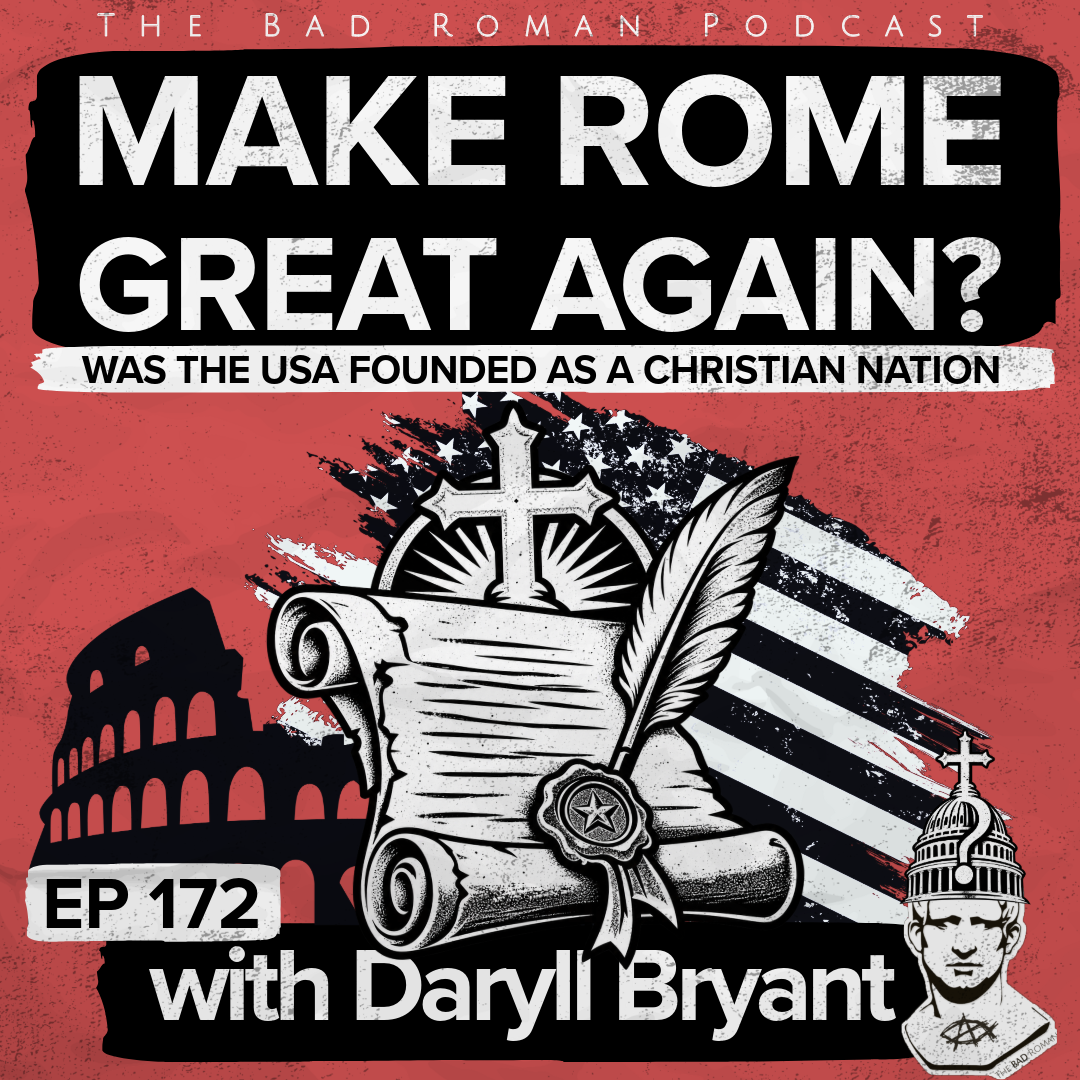
America is a Christian nation.
Sometimes it comes from someone he follows. Sometimes it's a post that seems to have appeared out of nowhere. Either way, Craig finds himself doing the same thing: opening the comments and asking people to prove it.
What makes America a Christian nation? Where does the Constitution say that? And what do we mean when we use the word Christian to describe a government?
Then Daryll Bryant sends Craig an article titled America Is Not a Christian Nation.
Craig reads it and knows they need to talk.
Daryll isn't arguing that Christianity had nothing to do with America's founding. He's making a distinction that often gets lost in the argument: a nation founded by Christians is not necessarily a nation founded as Christian.
In this episode of The Bad Roman Podcast, Craig and Daryll examine that distinction through American history, the Founding Fathers, the Constitution, religious freedom, and the Treaty of Tripoli. Their conversation also takes them back to the early church, Rome, Constantine, and the question of why Christians continue looking to political power for protection.
But the episode opens somewhere else.
Daryll is talking about the Christians in Acts who were accused of proclaiming another king instead of Caesar.
Then he imagines someone telling those early believers that they could follow Jesus and still devote themselves to making Rome great again.
The comparison is funny because it's familiar.
It's uncomfortable for the same reason.
What if the problem isn't that America has stopped being Christian? What if we've confused being Christian with making America something it was never called to be?
Founded by Christians. Founded as Christian. What's the Difference?
Daryll grew up in a conservative Christian environment in Colorado Springs. His family was politically involved. He attended Christian school, participated in Christian leadership and apologetics programs, and eventually started his own ministry.
For years, politics and Christianity seemed to fit together.
Then he began pulling at some of the assumptions he'd inherited.
Reading Pagan Christianity? by Frank Viola and George Barna led him to reconsider church traditions. Later, a friend in his Bible study challenged his understanding of voting by pointing him toward 1 Samuel 8.
Daryll remembers thinking the man was crazy.
At the time, he believed Christians needed to vote to maintain political protection and influence. But the passage about Israel demanding a king made him question what he was asking government to provide.
The last time he voted, he says, was in 2016.
That background matters because Daryll isn't approaching the founding of America as someone who has always rejected conservative Christianity or dismissed the country's religious history. Much of that history shaped his own understanding of the world.
He still believes Christianity played a significant role in America's founding.
He just doesn't think that settles the question.
In his article, Daryll distinguishes between the beliefs of people living in a country and the structure of the government those people create.
It's one thing to say many founders professed Christianity.
It's another to say the government they established was itself Christian.
Craig wants to know where the evidence leads.
What Does the Constitution Actually Establish?
Craig points out how often American founding documents are used as evidence that the United States was meant to be Christian.
A reference to God or the Creator becomes proof of a Christian government. A founder's religious beliefs become evidence of a national religious identity.
But how much do those details actually establish?
Daryll and Craig discuss the Declaration of Independence, the Constitution, and the religious diversity of the founding era.
They also return to something central to the American constitutional system: religious freedom.
The Constitution prohibits religious tests for federal office. The First Amendment protects religious exercise while restricting federal establishment of religion.
Those protections raise a question that's easy to miss when Christianity and American identity are treated as interchangeable.
If religious freedom protects people whose beliefs differ from Christianity, what does that tell us about the government's relationship to religion?
Daryll's answer is not that American history was free of Christian influence. It's that influence and constitutional establishment are different things.
That distinction allows for a more complicated account of the founding—one in which Christian convictions mattered, but didn't provide the only framework the founders used.
America Looked to Athens and Rome, Too
One passage from Daryll's article catches Craig's attention.
Daryll argues that the founders' political thinking wasn't confined to Jerusalem. It also looked toward Athens and Rome.
The American republic drew from a wider intellectual inheritance, including Greek and Roman political traditions, English constitutional thought, and Enlightenment philosophers such as John Locke.
Even familiar political words (senate, republic, capitol) reflect connections to the ancient world.
Craig finds the Roman influence particularly interesting.
The first Christians lived under Roman authority. They didn't treat Rome as an extension of the Kingdom of God. They proclaimed Jesus as Lord in a world that already had emperors, rulers, and established religious institutions.
So what should Christians make of a modern nation whose political structures draw partly from that same Roman inheritance?
Craig sees a contradiction in calling America Christian while placing so much confidence in institutions of worldly government.
Daryll sees a recurring problem: Christians taking traditions, institutions, and political arrangements that aren't inherently Christian and giving them Christian meaning.
The conversation calls that blending syncretism.
It's a word that comes up repeatedly, especially when the discussion turns from America's founding to the history of the church.
Another King, Not a Better Caesar
Daryll brings the conversation back to Jesus standing before Pilate.
He challenges the way Christians sometimes understand Jesus' declaration that His Kingdom is not of this world. Daryll interprets it not as a promise that Christ's Kingdom is irrelevant to earthly life, but as a declaration that His authority doesn't operate according to Rome's rules.
Then he points to Acts 17, where followers of Jesus are accused of proclaiming another king.
Their message wasn't simply that Jesus could offer private spiritual comfort while Caesar continued to receive their ultimate allegiance.
It was a claim about kingship.
Daryll makes the contrast memorable by imagining an early Christian saying that Jesus could save people while they worked to make Rome great again.
As he puts it, Scripture doesn't instruct Christians to make pagan nations great again.
Craig agrees, pointing to the history of the early church and the absence of a command to build Christ's Kingdom by securing the power of the Roman state.
It's the moment that opens this episode.
And it reframes the whole discussion.
If Jesus is King, why would Christians need their nation to be Christian before they could faithfully follow Him?
Constantine, the Church, and the Cost of Political Power
The discussion of Rome leads Craig to ask Daryll about Constantine.
Craig has often understood Constantine as a turning point when the church's relationship with imperial authority changed. Daryll agrees that the emperor matters, but believes some troubling developments began earlier.
He points to the growth of professional clergy and church hierarchies, arguing that institutional status, salaries, and competition for authority changed how church leadership worked.
It's a provocative interpretation, and the two recognize that the subject deserves a conversation of its own.
They also discuss Constantine's association of Christian symbols with imperial power and the historical blending of religious and political traditions.
Craig draws a parallel to American Christianity today.
He worries that political movements haven't merely persuaded Christians to support particular policies. They've drawn Christians into treating the state as an instrument of their faith—and sometimes as the institution they ultimately trust.
The parallel isn't exact, and centuries of church history can't be reduced to a single turning point.
But the question is worth asking.
When political rulers welcome Christianity into their institutions, is the church gaining power?
Or is political power gaining the church?
The Treaty of Tripoli: What Did the United States Say About Religion?
Later, Craig returns to a passage of Daryll's article that surprised him: the Treaty of Tripoli.
The English-language text of the treaty, ratified by the United States in 1797, includes a declaration that the American government was not founded on the Christian religion.
It's an arresting sentence, especially in a country where the opposite claim is often presented as obvious.
But the document has a complicated history.
The treaty was negotiated during George Washington's administration and ratified during John Adams's presidency. The surviving Arabic text doesn't contain a direct equivalent of the famous passage in the English version.
Craig and Daryll discuss that difference, and Daryll acknowledges that he doesn't know exactly why the texts differ.
The uncertainty is part of the story.
The Treaty of Tripoli deserves attention, but it shouldn't be treated as a shortcut around the wider historical record. Neither should the religious commitments of individual founders be treated as a shortcut to establishing the country's constitutional identity.
If we're going to argue about what America was founded to be, we need to examine more than the passages that support what we already believe.
That means reading carefully, understanding context, and being willing to say when we don't know.
Questioning America Isn't Hating Americans
Toward the end of the conversation, Craig addresses an accusation familiar to people who question American nationalism.
If you don't like America, why don't you leave?
Craig rejects the idea that criticizing a government means hating the people who live under it.
He distinguishes his opposition to political institutions from his responsibility to love his neighbors.
Jesus teaches His followers to love their neighbors and their enemies. That calling doesn't disappear because someone lives in a country whose government we oppose.
Daryll agrees.
For both men, the issue isn't whether someone can appreciate the place they live or recognize meaningful freedoms within it.
It's whether appreciation becomes allegiance, and whether Christians begin excusing political power because it speaks in the language of their faith.
The challenge applies beyond any one country or political party.
If our objection is to coercion, domination, and the elevation of earthly rulers, those concerns shouldn't disappear when the ruler shares our preferred politics.
A Republic Is Not the Kingdom
By the end, Craig and Daryll haven't tried to resolve every dispute about the Founding Fathers.
They've asked listeners to consider a distinction that changes the conversation.
America may have been deeply influenced by Christianity. Its founders may have drawn on biblical language and Christian moral traditions.
But that doesn't make its government the Kingdom of God.
And perhaps Christians don't need to prove that it does.
Daryll has built his writing around the conviction that believers should examine inherited assumptions for themselves. Craig has built The Bad Roman Project around a similar challenge: what happens when we begin measuring politics, institutions, and national loyalties against the teachings of Jesus?
The answer won't necessarily make us better Republicans or Democrats.
It may make us question why those identities have been allowed to define so much of what it means to be Christian.
America has a government.
Christians confess a King.
Knowing the difference might be more important than winning another argument about the founders.
Not left. Not right. Just following Jesus.
About the Guest
Daryll Bryant | REAL Xians
Daryll Bryant writes about Scripture, church traditions, political allegiance, and what it means to follow Jesus apart from inherited religious and institutional assumptions.
His REAL Xians project includes essays, theological reflections, and resources for Christians reconsidering the relationship between faith, church, and government.
He also discusses his Unbound community, which he is developing as a place to ask difficult questions, study, and learn with others.
🤝 Connect with Daryll 🤝
Highlights & Takeaways
Founded by Christians isn't the same as founded as a Christian nation. Daryll examines the difference between the beliefs of the founding generation and the constitutional system they established.
America's political ideas came from more than one tradition. John Locke, the Enlightenment, Greece, and Rome all enter the discussion alongside Christianity.
Religious freedom complicates the Christian nation claim. Craig asks what the Constitution's protections mean for believers and nonbelievers alike.
1 Samuel 8 changed Daryll's understanding of voting. He describes moving from conservative political involvement toward questioning dependence on earthly rulers.
The earliest Christians proclaimed another King. Acts 17 and Jesus before Pilate provide a theological contrast to modern nationalism.
Institutional Christianity and political power have a long history. Craig and Daryll examine Constantine, paid clergy, and their concerns about church-state entanglement.
The Treaty of Tripoli deserves historical care. Its English wording is significant, but its diplomatic and translation history matters.
Criticizing government isn't the same as hating people. Craig closes by returning to Jesus' command to love neighbors and enemies.
Listen
Notice the difference between Craig's questions about historical evidence and Daryll's questions about Christian allegiance.
Where does the conversation move from What did the founders intend? to What should followers of Jesus intend?
Reflect
When you've heard someone describe America as a Christian nation, what did you understand them to mean?
A country with Christian citizens? A society shaped by Christian morality? A government established to promote Christianity?
Have you ever treated those as the same thing?
And when you think about political power, what are you hoping it will protect or provide that you don't believe the church—or the people of God—can live out without it?
Read
Read Article VI and the First Amendment of the United States Constitution.
Then read 1 Samuel 8, John 18:33–38, and Acts 17:1–9.
The documents and passages aren't addressing identical questions. That's part of the point.
Ask what each one actually says before deciding what it proves.
For the historical argument behind this episode, read Daryll's essay, America Is Not a Christian Nation.
Practice
Choose one claim about the American founding you've heard repeated often.
Find the original document people use to support it. Read the surrounding passage. Learn when it was written and who wrote it.
Then ask someone who reaches a different conclusion how they interpret the same evidence.
You don't have to agree.
But you can refuse to let a familiar slogan do all your thinking for you.
Episode Timestamps
(01:00) Was America Founded as a Christian Nation?
Craig introduces Daryll Bryant
The social media claim that sparked the conversation
Why Daryll wrote his article
(02:49) Christianity and the American Founders
Different religious traditions in early America
Ministers and the independence movement
Christian influence versus a Christian government
(07:27) Daryll's Background and Changing Beliefs
Conservative Christianity and political involvement
Christian apologetics and church experience
Beginning to disentangle faith from institutions
(11:00) 1 Samuel 8, Voting, and Another King
A Bible study challenge that changed Daryll's thinking
Why he stopped voting
Looking to government for protection and provision
(18:13) Can Human Government Provide What Christians Seek?
Kings, presidents, democracy, and republics
Voting and the question of political allegiance
Craig's concerns about participation in government
(21:24) Religious Freedom and the Founding Documents
God, nature, and the language of the founders
Constitutional protections for different beliefs
Craig asks for evidence of a Christian nation
(23:55) Did the Constitution Establish Christianity?
The Declaration of Independence and Constitution
Daryll distinguishes founders' beliefs from federal institutions
Religious qualifications and state governments
(31:04) Jefferson, John Locke, and Natural Rights
Enlightenment ideas in the American founding
Property, liberty, and natural law
The difference between political philosophy and Scripture
(36:22) Christianity, the Ten Commandments, and Political Myth
Religious differences among the founders
Claims that American law rests on the Ten Commandments
Craig questions political religious symbolism
(37:40) Athens, Rome, and America's Political Inheritance
Roman and Greek influences
The early church's relationship with empire
Why Craig compares America to Rome
(38:58) Jesus, Pilate, and Another King
The Kingdom of God and Roman authority
Daryll's interpretation of “not of this world”
Acts 17 and the allegiance of early Christians
(45:31) Constantine, Paid Clergy, and Church Power
Did institutional problems begin before Constantine?
Daryll's concerns about professional clergy
Christianity's growing relationship with empire
(49:46) Christian Nationalism and the Institutional Church
Craig draws parallels to the present
Political movements and religious cooperation
When faith becomes entangled with state power
(54:35) The Treaty of Tripoli
The English-language treaty statement
The difference between the English and Arabic texts
Questions about how the treaty should be interpreted
(57:41) Does Questioning Government Mean Hating America?
Craig separates love of people from loyalty to institutions
Criticism of government and love of neighbor
Government power across national boundaries
(1:03:27) REAL Xians and the Unbound Community
Daryll's community and ongoing work
Studying Scripture and questioning inherited assumptions
Where to read more and connect
Continue the Conversation
Episode 153 — Star-Spangled Jesus: Waking up From Christian Nationalism with April Ajoy
April's experience offers a personal perspective on how Christian nationalism can become part of someone's understanding of faith—and what happens when they begin to question it.
Episode 164 — Breaking Free from Political Christianity: Rediscovering the Gospel Beyond Partisan Faith with Brian Drinkwine
Brian explores Christian nationalism, Constantine, political power, and the difference between the politics of empire and the way of Jesus.
Episode 170 — Allegiance to Jesus: Why Tyler Boyd Stopped Saying the Pledge of Allegiance
Tyler asks a related question about the words Christians use to promise loyalty—and what those promises mean when they already confess Jesus as King.
The Bad Roman Project is a place to ask hard questions about government, Christianity, and the allegiances we sometimes accept without examining.
Want to keep it going? Consider supporting the project through onetime or on going donations. Everything beyond production costs supports local charities in Memphis, Tennessee.
You can also support the project by trying Bad Roman Salsa, connecting on social media, or simply sharing an episode with a friend! No King but Jesus!
Related Episodes


Related Blog Post